Tag Archives: teaching

A Message Regarding Teachers, Students, And ChatGPT

When I was a student in high school, the internet was just starting to mature. More and more people were able to access it. Teachers and students alike began using it. Initially, it was a novelty. But once certain sites and programs emerged, namely Wikipedia, it garnered serious concern among teachers and administrators.

I still remember multiple teachers advising us to not use Wikipedia for any assignment. A few even warned us that, if they found out we just copied text from it, then that would result in an immediate failing grade.

As for the administrators, their concern was that it would completely undermine the traditional process for doing research. That usually involved going to a library, searching for the relevant books, sifting through those books, and taking detailed notes on the information within.

Yes, that process was cumbersome and archaic.

Yes, I regularly utilized that process.

Yes, it sucked as much as you think.

Eventually, the attitude shifted. When I was in my second year of college, more and more of my professors changed their attitude towards using sites like Wikipedia. They saw the value in using it to teach a subject. They still advised students to avoid using it as a sole reference point. But they didn’t actively deter or punish students from using it.

I bring this up because it seems a new generation of students and teachers is dealing with a similar situation with AI. And even though I’m not in school anymore, I can already surmise that this will be far more impactful than Wikipedia ever was. AI has already changed the way students and schools approach homework. It’s also changing the way teachers are approaching teaching, in general.

Now, it’s still too early to know whether AI will be a net benefit or a net negative with respect to educating students. But the overall sentiment towards AI, at least among teachers, is mostly negative. The reasons for this attitude vary, but it’s not that different from the reasons my old teachers gave for discouraging Wikipedia.

It’s doing too much of the work for the students. It’s essentially doing the thinking for them in terms summarizing the material, producing essays, or answering questions. The concern is that it’ll hinder students’ ability to develop critical thinking skills. Because if they can just let the AI do the work for them, why bother? The AI can do what they otherwise would’ve done in seconds.

I certainly don’t doubt that this concern is sincere. I have family members and close relatives who work as teachers. This is going to affect them, regardless of their attitudes towards AI. I imagine numerous teachers, schools, and administrators are going to resist utilizing this technology at every turn. Others will embrace it to the utmost because it could potentially make their jobs easier. Given the inherent stresses of teaching children at any age, could you honestly blame them?

To both those groups of educators, as well as the students currently coming of age, I have a message that I’d like to impart. And should I ever have kids of my own, I suspect this message will affect them too.

Embracing AI will ultimately be more productive than resisting it.

It’s not a warning or advice. It’s just a simple statement. I’m not just saying it because I generally support the development of AI. I’m simply speaking from experience.

That experience is heavily influenced by the fact that I was generally miserable in school. I did not care much for middle school or high school. And I certainly wouldn’t say that I learned as much as I’d hoped during that experience. If anything, the way school went about teaching me just didn’t work. The only thing I ever “learned” in school was how to pass tests. That’s not the same as learning something.

In college, things were different. Yes, there were still tests and exams to study for. However, there was more freedom and flexibility to learn about the things that interested me. That helped make college an overall better experience while helping me develop skills that served me well in my adult life.

But in any case, I can also say without reservation that if ChatGPT had been available to me, I definitely would’ve used it. It would’ve been very helpful in terms of summarizing notes, chapters in a textbook, or breaking down certain concepts I didn’t understand. And yes, I probably would’ve used it to help me with my homework, polish my essays, or study for exams. Would that have made me less knowledgeable? Would I have ended up learning less, as a result?

I honestly don’t think so. Because if I’m interested in something, I’ll seek out more information that’s beyond the assignment. I’ll look for things outside the textbook or the syllabus. And if that ends up helping me with an exam or a lecture, then that’s just a bonus.

I suspect there are plenty of other kids like that. Kids, in general, are pretty curious. If they’re interested in something, they’ll pursue it. Sometimes, teachers don’t have the time, energy, or willingness to teach them beyond what the school allows or assigns. Other times, parents aren’t able to teach them because they either don’t know enough about it or just don’t have the time.

AI can fill that gap that will only widen as more schools struggle to find capable teachers. Given how bureaucratic the education system is, especially in America, there aren’t many feasible options outside of AI. Resisting it won’t work in the long run. Resisting technology of any kind rarely works.

It may even get to a point where students primarily learn major skills through AI. It’s already happening on a small scale in some areas. That trend is likely to accelerate as AI continues to improve. The incentives are in place. The need is certainly there. There may be those who don’t like the idea of kids being taught primarily by a non-human AI. They may have concerns that are entirely warranted.

But in the end, AI is here to stay. It’s capable of filling an important need at a time when knowledge, education, and critical thinking skills have never been more important. If the current education system cannot meet that demand, then we’ll need tools like AI. Without it, the students will ultimately pay the price.


Leave a comment

Filed under Artificial Intelligence

AI Chatbots May (Thankfully) Render Homework Obsolete

Homework sucks.

Let’s get that out of the way.

I doubt anyone will disagree with that sentiment. No matter who you are or how many years you’ve been out of school, you probably don’t miss doing homework. It’s one of those special shared hatreds reserved only for traffic jams, parking tickets, and slow internet. But unlike those undeniable frustrations, homework isn’t an inescapable force of nature or law. It’s something we, as a society, choose to continue.

I’ve certainly questioned that choice, going back to when I was still in school. Having to do homework was among the many reasons why I was so miserable in school. And even though it was required, I can’t honestly say it ever helped me learn anything. Most teachers and administrators often explained why it was important to ensure we were adequately learning the material. But as I’ve gotten older, I’ve come to realize that, even if that were a valid reason, it still was still ineffective.

Just ask yourself honestly. Did you ever do homework because you were curious and wanted to learn?

Now, I could rant and lament on why homework sucks for days on end. But rather than torture myself to such an extreme, I wanted to highlight something that might offer hope to those who still remember how much homework sucked, as well as those currently in school at this very moment. It has to do with the impact of artificial intelligence and chatbots like ChatGPT.

I know I’ve talked a lot about artificial intelligence in the past. I’ve also highlighted the impact and hype surrounding ChatGPT. It is definitely one of the most intriguing and disruptive technologies to come along in decades. But unlike other discussions about whether artificial intelligence and ChatGPT will lead to the destruction of the human race, this is one issue in which the impact is already happening.

Recently, Vox produced an intriguing video about how ChatGPT has impacted education, especially homework. Even as someone who graduated school years ago, I found the issues and insights of this video remarkable. I encourage everyone to check it out.

The long and short of it is simple. ChatGPT is rendering most homework assignments, be they essays or worksheets, obsolete. Students are using ChatGPT to basically do the bulk of the work for them. The only real effort they need to do is make sure that whatever they produce isn’t obviously the product of a chatbot.

That alone can be difficult. It is well-documented that chatbots like ChatGPT can be inaccurate. But when compared to having to do a long, boring assignment that a student probably isn’t interested in, that kind of challenge seems manageable by comparison.

Also, in the interest of full disclosure, I freely admit that I probably would’ve used ChatGPT when I was in school if I had access to it. I promise it wouldn’t be entirely out of laziness or an unwillingness to learn. I just found most homework assignments to be so dull and pointless that I cared more about just getting them done rather than actually learning anything.

I imagine I’m not the only one who feels this way. I suspect the majority of students simply see homework as a means of ensuring grades rather than actually learning something. And even if that assumption is flawed, it’s still an issue that speaks to major flaws in how we educate ourselves and others.

And until ChatGPT, it was easy to ignore that issue. Schools, teachers, and administrators had no reason to stop giving homework or question whether it was an effective tool. It was just one of those things that our education system had always done. So, why not keep doing it?

Well, now there’s a valid reason. Homework, as we know it, can be easily completed by any student with an internet connection. If there was any learning potential, it’s pretty much lost. As the Vox video stated, it has led schools and educators to consider an entirely new recourse.

The knee-jerk response that I suspect most will adopt is to try and ban or limit the use of chatbots. There are software programs out there that can help detect content that has been generated by a chatbot. However, I liken these programs to using scotch tape to seal the ever-widening cracks of a faulty foundation.

Because, like it or not, these AI chatbots are becoming more advanced. And the tools to keep up with them are always going to lag behind. That is a losing race and one no education system should attempt.

There’s even precedent for surmising why that’s a bad approach. When I was in college, there was a blanket ban on using Wikipedia. But enforcing that ban was a losing battle that caused more problems than it solved. It also created some nasty situations where students were accused of plagiarism when they did nothing of the sort. It took a few high-profile incidents, but most schools eventually came to embrace Wikipedia as a useful tool when approached correctly.

I think the impact of chatbots will have to go through a similar process. But unlike Wikipedia, the application of chatbots is a lot broader. These are tools that can effectively summarize books, write essays, and even write poetry with a few simple prompts. And in the same way young people have become more tech savvy than their parents, I suspect they’ll become more adept than most with respect to navigating chatbots.

That means homework, as we’ve been doing it for the past several decades, will be obsolete. While that’s certainly cause for celebration for many, it’s also an opportunity to take a step back and evaluate the process of education, as a whole.

It’s still very important that we educate young people in a meaningful way.

It’s also important to acknowledge that young people today will have access to resources that others have not.

If homework is no longer useful in that regard, what else could we do? What’s a more effective way to teach kids a concept, even when they’re not that motivated to learn it?

I don’t claim to know the answers. I am not a teacher, but I do remember how miserable I was in school and how little it really taught me. Hopefully, the impact of chatbots like ChatGPT will prompt a more thorough evaluation of how we approach education. Because if we keep clinging to old methods, then nobody will benefit in the long run, especially kids.

1 Comment

Filed under Artificial Intelligence, ChatGPT, technology

Why We Should Teach The Uglier Parts Of History (And Why Avoiding It Is Pointless)

Tulsa Race Massacre Sidelined Legacy of Black Wealth in Greenwood - WSJ

I am an American.

I am proud to be an American.

There’s no other country I’d want to be born in.

I say all while also acknowledging that America isn’t perfect. I’ve taken plenty of history classes, both in high school and in college. I’ve also sought out information about America’s past and the facts are clear. The United States of America does have some undeniably dark moments in its history. Some could be classified as outright atrocities.

It’s not wrong to state that those events happened and they were awful. In fact, I believe it’s critical for any country, nation, or community of any kind to admit their past failures and flaws. We cannot learn, grow, or improve as a society if we ignore those less favorable parts of our history. If we only ever know the good stuff, then we have no reason to improve and that only breeds complacency, arrogance, and stagnation. That’s something the world needs less of.

This brings me the controversy surrounding critical race theory. I know that just uttering that phrase in passing these days is sure to draw ire from certain crowds, some more so than others. In general, I try to avoid touching on topics like this when the outrage machine is still going full-throttle. Even when I do discuss something controversial, like abortion, I try to focus on the bigger picture.

Now, the specifics of critical race theory are too vast for me to get into. I’m certainly no expert, nor would I ever claim to be. I encourage people to investigate it themselves on Wikipedia. However, do not seek sources from the likes of PragerU, the Heritage Foundation, or any information source that claims to espouse the “truth” about Critical Race Theory.

They’re just right-wing propaganda pushers who are lying to you on behalf of their donors. They are not credible on this matter.

While I don’t see Critical Race Theory as being completely neutral either, it does have some relative themes. It gives greater scrutiny to how racism and past racist policies in America have had lasting effects on minority communities, even after the progress made during the civil rights movement.

That’s not an unreasonable approach to studying the past and present. After all, it’s undeniable that racism and its past effects still exist. If you deny that, then you’re just denying reality outright. Certain aspects of racism can’t be resolved by simply passing a law or enacting a certain policy. People and societies are just too complex.

Now, the way in which Critical Race Theory scrutinizes these issues isn’t perfect. In terms of analyzing and making sense of history, I think it doesn’t paint the clearest picture in terms of America’s racist past and how that past affects the present.

That said, I support it being taught or, at the very least, explored within a school. I think this is something we should teach kids and young people about in order to get them thinking about history, race, and the society in which they live. At the same time, I also think it exposes a critical element with respect to appreciating history and its many lessons.

The reason I’m bringing it up now is two-fold. Firstly, I think those protesting it are absurd and their reasons for criticizing critical race theory are equally absurd. Some are going so far as to try and ban it. Instead, they favor a more “patriotic” education for school age children. I put “patriotic” in quotes because there’s nothing patriotic about it. It’s just pure propaganda, plain and simple.

A true patriot doesn’t need propaganda to be proud of their country.

A true patriot loves their country, despite their flaws. Just like you do with someone you love, you don’t ignore those flaws and use them as motivation to be better.

The second reason I’m bringing it up has less to do with the political rhetoric surrounding Critical Race Theory. It’s being framed as though this is somehow redefining the story of America. It’s seen as somehow diminishing America’s greatness and ideals. Those who are blindly patriotic or excessively nationalistic are going to have a problem with that.

Now, blind and excessive nationalisms is a problem all its own. I won’t get into that, but I do feel that it highlights another important point about protesting new forms of study. In essence, those complaining about Critical Race Theory are working against their own agenda. They seem to forget that the internet still exists.

It doesn’t matter if efforts to ban Critical Race Theory succeed. It doesn’t matter if every American textbook removes all mentions of slavery, Jim Crow, Japanese internment camps, or atrocities committed against Native Americans. That information is still out there. It’s on the internet and it’s easy for anyone with an internet connection to find.

In fact, by outright banning or opposing certain studies of history, it may only raise greater interest in it. Like it or not, people are going to get curious. Tell kids and teenagers that they should never learn about Critical Race Theory is only going to make them more curious. So long as they still have an internet connection, they will find that information.

That’s exactly why I’m in favor of teaching history that explores, analyzes, and dares to extrapolate from the uglier parts of history. It can do more than educate. It can also help us come to terms with our flaws and inspire us to be better.

A good example of this is the recent relevance of the Tulsa Race Massacre. There’s no getting around it. This event was a horrendous moment in American history and one that reveals just how ugly racism got in this country. Growing up, I never learned about this event. Most people probably never would’ve learned about it, had it not re-entered the news amidst recent pushes for racial justice.

This moment in history was awful. There’s no getting around that. Even if you’re an American who wasn’t alive during this event, we should still acknowledge it. We should still learn from it. That’s how we’ll get better. The past has so many painful lessons and we’ll never learn those lessons if we try to gloss over them.

2 Comments

Filed under Current Events, history, outrage culture, political correctness, politics

Recalling (And Thanking) My Favorite Teacher In High School

See the source image

I’ve made no secret of how much I hated high school. I’ve also made no secret of how miserable I was as a teenagers. I know most teenagers are inherently moody. It’s as unavoidable as acne, body hair, and homework. I was just a lot moodier than most teens and for piss poor reasons.

However, my teenage years and high school experience weren’t all purified misery. There were indeed a few notable bright spots. Since this is the time of year when high school students are preparing for their last round of tests or planning for college, I thought it would be a good time to share one of those bright spots.

It’s not a single event, moment, or achievement. It’s a person. Specifically, he was my favorite teacher out of every teacher I had up to that point in school.

Out of respect for my teacher’s privacy, I won’t use his real name. I’ll just call him Mr. Lee. If I were to list all the things that made Mr. Lee such a great teacher, it would take me all week and that’s if I skipped meals. There are some teachers who just read from books and assign homework. There are also teachers who genuinely care and genuinely love to teach. Mr. Lee was the latter.

I had him for two classes. First, I had him for a computer science class. Then, I had him for AP Calculus. In both classes, his skill and passion for teaching shined. That’s not easy to do when you’re teaching something like calculus to a bunch of hormonal teenagers, but the man made it look easy. He even seemed to have fun while doing it.

It probably helped that Mr. Lee was incredibly smart. By that, I don’t just mean he was qualified to teach those subject. Mr. Lee graduated from Harvard with honors. He had a masters degree in computer engineering. He could’ve easily gotten a job at a big tech company and earned six figures by the time he was 30. Instead, he decided to teach immature teenagers how to write computer code and do calculus.

That, alone, speaks to the kind of character this man had. He was the kind of teacher who had an answer for every question and he never needed to check a book, phone, or computer. When you asked him something, he wouldn’t just give you an answer. He’d give you a damn good reason as to why it’s the right answer.

Despite how smart he was, Mr. Lee still carried himself with uncanny humility. He never acted like he was better than everyone else for being so smart. He was actually very approachable. You could talk to the man about anything. I once had a 10 minute conversation with him about how to make the perfect pizza. I still smile whenever I recall him explaining how carefully he spread the cheese on every pie.

Mr. Lee didn’t just demand your respect. He earned it. More importantly, and this is what set him apart, he made you want to earn his respect. Nobody slouched in his class. Nobody disrespected him or tried to nap through a lesson. That was the one class you really couldn’t sleep through because Mr. Lee made every lesson so engaging.

Again, this man taught AP Calculus. That’s not an easy subject to make engaging.

He still found a way. He always found a way to make a concept easy to understand. It’s because of him that I passed every exam, including the notoriously difficult AP Calculus exam that every student dreaded. I don’t think I’ve ever been more confident taking a test that didn’t involve an essay question.

I owe that success to Mr. Lee. Without him, I would’ve been even more miserable in high school. His classes, as difficult as they were, made me feel like I was learning something valuable. I still appreciate that value to this day.

You don’t always know which teacher will impact you the most over the course of your life, but when they do, it’s worth cherishing. I doubt Mr. Lee will ever read this or remember me, but during a less-than-pleasant time in my life, he was a breath of fresh air. For that, I sincerely thank him.

Leave a comment

Filed under Jack Fisher's Insights, Uplifting Stories

What “Daria” Can Teach Us About Educating (Uninterested) Teenagers

daria-920x584

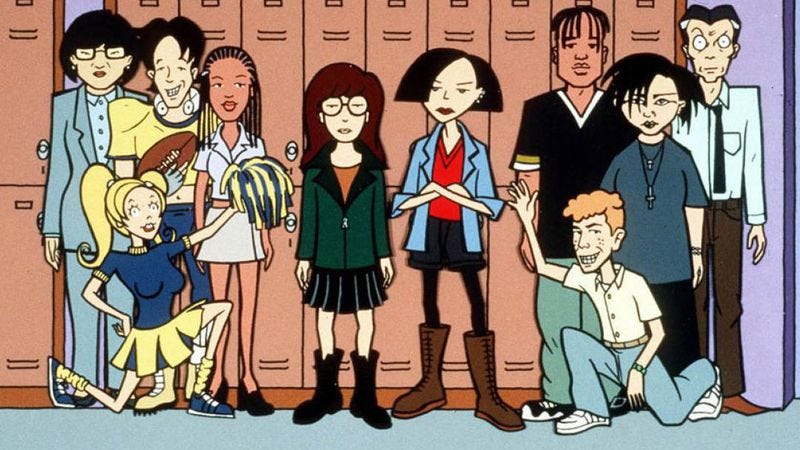
Some shows have one particular episode that you can watch again and again while still enjoying it. Great shows have multiple episodes like that. By that measure, “Daria” is greater than most. Even by the standards of late 90s animation, the show stands out in so many ways. It’s one of those rare shows that has aged remarkably well and feels more relevant now than when it originally aired.

I’ve already praised “Daria” for its unique approach to shedding a critical light on a world full of lies, half-truths, and fake news. I’ve even singled out a single episode for how the show handled a sensitive issue like mental health. These are issues that have only become more relevant since the show went off the air.

In that same spirit, I’d like to highlight another episode from the show that highlights another major issue. It also happens to be my favorite episode and the one I’ve probably re-watched the most. That episode is “Lucky Strike,” the sixth episode of the fifth season. On top of being one of the funniest episodes of the series, it also has some of the shows best moments while still tackling a major issue.

The issue, this time around, is education. It might not be the kind of a hot-button issue that makes for major headlines, but it’s still as relevant as ever, especially if we’re referring to the American education system. It’s not hard to find stories about just how bad it is, especially when compared to how other industrialized countries do it.

It was a big deal in the 90s and early 2000s, as well. Fittingly enough, this episode aired just a few months before the passage of the No Child Left Behind Act, which has been the cornerstone of the American education system. While reasonable people can debate how well it has or hasn’t worked, “Daria” has already made one of the most effective arguments about what constitutes good education.

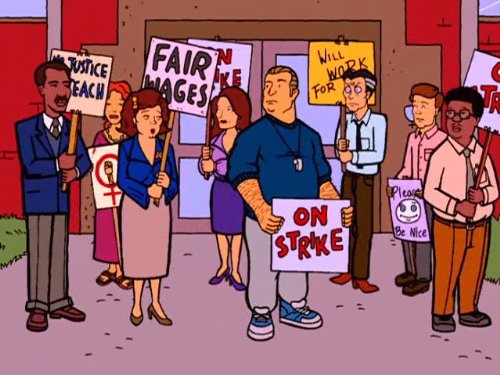
The premise of the episode begins with a teacher strike, an issue that has become distressingly common in recent years. Lawndale High’s notoriously uptight principal, Angela Li, short-changes a group of teachers who are underpaid, under-appreciated, and have to deal with uninterested idiots like Kevin Thompson and Brittney Taylor. By any measure, they have a very good reason to strike.

Never one to concede defeat or express genuine concern for student aptitude, she keeps the school running by hiring substitute teachers, some of which demonstrate limited qualifications at best. One even showed an overtly creepy attraction with one of the female students. This leads to Daria getting roped into teaching a class.

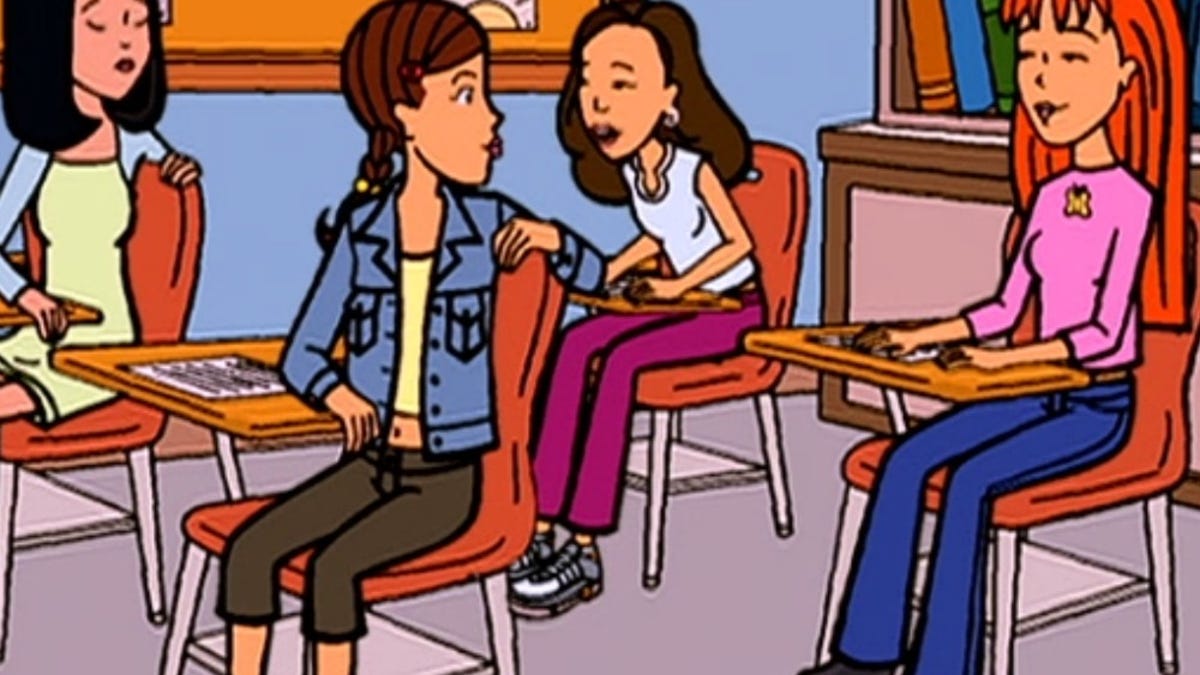
As it just so happens, the class she’s teaching is the same class that her sister and unapologetic popularity whore, Quinn, is in. Given how Quinn has spent almost the entire series denying she’s even related to Daria, it’s a great opportunity to make things awkward. Daria makes more than a few quips about it in her own wonderfully misanthropic way.

However, when it comes to actually teaching the class, Daria does something that sets herself apart from most substitutes. Even if she’s only doing it to mess with her sister, she takes her role seriously. She shows a genuine desire to teach, but she doesn’t use the same approach as the rest of her teachers. She utilizes her own unique way.

It helps that the class is an English class. Daria is a voracious reader. That is established in the first episodes of the series and belabored on multiple occasions. It also helps that the assignment is simple. The class is reading Romeo and Juliet, a story that almost every high school English class reads at some point. In terms of substitute teacher gigs, it’s as standard as it comes.

I remember reading this play in high school as well. I don’t remember it fondly, though. In class, we would just read through each act, do a few assignments in a textbook, and take a test at the end. Most of the time, the test involved multiple choice or short answer. There were only right and wrong answers. That was really all there was to it.

Daria’s approach is different. Daria doesn’t just teach from a textbook. She has the students read the play, but not so they can get the answers for an assignment. She takes the time to help them appreciate it. When one of her air-headed students doesn’t appreciate a particular part, she helps put it into a more relevant context. It doesn’t just work. It makes the story feel like something other than an assignment.

It’s an approach that anyone who loathes standardized tests can appreciate. I’ve made my disdain for standardized tests known before, but it’s not a personal peeve on my part. There is legitimate research that indicates that standardized testing is not a good way to educate kids.

Teaching kids to take a test is not the same as teaching. They’re learning how to memorize answers for a test. That’s not real learning. You can memorize all the answers for a particular test, but not know why those answers are correct. For someone like Daria Morgendorffer, who places a high value on thinking for yourself, this approach just doesn’t work for her.

For everyone else, the test is the only thing that matters. For the always-superficial Quinn, that’s her primary concern. She laments about how her sister might screw her over or worse, undermine her popularity. It’s such a burden that actually reading the play and knowing what it’s about barely registers.

Then, in one of Daria’s finest moments, she further deviates from the traditional educational model and gives her class a simple essay test. There’s no multiple choice or short answer. She just gives them a simple question.

What is Romeo and Juliet about?

That’s it. The only requirement is that they write at least 250 words and support their answer. For those who didn’t care enough to read the play, like Quinn’s equally-superficial posse, the Fashion Club, it’s the worst possible scenario. For Quinn, who actually read the play, it was easy.

In fact, it was because of that test that Quinn also had her finest hour. In one of the few moments of the show in which she’s actually likable, she defends Daria’s approach to teaching to the entire class. Then, in another pivotal moment for the series, she admits that Daria is her sister.

In addition to this critical moment of personal growth, Daria shows that she truly values people who think for themselves. Even when one of her students makes an objectively foolish comment about Romeo and Juliet, she still gives him a good grade because he actually tried to back it up. For her, that’s more valuable than simply knowing the difference between Paris and Tybalt.

Her approach is even appreciated by her students. Keep in mind, these are the same students who show little to no interest in class throughout the show. They are, like most teenagers, not that big on having to be at school for seven hours a day, learning things they don’t want to learn about. Daria understands this and tries to make the class less tedious. It’s something even an air-headed teenager can appreciate.

Most of them, anyway.

It’s also a valuable lesson that has real-world applications. Some places have even applied Daria’s approach, to some extent. Countries like Finland have a system that doesn’t rely so heavily on standardized tests. Not surprisingly, Finland’s education ranking is significantly better than the United States and by a significant margin. Daria would’ve actually fit in with that system.

It’s not just because that system eschews standardized tests. It actually emphasizes teaching a student how to think and reason. A test isn’t going to reveal that. On top of that, teachers are better-educated and well-compensated in places like Finland. They would not have had to strike like the teachers in this episode.

In some respects, Daria showed how much better someone could teach a class if they didn’t have to deal with the constraints of the current system. It even helped that the Principal Li was more focused on outwitting the teacher union than she was with teaching students. Without those constraints, Daria managed to teach a class in a way that her students appreciated.

Between that moment and the moment she shared with her sister, “Lucky Strike” accomplishes a great deal. Daria has a chance to shine and makes the most of it. On top of that, she demonstrates that it is possible to educate a room of disinterested teenagers in a way that’s genuinely effective.

There are many other moments in “Daria” where major complications, and the many absurdities they entail, get cut down by the show’s distinct brand of misanthropic humor. Daria rarely sets out to make big statements, be they about the educations system or our flawed understanding of mental health. However, she still finds a way to make her point and never crack a smile.

That’s why Daria is so lovable. It’s also why we need wisdom like hers more than ever.

Leave a comment

Filed under Current Events, Daria, human nature, psychology, television