Tag Archives: sexual health

Is Jealousy Natural? An Honest Question

Is it really so natural to be jealous of someone when they love or lust over someone other than you? To anyone who has ever been jilted or cheated on, this may be an outrageous question to ask. How can anyone not feel outrage when the person they love has feelings for someone else? It’s the basis for at least 85 percent of all love stories and around half of every episode of Jerry Springer.

Jealousy seems like one of those emotions that’s so natural. We’ve come to see it on the same level as fear, hunger, or horniness. Few really question these assumptions beyond a certain context. Today, I’d like take a sledge-hammer to that context and dare to probe deeper. If that sounds overly lurid, I apologize, but I’m being genuinely serious here.

If ever there was an emotion that brings out the worst in people, jealousy seems tailor-made for it. One of my favorite comedians, Christopher Titus, once described it like this:

Is it somewhat extreme? Yes. However, I think there’s a sizable portion of the population that agrees with this sentiment. Jealousy can make people do horrible things. Sometimes, just seeing someone with someone else is enough to make us upset to the point of doing horrible things we wouldn’t otherwise do. Jealous and jilted lovers have committed serious crimes, including outright murder.

It’s those irrational extremes, however, that should beg the question. Is this feeling really a basic product of the human condition? How much of it is in our genes and how much of it is in our heads? It’s something we need to think about it, if only to assess the horrific behaviors it inspires in people.

Now I admit I didn’t really think about this question until recently. I admit I’ve felt pretty jealous at numerous points in my life and it’s not a pleasant feeling. I went through a period as a teenager where I got downright fatalistic whenever I heard a girl I liked had a boyfriend. Some of that can be chalked up to teenage hormones and serious personal issues. Others, however, are a bit more complex.

The first time I really thought about this issue came while reading Darrel Ray’s book, “Sex and God.” It’s a book I’ve recommended on this blog before and while it does primarily discuss the effects of religion on sex, it also frames jealousy in a very different context that makes it seem less a natural emotion and more a byproduct of sorts.

It goes back to the whole “caveman logic” I’ve used in discussing other topics on this blog, such as nudity. Biologically speaking, we’re still the same cavemen and cavewomen who roamed the African savanna 50,000 years ago, hunting and gathering for food. Then, something happened that changed our way of life and in evolutionary terms, it happened fairly recently. That something is agriculture.

That’s not to say this is a bad thing. The Agricultural Revolution is a big reason why civilization, as we know it, developed in the first place. However, it did come with a specific byproduct. It introduced the concept of land ownership and passing down property through bloodlines. It’s a concept that is not strictly Western. It occurs in almost every society in every part of the world that relies on agriculture to some extent. The culture develops its customs around owning and managing land. So naturally, some of those customs extend to owning and managing people.

Using caveman logic, the concept of owning land is entirely arbitrary. Unlike a tool or physical good that we create, we can’t hold it or lock it in a safe. However, we still treat it as something we need to protect from theft. We treat it as something that we associate with our own name. This is where the idea of passing possessions down to children enters the picture. It’s one thing to just give a child a tool or heirloom you made. It’s quite another to leave them ownership of a farm or property.

This is why marital fidelity, virginity, and knowing that your kid is really your kid became so important. Before the days of Maury Povich and blood tests, the only way to truly know that your kid is yours is for your bride to be a virgin on her wedding night and to have never cheated on you. It’s not so much about nature as much as it is about economics. There’s an economic and legal incentive to treat sexuality, child-rearing, and sexual relations as a commodity. As a result, we guard it like we do other commodities.

From that perspective, it’s easy to see how jealousy emerges. It’s like seeing someone with a nicer car or more food than you. It makes you envious and jealous. It stirs up all sorts of negative emotions that don’t always manifest in healthy ways. We think it’s natural, but take a second to consider the implications of this feeling.

To be jealous of another person’s feelings over someone else implies that you own that person to some extent. It implies you own their emotions, their sentiments, and their sexuality. For most people in the modern era, the idea of owning another human being in any capacity is abhorrent, yet we don’t bat an eye when we think we own someone’s emotions.

In the context of caveman logic, it doesn’t hold up. As small communities of hunter/gatherers, the idea of owning another person’s emotions wasn’t very pragmatic to say the least. Two people and whatever children they have aren’t enough to fend for themselves against a pack of sabretooth tigers. They need to band together as a community and a by-product of this, as we see in other primates, is that sexual monogamy isn’t the norm. It can and does happen, but it isn’t the ideal. It’s just a variation.

Now it’s one thing to make a promise of sexual fidelity to someone and break it. It’s quite another to just assume that someone else’s emotions must be managed a certain way. That undermines the very concept of what it means to be a sovereign human being. However, our culture is still structured around this idea that one person owns the love and lust of another and this is somehow an ideal.

It’s for this reason that I now see the concept of jealousy as somewhat flawed. When I think about my own romantic inclinations, I don’t want to own another human being. I don’t want to be owned either. I want the love and lust I share with another to be freely exchanged for all the right reasons. There’s room for romance. There’s room for lust. There’s room for commitment as well. Jealousy feels like a perversion of this sentiment and something that needs to be re-evaluated.

So once again, I’d like to open this up a little. What do you, the readers, think about our current concept of jealousy? What is your experience with it? Do you think it’s natural? Do you think there’s room to change our perceptions?

This idea has given me plenty of think about for future books. There is one new idea I’m developing, hopefully for a short, sweet, and sexy story I can write after I’m done with my next project. I think there are too many stories out there that focus on love triangles and scorned lovers. I think the marketplace is ready for something new and I hope to provide it.
12 Comments

Filed under Jack Fisher's Insights, Uncategorized

Other Topic Suggestions

Well, I’ve spent the past few days talking about nudity and its many joys and benefits. I intend to switch to a new topic for the coming week. I can’t promise it’ll be as fun or as sexy, but I want to continue generating new discussions on this blog, if only to explore concepts for future books.

I do have have one topic in particular I want to discuss for tomorrow. However, before I jump into that, I want to put this out there. I know this blog doesn’t have a large following. I also know I’m not a successful writer yet. Seven self-published books, few of which have any reviews or sales, doesn’t make me successful. In order to generate interest and readers, I need to create an audience. I want to do that with this blog in any way I can.

So with this in mind, I’d like to open things up for potential topics of discussion. For the handful of readers I do have and the others who have yet to stumble across this blog, what would you like me to discuss here? What topic do you think warrants greater scrutiny?

It doesn’t have to be solely about sex or erotic fiction. It can be about pop culture in general. It can be something about society or current affairs. It can be about philosophy or feminism. I’m willing to explore any topic. I only ask that it not involve too much politics or religion? Those are two issues that tend to get overly divisive and I don’t want to offend. I’d rather entertain, enlighten, or titillate. If I can do all three, then that’s even better.

So what’s it going to be? What do you want to see this blog discuss? I’ll let you, the lucky few followers of this blog, lead the way for once. If I’m going to be a successful writer in any capacity, I need to listen to my audience. Like a good lover, I need to heed the needs of those I’m trying to please.

Leave a comment

Filed under Jack Fisher's Insights

One More Thought on Nudity

I know I’ve spent the past few days focusing a lot on nudity in my post. In my defense, it’s the middle of August and it’s very hot. Being naked is more pragmatic than usual in these conditions. However, I’ve gotten such a positive response from my discussions on nudity that I feel I need to add one more tidbit before I switch to another topic.

I’ve discussed how I, a humble erotica writer, enjoy sleeping in the buff. I’ve also touched on the health benefits of being naked. I’ve even encouraged others to ditch the clothes and enjoy the warm summer air on their skin. Then, I remembered that we live in a society that’s still frustratingly erratic when it comes to our views of nudity. All it takes is one person offending some other person with a good lawyer to cause problems. So for legal reasons, I’d like this post to act as a disclaimer of sorts.

It’s true. Not every society views nudity the same way. As I recently pointed out from my own vacation, New York City’s laws on public nudity are somewhat lax. It’s legal to be topless in New York and the cops generally don’t care if you wear crazy sexy shit in public, so long as you’re not actively humping someone in broad daylight. A quick search of the database at HG.org, a comprehensive legal database for anyone in need of a lawyer, shows that every state has different laws regarding nudity. In some cases, it’s a misdemeanor on part with a parking ticket. In others, it’s a full-blown felony.

Now it’s worth noting that some of these laws aren’t strictly enforced. They’re more like stop signs in that people generally follow them, but others flat out ignore them and don’t really get penalized unless they do it in front of a cop. If you’re not hurting anyone or trying to actively harass someone, you’re probably not going to get into too much trouble. I should point out that probably is not the same as definitely.

It’s also worth noting that there are parts of the country that are exceedingly prudish when it comes to nudity laws. I won’t name names, but some of these areas still have anti-fornication laws on the books that they refuse to remove. That should give you some idea of the kind of culture we’re dealing with here. Those areas are the way they are for a reason and it’s best not to belabor it. Eventually, prudishness has a way of fading once younger people get too tired and/or too horny to embrace it.

So where can you go in order to safely enjoy being naked? There are a few places where nudity isn’t just permitted. It’s part of the culture there. It’s embraced and celebrated. If I ever become a successful erotica writer, I’d like to visit some of these places and partake in the festivities. Until then, here’s a video from The Richest that should act as a nudist travel guide.

4 Comments

Filed under Jack Fisher's Insights

Why The World Needs More Nudity

Yesterday, I confessed to the world that I, Jack Fisher, sleep naked and love it. I praised the joys and even highlighted the benefits. I even got a few generous commenters to express support for my nude sleeping preferences. To those commenters, I thank you and I hope you get a chance to experience those joys as well.

After writing that post, it also got me thinking. If sleeping naked offers so many benefits, then does that mean there are other benefits to being naked in general? Using the same caveman logic I used yesterday, it seems logical. Our bodies evolved on the African savanna. It’s very hot in the African savanna, which means wearing a lot of clothes isn’t all that practical. So for our species to survive, we had to evolve some benefits to walking around in the buff.

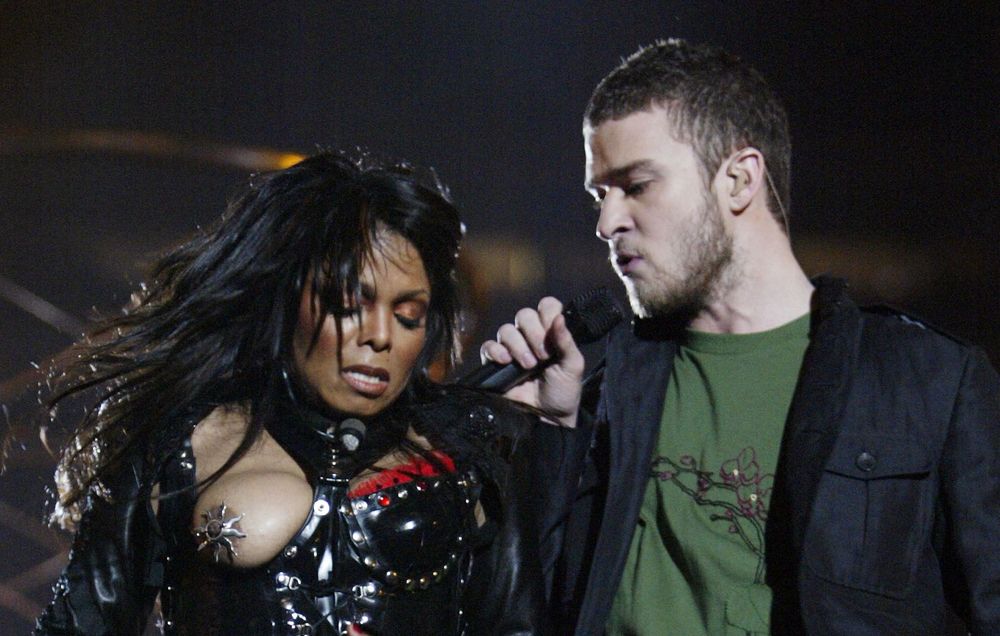
However, caveman logic alone isn’t enough. It also doesn’t explain why there is so much taboo surrounding nudity. We all see it in most forms of popular media. There are movies, TV shows, and music videos where people shoot, stab, and bludgeon each other horribly. This is all fine, but showing a female nipple? That’s somehow so horrific that it traumatizes society as a whole. That’s why Janet Jackson’s infamous wardrobe malfunction during the Super Bowl XXXVIII half-time show caused society to crumble as millions of people were traumatized.

Oh wait, that didn’t happened. Society didn’t crumble. A generation of children wasn’t traumatized. It’s almost as if human beings aren’t biologically programmed to faint in terror at the sight of their own physiology. What a radical concept, right?

So why are “wardrobe malfunctions” a thing? Why is the sight of a female nipple or an exposed penis so horrific for some people? Well, that’s difficult to answer. It is fairly well-documented that America’s approach to sexuality is downright schizophrenic at times. America loves to champion freedom, but goes out of its way to shame or inhibit sexual expression. Tech Times did a nice job of highlighting some of America’s odd prudishness on the internet, despite being the home of the biggest porn industries in the world.

It is an odd quirk of western culture in general, claiming to promote freedom while clinging to prudish attitudes towards sex. Some of this probably stems from outdated cultural practices meant to stem excessive promiscuity. As I’ve discussed before in previous blog posts, western property-owning societies did have a logistical reason for discouraging promiscuity because it undermined the transfer of property and spread disease. Many of those reasons are no longer valid, thanks to advances in technology and medicine. That still doesn’t stop people from clinging to these concepts.

Most people these days don’t claim that exposed female breasts alone will traumatize children. If not, they should take a trip to New York City. There are women on the streets standing around topless, in front of families and children, and nobody is traumatized. Even children have some innate understanding that naked bodies are not disgusting. It’s the adults of the world that want us to believe as such.

As a result, we get entire societies and cultures promoting modesty as a high virtue. We especially see this in the Middle East where there’s this assumption that men can’t control themselves at the sight of a naked woman. As a man, I find this extremely offensive. I’ve seen many naked women before in non-intimate settings. It really wasn’t that hard to control myself. If I, a writer of erotic fiction, can do so, then how can anyone else claim otherwise?

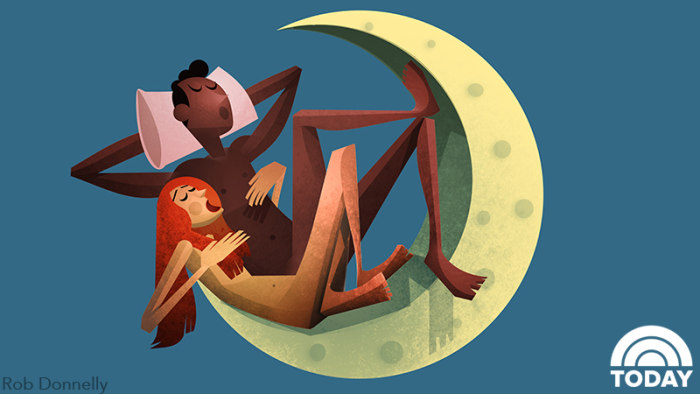
We evolved to be naked. We’re all naked underneath our clothes. Get over it. There are a great many joys to being naked. There are also many health benefits, thanks once again to the wonders of caveman logic. Today.com even did a nice write-up on the benefits of being naked. It’s good for your skin, it improves your mood, and it increases Vitamin D levels in your body. So for the good of your health, ditch the clothes and embrace its naked glory!

If you still need more proof, check out this video from DNews. If it still doesn’t convince you, then you’re just being difficult.

15 Comments

Filed under Jack Fisher's Insights, Uncategorized

The Joys of Sleeping Naked

After a week of vacation and rejection emails, I’m ready to start talking about more entertaining topics again. I don’t want this blog to just be about me and my failed efforts at becoming a published author. I want this blog to have some entertainment value, preferably the sexy kind. I’m still committed to delivering that and today is no exception.

For this topic, I’d like to get a little personal. I don’t normally do this, but I think this is due. I’m going to confess something that most people don’t confess outside of private conversations or absent significant alcohol intact. I, Jack Fisher, sleep naked.

Yes, it’s true. The same guy who tries to make a living writing sexy love stories sleeps in the buff. It doesn’t matter if it’s the dead of winter. It doesn’t matter if it’s the middle of summer. I sleep naked and I love it. I also highly recommend that others do it. It doesn’t matter if your a man, woman, trans, gay, or straight. Sleeping naked is one of life’s most underrated pleasures.

Now I didn’t always sleep naked, but that’s mostly due to logistical issues. I grew up in a fairly large household where walking around naked tends to cause problems. I also lived with roommates for a good chunk of my early adult life and too much nudity causes entirely different problems in that situation. Even after I moved into a more comfortable living situation on my own, I still wore underwear to bed. Then, one day I just stopped.

I don’t remember exactly when I decided to start sleeping naked. I don’t know what was going through my mind or why the idea came to me. I just know that after the first night, I could never go back. There’s just something inherently liberating about sleeping naked. I’ve found that it improves the quality of my sleep. It reduces stress. It even settles my mind, which is important for any aspiring writer trying to flesh out new ideas. Other than my manly parts flopping around under the sheets, I can think of no real drawbacks.

I know these benefits are just anecdotal. There can’t be any scientific reasons why sleeping naked is awesome, can there? Well, it turns out science has a dirty mind because they actually did study this and wouldn’t you know it? There are actual documented benefits. Elite Daily listed 7 scientific reasons why you should sleep naked, but I believe there are far more than that.

I believe this because of a little something I like to call caveman logic. This logic simply acknowledges that our bodies, as magnificent as they are, evolved from hunter/gatherer societies in the African savanna 100,000 years ago. Since evolution is slow and our bodies, save for one organ, are pretty dumb on a fundamental level, our biology still functions under the same evolutionary guidelines that emerged all those years ago.

That means sleeping with silk clothes and bleached cotton doesn’t necessarily complement that biology. Remember, our species evolved in a tropical and semi-tropical climate. So sleeping naked was kind of the only option and naturally, our bodies adapted and evolved.

The problem is that 100,000 years of cultural, societal, and religious development tends to create a lot of mixed messages about our bodies and how we see them. That’s why nudity is still so taboo in some areas. However, I don’t think there should be any taboo about sleeping naked.

Whether your alone or with a lover, there are just too many benefits. Human beings, following caveman logic, evolved to be social, emotional creatures. The simple act of being naked with someone creates all these pleasant, intimate feelings that make us happy and content. It’s almost as though nature wants us to be naked, intimate, and content with one another instead of isolated, hostile, and ashamed. Strange, isn’t it?

I’m not a doctor and I don’t pretend to be one. I’m an aspiring writer who has yet to taste real success. I’m not exactly an authority on sexual health or physical health in general. However, I do feel confident in recommending to others that they give sleeping naked a try. If you need even more proof, check out this video from DNews. If that still doesn’t convince you, then that’s your call.

Now if you’ll excuse me, these pants are getting mighty uncomfortable.

52 Comments

Filed under Jack Fisher's Insights, Uncategorized

A Sexy Thought Experiment

Here’s a sexy thought that anyone can do comfortably clothed. It’s a thought I think everyone has to some degree once they start contemplating their sexuality. I imagine it’s a thought parents have as they watch their children approach sexual maturity, albeit with silent horror. It’s not a kind of thinking that matches up with reality just yet, but it has the potential to be so it’s worth contemplating. So here it is:

What will happen to our understanding of sex if we’re able to remove all its known consequences?

Admit it. This thought has intrigued/troubled you to some extent. It’s a thought that I think people have entertained throughout human history. What would it be like to live in a world where nobody has to worry about getting pregnant or getting some terrible disease when they have sex? Would it be like nearly every bad porno we’ve ever seen? Would society implode, like some social conservatives claim? Would our understanding of marriage, love, and relationships remain intact?

These are all intriguing/distressing questions. How much of our sexual expression is restrained or shaped by our understanding of these consequences? If tomorrow morning, someone announces they’ve cured every infectious disease and created the perfect birth control product, what would change? Would people have more sex? Would they have riskier, more elaborate forms of sex? Would they have sex in ways that even aspiring erotica writers cannot contemplate? It’s hard to say, but it is worth contemplating because this is the 21st century. These are no longer entirely empty questions.

To provide some perspective, it wasn’t until recently that science has advanced to a point where people can control the consequences of sex. When it comes to birth control, the most common method of birth control throughout human history was simply pulling out. That didn’t always work because human beings can’t always be expected to exercise such discipline. It wasn’t until 1957 when the FDA approved the first birth control pill, giving women a genuine medical mechanism for controlling when they became pregnant. It wasn’t perfect. It did have side-effects, but it was a major advance.

There are more advances on the horizon. Today, the options for birth control are varied and becoming more varied with every year. Methods like IUDs (intrauterine devices) provide some of the most effective, reliable forms of contraception on the market today. Since there has always been demand for women to control their fertility, basic economics ensure that even more effective methods will emerge in the future.

Then, there are diseases, the ultimate libido killer. For most of human history, society was at the mercy of these diseases. Encouraging restraint had a real, legitimate purpose because many of these diseases could kill you. You didn’t even need religious zealots telling you that promiscuity was dangerous. These diseases were everywhere and pretty scary. They could actually kill you if left untreated.

As with birth control, it wasn’t until the 20th century that we gained an actual medical method of fighting these diseases. Enter antibiotics, courtesy of Alexander Flemming and the advent of penicillin. For the first time, we had a way to treat these terrible, life-threatening diseases. It’s gotten to a point where a few shots and a round of pills will cure most people of the diseases that ravaged ancient societies.

From a medical standpoint, sex has never been cleaner, so to speak. There are still dangerous diseases out there. However, only one disease, AIDS, is definitively deadly and even that condition has become more manageable over the past decade, so much so that it’s no longer the death sentence it once was. Other diseases can be debilitating, but modern science continues to advance. It’s advancing to a point where we may very well enter an era where every infectious disease is either curable, treatable, or completely preventable.

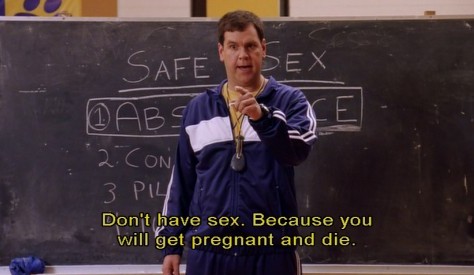
It’s a promising world, one where suffering and hardship are significantly reduced. Our world is already so much safer and healthier than it has been in the past. People today have more freedom to safely explore their sexuality than ever before. However, a lot of our sex education classes basically amount to this.

It’s a sign that, despite all these amazing advanced, certain parts of society are reluctant to embrace this world. They see these advances and worry that their children will live in a world where recklessness has no consequences. That, or they’re jealous that they’re too old to enjoy that world. It may be a combination of the two.

As I said before, for most of human history, there was a legitimate reason for people to exercise restraint in their sexual expression. However, society has tacked on a lot of other reasons that medical science can’t sure.

Religion and culture have ascribed this arbitrary “holiness” to chastity that has no basis in reality. These same forces hijack the human capacity for guilt and shame to scold those who dare explore their sexuality in ways that society deems inappropriate. This is a major theme in my book, “The Final Communion.” It offers an extreme example of what this kind of sentiment can do to people.

While religion and culture will continue to fight ardently to preserve their current state, we can take comfort in the knowledge that they tend to fail miserably in the long run. No matter how many obstacles or consequences are ascribed to sexual expression, be they legitimate or not, the drive to express these feelings remains strong. It’s one of the most powerful forces in nature. For that reason, it’s impossible to know for sure how society will change.

With all this context in mind, I’ll rephrase the thought experiment. Flash forward to some arbitrary point in the future. In that future, birth control is easy and accessible to everyone. In order to ensure that nobody need suffer the consequences, men and women are given injections around puberty that provide 100 percent effective contraception. In terms of disease, there are now special smart-drugs that can target or prevent any major or minor disease with perfect efficiency.

Now, an entire generation can grow up in a world where they never have to worry about the consequences of sex and they can explore it freely and openly. What kind of society will this generation create? We may not get there in our lifetime, but it will manifest at some point. It’s an important question to ask and one that I hope to explore in future books.

8 Comments

Filed under Jack Fisher's Insights, Uncategorized

Trends in Sexual Activity: Why Are People Having Less Sex?

We hear it all the time. Older generations complain constantly that young people are out of control. They’re too deviant. They’re too rebellious. They’re out there in the streets, running around naked, worshiping demons, and having sex like jackrabbits on crack.

Talk to anyone over the age of 45 and they’ll probably tell you that young people these days are more deviant than their generation. They’ll say young people are detached, distant, and selfish. They’re more concerned about texting on their phones than spending time with family, working on the farm, or volunteering at their church. Is there some merit to their criticism? Yes. Is their sentiment valid? No. In fact, it may be the opposite.

Last week, the Washington Post did an article highlighting the trends in sexual activity among Millennials. Some of these trends don’t fit the whining and complaining that older generations bemoan. It turns out, young people today are having significantly less sex than Baby Boomers or the Gen X crowd. The portion of youth that remains sexually inactive has more than doubled over the past 30 years. That’s a pretty big shift and nobody really knows why.

There are some theories. The article highlights concerns about sexually transmitted diseases, which grew significantly in the 80s and 90s. However, that alone doesn’t account for the data. Others suggest that the easier availability of porn, thanks largely to the internet, has made it easier for people to fulfill their needs without a partner. This is probably only partially true at best. Anyone who lived before the age of the internet will tell you that even without porn, they found ways to get off. They may not tell you before a few drinks, but it is true. People still masturbated before the internet.

I’m not a scientist. I don’t have any expertise in this area other than writing books centered around sexy themes. That said, I have learned through my many years of hearing people complain about sexual trends to notice a few themes.

Anything that’s happening in the sexual landscape of a culture basically becomes this big ink blot test. People are having more sex? This must be due to some perverse religious trend, some devious new form of media, or some widespread rebellion against authority. People are having less sex? This must also be due to some perverse religious trend, some devious new form of media, or some widespread rebellion against authority. People see this and use it to inject whatever conclusion they feel fits their agenda. They do the same with politics, religion, and tastes in fast food.

So what do I think? Well, I think like most things involving the complexities of human society, trends in sex have multiple influences. It’s not just smartphones, media, or diseases alone that affect these trends. It’s a combination of many forces, some more powerful than others. So if I had to give more weight to one force in particular, I’d favor the one that tends to govern most human affairs to a significant degree: economics.

Let’s face it. Sex and being in a relationship is expensive. Men and women expect a lot more these days and not just in terms of fancy dates. Between the cost of divorce and the conflicting expectations, getting sex requires a lot of time and energy. In an era where young people have to work a lot harder to achieve the same level of financial stability of their parents, there’s just not as much to dedicate to sex.

It’s not a very sexy explanation. I admit that. People are having less sex because they can’t find good jobs or are shackled with too much debt? That’s not a satisfying explanation and it doesn’t lend itself to a simple solution. People like things that are satisfying. Ironically, it’s kind of like sex. If it isn’t satisfying, they look elsewhere. In this case, however, what isn’t satisfying may also be valid.

Money does affect relationships in a major way. According to the Walls Street Journal, millenials in particular are shackled with a lot of debt, mostly from college loans. Few things kill your sex drive more than the knowledge that you can’t pay your bills and barely have enough money to survive. In terms of our basic needs, survival does take priority over orgasms most of the time.

Is it the only explanation? No. I don’t claim that this is the sole explanation for the decline in sexual activity among young people. There are likely other factors in play, such as changes in feminism and growing awareness of sexual assault. It’s hard to quantify just how much those factors affect the results. It may even be impossible in some ways.

Be this as it may, the success of the porn industry and the continued success of erotica give me hope that people of all generations still have a healthy libido. I hope to nurture it with my books. In the meantime, here’s an insightful video from Think Tank that explores this issue in greater detail. Their explanations are probably only part of the story though. What do you think is causing young people to have less sex? Nobody knows for sure, but that won’t stop plenty from speculating.

8 Comments

Filed under Jack Fisher's Insights, Uncategorized

Sex, Drugs, and their Effects

Sex, drugs, and rock n’ roll are a big part of popular culture, but what happens when you take away the rock n’ roll part? Despite what the Nixon administration, D.A.R.E., and every after-school special ever made would have us believe, human beings have used drugs in some form or another to enhance some part of their lives. Naturally, one of biggest parts we use it for is sex.

I’m not just talking about the drugs rock stars do with groupies. In 2015 alone, the drug company, Pfizer, made $1.708 billion in revenue from Viagra alone. So yes, sex sells and it’s a multi-billion dollar industry. So rock n’ roll really isn’t necessary for this potent combination to fly and no matter what drug warriors do, economics will keep this potent combination in business.

As we speak, these same billion-dollar companies are trying to make a Viagra for women as well. Like the female orgasm, however, it’s not quite as simple as getting blood to flow to the genitals. The greater difficulty women have in achieving orgasm, not to mention differences in evolutionary function that I’ve touched on before, make crafting such a drug a challenge. That hasn’t kept people from trying though.

Again, there are billions of dollars at stake. There’s too much incentive to give people drugs that enhance their sex life. At the moment, the only “female Viagra” that has this potential is called Flibanserin. It’s not quite an orgasm in a pill just yet, but it’s a vital first step and we can expect more like it in the coming years.

So why bring up sex and drugs? Well, it plays into some of the other issues I’ve talked about regarding ways that technology is changing sex. History shows that any advance, be it the advent of the latex condom or the birth control pill, is going to change attitudes about sex and the ways in which humans relate to one another. With the pace of technological change advancing at a rate that’s hard to keep up with, it’s difficult to imagine what kind of changes we’ll see.

These changes aren’t like trends in computers and smartphones either. Advances in drugs don’t always follow a simple pattern in terms of how they effect sex. There are drugs that negatively affect our sex drive, many of which are available at any drug store or with a prescription. The same goes for illicit drugs. Contrary to popular belief, alcohol isn’t an aphrodisiac. It can actually hinder sexual function. It’s only associated with sex because it removes inhibitions, thereby making people more open to sexual encounters.

The interplay between sex and other drugs, illicit and otherwise, is extremely complex and too much for a single blog post. It’s also unresolved because, despite mixing sex and drugs for years, we still don’t know everything about the way the two interact. Last year, Vice did a thorough report on how different drugs effect sex during their investigation into “Chemsex,” a topic I’ll cover in another blog post. You can read the article here:

Vice: This is your Sex on Drugs

There’s a lot in this article to examine. Drugs and their effects on the human body are complex and varied. At the moment, there’s no single drug that enhances sex for everybody in every instance. This quote from the article sums it up nicely:

Given how long—and often—humans have mixed drugs and sex, you’d think we’d understand the two pretty well by now. But as Johnson—who runs clinical trials testing narcotics’ effects on human behavior—can attest, drugs affect us all a little differently. Some have a direct pharmacological impact on the way we experience the world, while others affect our brains so dramatically that their impact on sex is a total crapshoot.

So as it stands, the interplay between sex and drugs is extremely varied and unpredictable. That unpredictability can make for interesting stories. At the moment, I’m throwing around a few ideas that explore this unpredictability. However, it’s the future of sex and drugs that I’m most interested in.

Every year, more and more drugs are emerging, legal and illegal alike. If there’s a way to mix these drugs with sex, people will find it and they will exploit it to the utmost. It may improve our sexual experiences. It may hinder them. One day, we may be able to control that. What kind of society will that create? How will that affect the way we relate to one another? Those are all important questions, but they’re best addressed in future blog posts.

1 Comment

Filed under Jack Fisher's Insights, Uncategorized

The Evolutionary Origin of the Female Orgasm

Last week, one particular story flew under the radar. I suspect a lot of stories will do that in the midst of a Presidential Election/Political Sideshow. However, being an aspiring writer who focuses on erotica, sex, and intimate romance, these sorts of stories do catch my attention. They also give me something new to think about as I’m developing my stories.

Believe it or not, there’s an ongoing struggle in the scientific world and it has to do with the female orgasm. Yes, the same science that gives is iPhones, rockets, and crazy glue still can’t decipher the female orgasm. Why is it a mystery? Well, evolutionary speaking, we don’t know why the hell it’s there.

Granted, we’re grateful for the joys of orgasms, male and female alike. I’ve already written about the numerous health benefits that come with orgasms so it’s not like nature isn’t aware of them to some degree. Nature tends to make use of something, regardless of how it came to be. That’s the thing though. From an evolutionary standpoint, we really don’t know how the female orgasm came to be or what purpose it serves.

Human physiology is pretty damn remarkable compared to other primates. In most primates, what science defines as an orgasm plays a part in reproductive success. A male’s orgasm is accompanied by the release of sperm. A female orgasm is accompanied by ovulation. It makes perfect evolutionary sense. A species that experiences orgasm in accord with reproductive behaviors is definitely going to have the right incentive to propagate.

Humans are different though. While the male orgasm is still associated with the release of sexual fluids vital for reproduction, the female orgasm offers no such benefit. A woman need not have an orgasm in order to reproduce. Ideally, it’s just a happy byproduct. Since nature favors survival over meaningless fun though, it still doesn’t explain why the female orgasm is still there. Now, a study published in July 2016 in the Journal of Experimental Zoology offers a potential explanation. Here’s the abstract:

The evolutionary explanation of female orgasm has been difficult to come by. The orgasm in women does not obviously contribute to the reproductive success, and surprisingly unreliably accompanies heterosexual intercourse. Two types of explanations have been proposed: one insisting on extant adaptive roles in reproduction, another explaining female orgasm as a byproduct of selection on male orgasm, which is crucial for sperm transfer. We emphasize that these explanations tend to focus on evidence from human biology and thus address the modification of a trait rather than its evolutionary origin. To trace the trait through evolution requires identifying its homologue in other species, which may have limited similarity with the human trait. Human female orgasm is associated with an endocrine surge similar to the copulatory surges in species with induced ovulation. We suggest that the homolog of human orgasm is the reflex that, ancestrally, induced ovulation. This reflex became superfluous with the evolution of spontaneous ovulation, potentially freeing female orgasm for other roles. This is supported by phylogenetic evidence showing that induced ovulation is ancestral, while spontaneous ovulation is derived within eutherians. In addition, the comparative anatomy of female reproductive tract shows that evolution of spontaneous ovulation is correlated with increasing distance of clitoris from the copulatory canal. In summary, we suggest that the female orgasm-like trait may have been adaptive, however for a different role, namely for inducing ovulation. With the evolution of spontaneous ovulation, orgasm was freed to gain secondary roles, which may explain its maintenance, but not its origin.

There are some telling words within the science jargon, namely the concept of the female orgasm being unreliable during sexual intercourse. I doubt women need science to prove this to them. However, that unreliability may be a big reason why orgasms developed into other uses. The study calls it “adaptive,” something that tends to happen a lot in evolution. If a trait ceases to have one use, it can develop another. That’s how land mammals develop into whales. This kind of adaptation, however, is much sexier.

It’s that adaptation part that helped make human beings the extremely social, uniquely passionate creatures that they are. If orgasms no longer have solely reproductive roles, then it can develop other roles within our species. Those roles include romantic roles. An orgasm doesn’t have to involve reproduction. It can involve love, the bonding of two individuals to create a more cohesive society. It’s that cohesion that helps make humans the dominant species of the planet. A bear may be physically stronger than any human, but humans can coordinate better to take them down. Orgasms are just part of that process.

Now it’s not like we need more reasons to celebrate orgasms, male and female alike, but it is nice to know that they did play a role in the success of our species. Success, on any level, is worth celebrating and orgasms give us plenty of ways to celebrate.

3 Comments

Filed under Jack Fisher's Insights, Uncategorized

Sex, Robots, and the Future

Do you find robots sexy? That’s not a joke. That’s a serious question and one that we may need to answer sooner than you think. We’ve all heard people raise concerns about the robot apocalypse. When most people think of it, they tend to think of world described in “The Matrix” or “The Terminator.” While these make for good Hollywood action movies, there is one part of this so-called apocalypse that isn’t touched on very often. That’s to be expected though because this part can’t fit into a PG-13 movie.

It’s going to happen. It’s actually already starting to happen, as Men’s Health reported earlier this year when a man professed his love to a life-like sex doll. We are going to have sex with robots. We are going to develop intimate relationship with robots. As they become more advanced and more capable of interacting with us, our human emotions will come into play. Along with those emotions will come desires. So how will they manifest? How will our society function in a world where men and women can have romantic sexual relationships with robots?

Now the concept of sexy robots is not at all new. The first “Austin Powers” movie gives us our most basic and crude concept.

These kinds or robots, as colorful and comical as they may be, are currently beyond our technical capabilities. So far, you can’t purchase a real sex robot today. However, you can purchase a very lifelike duplicate through RealDolls.com, a company that has been in business for years. While you can have sex with these dolls, they don’t interact. They can’t talk or exert themselves with any meaningful intelligence, emotional or otherwise.

That will eventually change because our technology is progressing rapidly. We already have robots who can beat people in chess and Jeopardy. We also have robots that can interact with some level of personality, such as Apple’s Siri and Microsoft’s Cortana. How much longer until we have a robot that’s advanced enough to be a real person? We don’t know yet, but we are starting to give the idea serious consideration. Last year, the movie “Ex Macina” built an entire story around it and it ended up being a lot more mature (not to mention darker) than “Austin Powers.”

Like “The Terminator” though, this story is limited in vision and scope. It focuses heavily on creating conflict more than exploring the implications. Those implications will show up before the conflict and some are giving it serious thought.

The New American posted an article last year about how some are already advocating for human/robot marriage. Marriage has already undergone significant changes with the recent advances in same-sex marriage. Will marriage with robots undergo a similar process in the coming decades? It’s hard to say, but there’s no question that we are becoming more and more linked with our technology. Is it just a matter of time before we start developing emotional, romantic, sexual relationships with robots?

On the surface, it has some distressing implications. A robot has no rights. A robot cannot sue for spousal abuse. A robot can be turned off, reprogrammed, and shut down. A robot can also be made to look like anything someone wants. What if someone wanted a robot that looked like a child or a specific actor/actress? What are the legal implications of that?

It’s hard to imagine how a human/robot relationship will function now, but then again same-sex marriage was in a similar position 20 years ago. Who’s to say that 20 years in the future won’t follow a similar path?

I tend to be more optimistic when it comes to the robot “apocalypse.” I believe that once robots become intelligent enough for us to have relationships with, be they sexual or otherwise, it’s going to change us as individuals every bit as much as we’ll change them. If a robot is smarter than us, then they will know how to accommodate us. They’ll know how to provide every emotional need we may have. Will that be healthy? Could having all your emotional needs being met by a robot be good for us?

Some may claim that robot relationships will lead to the extinction of the human race. Actually, it may do the opposite. If we can make a robot capable of having sex, then we can make a robot capable of giving birth as well. Artificial wombs are a real concept that’s in development. We may very well get to the point where we don’t need sex to reproduce anymore. If a society wants to grow its population, it can do so without putting women through the rigors of childbirth.

How will that society function? How will a relationship between a human and a robot function? It’s an intriguing question. It’s one I’m contemplating for a possible book. Nothing is set for now. I have other projects I’m still working on. In the meantime, I’ll let this video from the Huffington Post continue the discussion.

https://s.embed.live.huffingtonpost.com/HPLEmbedPlayer/?segmentId=560c199399ec6d3aff0001fb&autoPlay=false

9 Comments

Filed under Jack Fisher's Insights, Uncategorized