Tag Archives: reasons vs excuses

How To Manage Your Excuse Bank (Within Reason)

https://i0.wp.com/www.caproasia.com/wp-content/uploads/2015/08/Professional-Banker-3.jpg

When I did my first post on reasons versus excuses, I challenged readers to take a closer look at their actions and decisions. Why did they end up doing what they did? Was there a reason for it? Was that reason actually an excuse? Did that reason or excuse end with you getting laid, fired, or slapped in the face?

Given how many actions and decisions unfold on a day-to-day basis in the massive doughnut shop that is life, it’s hard to make sense of them all. I’m sure those without OCD or a personality disorder was quickly overwhelmed by the sheer breadth of reasons and excuses they came up with for their behaviors. Don’t worry and put down the vodka. That’s entirely normal.

We’re all human. We’re all bound to make bad decisions or bad reasons and/or lousy excuses. That’s part of life. The key is learning from those bad decisions and improving the skills that help us better our loves, help those around us, and even get us laid from time to time. Since I’m an erotica/romance writer, that last one was worth adding.

It’s also worth offering whatever help I can to others in developing those skills. Again, I need to remind everyone that I’m an aspiring erotica/romance writer. I’m not a scientist, a therapist, a psychologist, or doctor. I may write about people in those occupations getting involved in sexy situations, but I’m not at all qualified to offer the kind of substantive advice, complete with technical charts and an hourly bill.

https://i0.wp.com/allennance.com/wp-content/uploads/2013/12/peanuts-blogging-advice-770x433.jpg

However, in dealing with plenty of colorful personalities throughout my life and writing various personalities in my novels, I do feel like I can at least offer some insight that can help people use my colorful ramblings in pragmatic ways. I can’t guarantee they’ll work, get you laid, or make you rich. This is just me trying to make my words both sexy and useful.

In discussing reasons versus excuses, I brought up the concept of excuse banking. It’s almost exactly what it sounds like. It’s the process of acting, believing, and learning in a way that effectively pockets an excuse to use to justify decisions later on. Since our brains are wired to decide first and then justify those decisions, excuse banking is very much a pragmatic manifestation of our collective psyche.

It’s not inherently good or bad. It can certainly get pretty darn bad, as I pointed out when I tied excessive excuse banking to political and religious extremism. Most people, though, don’t operate in extremes and if they do, it’s usually out of fear and survival, which are among the most valid reasons we can have for doing something. For the purposes of providing useful advice in excuse banking, I’d like to focus on the good.

In that spirit, I’d like to offer a quick rundown of tips and tricks for managing your excuse bank effectively. We’re all going to make excuses at some point. We’re all going to bank those excuses in some form or another. We might as well figure out how to do it in a way that improves our lives and gets us laid.


Tip #1: Maintain A Balance, But Avoid Hoarding

Like any useful bank account or credit card, it’s important to maintain a balance. You always want to have some reserves, just in case it’s an emergency and you need a valid excuse to explain why your pants are in the refrigerator. You don’t want to be stuck relying on reasons that may or may not apply. That’s just going to make you look stupid, incompetent, and decidedly unsexy.

Unlike a traditional bank account, though, you don’t want to let your excuse bank get too bloated. That’s because excuses aren’t hard assets. They’re intangible, malleable, and much easier to abuse. You may be able to use a dollar bill to snort a line of blow, but with an big enough excuse you can justify snorting blow off a stripper’s tits.

That’s why you should not hoard your excuses the same way I hoard comic books. As I noted in my post on extremism, having too many excuses that are too malleable creates all sorts of nasty temptations. Having those excuses is like having a loaded AK-47 in a traffic jam. Even if you can resist the temptation, the potential is still there and the danger of that potential can be pretty vast. Just ask any experienced traffic cop.


Tip #2: Invest With Other Peoples Whenever Possible

This part of excuse banking also highlights one of the key differences from other types of banking. In a sense, excuse banking is almost always a joint effort. It’s not enough to just have an excuse. You also need other people to believe them in order for them to be useful.

An excuse with a random stranger and an excuse with a close family member is not going to have the same value. At the same time, an excuse you bank on your own isn’t going to be as valuable as one you bank with other people. Human beings are very social creatures. When you forge close social bonds, be they with family or lovers, your excuses carry more weight and so do those of others.

In a sense, it’s a win-win investment. By banking excuses within a social group, you develop a sense of trust and understanding. That makes deposits and withdraws from your bank easier and less likely to blow up in your face. Just watch any Ben Stiller movie to see why that’s so important.


Tip #3: Know Which Investments Grow And Which Are Toxic

It’s true. Excuse banking sometimes deals in toxic assets. I’m not just talking about bad mortgages or too much stock in Enron either. When your excuse bank has toxic assets in it, you’re in big trouble.

A toxic asset in an excuse bank is often one we don’t realize is toxic. Sometimes, we even refuse to realize it. That’s what often happens with dictators, religious zealots, and child actors. Their excuse bank is so full of toxic assets that they don’t know how bad their excuses are and if someone tries to tell them, they don’t listen. That often leads to the kind of tragic self-destruction that becomes an A&E documentary.

That’s why it’s so important to identify these toxic assets before they poison you. Those assets will undermine your ability to work with others and gain their trust, two things everybody needs to survive in a functioning society. So how do you know if an asset is really toxic? Just follow these simple steps:

  • Step One: Ask yourself, “Would this excuse allow me to punch someone in the face and make them apologize for hurting my hand?”
  • Step Two: If you answered yes to the following question, then the excuse is toxic.

Tip #4: Understand An Investment’s Potential, But Don’t Ignore The Risks

Like any investment, there are risks and rewards that you have to weigh. Sometimes the risks are minimal. When you fake sick just a couple times and don’t announce to the world on FaceBook that you’re running a marathon, the risks are pretty minimal. Those risks escalate when you let them pile up, so much so that your girlfriend won’t believe you when you say you need to perform brain surgery on the President.

This is especially important for anyone in a position in power, be they the despot of a country or a manager at Walmart. Having power offers a lot of potential because it creates both excuses and reasons for people to do what you tell them. However, the risks are much greater, especially if you want to use that power competently.

It’s easy to lose yourself in power. Anyone who used cheat codes in old Mario games understands that. That’s what makes it so dangerous because it prompts us to ignore the risks. When we do that, we’re less likely to realize when our excuses become toxic. People don’t trust us and look for ways to get us out of the way. No matter how much power you have, you won’t be able to use it effectively if your excuses are toxic.


Tip #5: Avoid Banking Excuses As A Means To Improve Past Investments

This tip is directly tied to a little something called the sunk cost fallacy. Anyone who has ever had a gambling problem or knows someone who would bet their shirt at a blackjack table knows it well. It’s this annoying quirk in our psyche that compels us to keep throwing resources into a game we’ve already lost to justify past investments.

In a sense, it’s an excuse to justify stupid risks that didn’t pay off. It’s a way to alleviate the mental stress of knowing just how badly we’ve lost. In the context of excuse banking, it applies to more than just a bad run of luck at a casino.

Like trying to win back what you’ve lost, banking excuses to improve toxic assets rarely works out. When an excuse has become toxic, it usually stays that way. It’s like the boy who cried wolf. Even if the wolf does come once in a while, there isn’t much you can do to improve the utility of the excuse.

Excuses, like fresh fruit, can perish quickly. They can be finite and applicable only to specific circumstances. Once those circumstances pass, trying to cling to those excuses is like trying to make spoiled milk taste good. It just can’t be done.


Tip #6: Long Term Investments Usually Pay More Than Short Term Investments

This is where we kind of have to battle our inner caveman here. As I’ve covered before, caveman logic compels us to think primarily in the short-term. We prioritize the potential for avoiding tigers and mating with fertile partners. Those short-term investments worked well in the caveman days, but they work less well in more complex societies.

The key purpose of excuse banking is to ensure you can justify your decisions to others. If you can’t do that, then other people aren’t going to trust you, work with you, or want to have sex with you. Now there’s a time and place for short-term investments, but they’re usually very specific and rare.

Long-term excuse banking involves crafting excuses that build trust and understanding with others. Ideally, they have some amount of reason to support them, if only in part. Bank enough long-term excuses and you’ll find people who are eager to work with you, ready to trust you, and eager to take their clothes off with you.

That kind of investment usually takes a lot more time and effort, but the payoffs can be pretty damn awesome.


These are just a few tips to start out. If I come up with others or learn from someone else, I’ll share them in another post or list. If anyone else has investment advice in the world of excuse banking, please share it.

Excuses may be one of the most important investments we can make. It’s one of the few currencies that is valid in every country, culture, and society. Sure, we can’t use them to tip strippers, but they’ll help us in negotiating our lap dance.

3 Comments

Filed under Reasons and Excuses

Extremism: The Ultimate Excuse Bank

https://i0.wp.com/wp.production.patheos.com/blogs/quranalyzeit/files/2014/04/1900133_513898185402876_874183235_n.jpg

Strap yourselves in and tighten your sphincter because this is another one of those posts that I’m sure is going to offend a few people. I try not to do posts like this too often. I like to leave that kind of offending to shock jocks, Fox News, and Kanye West. I’m an aspiring erotica/romance writer. I’m not Howard Stern.

However, sometimes I need to dip my toes in the piss-filled pool of offense in order to make an important point. I did that last year when I explored the mind of misogynistic men that too many women don’t even try to understand. That was hard to write, but it was something I felt needed to be said.

This post is similar. I knew I was going to write something like this when I began my discussion on reasons versus excuses. I also knew that by doing so, I would offend a few people. I’m not going to apologize for that. Sometimes, a message needs to be offensive in order to get the point across.

In this instance, that point has to do with extremism. I’m not just talking about religious extremism. I’m not just talking about political extremism. I’m not just talking about the extremism you find on Twilight message boards either. I’m talking about extremism in all forms.

I want to keep the context broad so that the topic can be applied to every possible instance. From the Islamic extremism that every news outlet tries to mention a thousand times a day to the political extremism that builds shining “utopias” like North Korea, this issue can apply to all of them. It won’t be the most comfortable application. If anything, it’s akin to applying acid to a contact lens.

To understand the common link between all these various forms of extremism, some of which actively try to murder each other in the streets, we need to revisit the concept of “excuse banking.” Sure, it’s a concept I just invented and has as much scholastic weight as a Will Ferrell movie, but it’s a concept that helps make sense of the irrational whims of people who really think they’re rational.

The basics of excuse banking are simple. They take whatever actions, beliefs, knowledge, or social connections someone has and effectively molds them into a ready-made list of excuses to justify their future actions. Excuse banking is basically akin to stocking up on Twinkies so that when you get hungry, you’re ready.

Remember, we don’t make decisions based on logic. We decide first and then look for reasons or excuses to justify them. That’s just how the human brain is wired. That’s how it has been wired since our caveman days and we can’t change that wiring any more than we can change the color of the sky.

With extremism, excuse banking goes a step beyond justifying your decision to buy a thousand posters of a half-naked David Hasselhoff. Extremism, in many ways, is the ultimate manifestation of excuse banking. It provides people with a set of infinitely malleable, constantly excuses to justify pretty much anything. Why else would actual Flat Earth Societies still exist?

In such an extreme, excuse banking goes far beyond just justifying a decision. When someone has such a malleable excuse in unlimited supply, it can lead to a form of self-hypnosis and self-delusion wherein someone actively avoids looking for reasons. They favor, cling to, and obsess over their preferred excuses.

It takes many forms, but the patterns are fairly similar. In religion, especially in the big three Abrahamic religions, there’s a perfect, all-powerful, all-knowing excuse sitting in the clouds. Call that excuse any name you want, be it Yahweh, Allah, God, or Cthulhu, it still functions the same.

If you have faith in said deity, then that deity will bless you and vindicate you. You don’t need to provide reasons for anything. You can just claim that the deity commands or wishes it and that’s the end of the conversation. You don’t need to justify anything else.

You want to murder an abortion doctor? That’s okay because your deity says it’s justified.

You want to blow up a bus full of civilians? That’s okay because your deity says it’s justified.

You want to take slaves from neighboring tribes? That’s okay because your deity says it’s justified.

You want to mutilate the penises of infant boys? That’s okay because your deity says it’s justified.

Sometimes the justification comes in the form of holy books that cannot be questioned. Sometimes it comes in the form of charismatic cult leaders who want first dibs on all the pretty girls in room. Sometimes it’s just some guy claiming to be a prophet that somehow slipped through the cracks and works at Dairy Queen during the week.

However it happens, the pattern is fairly clear. In terms of excuse banking, it’s almost too perfect. Having vindication from an all-knowing, all-powerful deity is basically like playing an old video game with cheat codes. Nobody can argue with a deity like that. Nobody can even verify the will of that deity.

Think back to what distinguishes a reason from an excuse. Reasons, by their definition, need to be verifiable on some level. Deities can never be verified. That’s why many religious extremists emphasize faith, which is essentially accepting the belief beforehand, absent any reason.

For the Richard Dawkins’ of the world, that seems dishonest. However, from a purely pragmatic perspective, it perfectly meshes with the wiring of our brain. It perfectly aligns with the process of making decisions first and then justifying them. In that sense, religion has far more advantages than atheism ever will. Sorry, Richard Dawkins, but the game is just not in your favor.

Think about any religious zealot. They’ll claim the same thing. Their deity and their holy book condone, promote, and even command whatever behavior they do, no matter how irrational or atrocious it might be. That’s how terrorists justify their atrocities. That’s how someone can harass the families of dead soldiers and still think they’re a good person. They’ve banked the ultimate excuse to justify that sentiment.

Now I’m not just going to harp on religion. I’ll leave that in the capable hands of South Park and Seth MacFarlane. Religion is just the most obvious example. Political ideology is still a close second though.

By political ideology, I mean any ideology that has an extreme element to them, which is essentially all of them. There may not be an all-powerful, all-knowing deity, but there are still a set of infinitely malleable excuses that adherents use to justify anything and everything.

Communism is probably the most famous example. From the Soviet Union to North Korea, communisms as a concept basically functioned as a deity in that its adherents thought it was perfect. Anyone who claimed otherwise was killed and those who did the killing had a valid excuse. They were protecting communism and the god-like leaders that promoted it. How else could Kim Jong Ill get away with those ridiculous glasses?

It also scales to smaller domains. Here in America, we have political parties who treat their affiliation the same way religious zealots treat their deities. That’s how one party can get so outraged when the other does something, but be totally okay with it when they do the same thing.

Through excuse banking, a political party can justify their actions because they see their party as correct, moral, and ethical party. There’s no reason for this and there’s no way to truly justify that sentiment. By blindly accepting it, they have the ultimate excuse. That’s why it’s entirely possible for a party member who claims to be pro-life to pay for his mistresses’ abortion and still be considered moral.

Go beyond political parties and you’ll find extreme excuse banking in all sorts of fields. It has been happening a lot more in fields subject to political correctness, especially in areas like feminism. It’s already evolved its own set of language and terms, much like any religious or ideological movement.

Such excuse banking can end up dividing an ideology that actually has verifiably good ideas. The inequality of women was and still is an unfair practice, something that feminism worked hard to overcome. However, extreme measures of excuse banking led to horrendously misguided subcultures in that movement, some of which joked about the mass murder of an entire gender.

This is the part where I hope everyone can unclench their asshole a bit. I know this is a difficult discussion to have, but these are all topics that affect us profoundly. Whatever the balance in your own excuse bank might be, religion and ideology affect our lives in profound ways. That’s why it’s so important to have a way to make sense of it.

This is also the part where I want to remind everyone that extreme forms of excuse banking in no way makes someone a bad person. I still believe that most people are good people who operate under the same burdens as the rest of us. Some, either by circumstance or endowment, find themselves clinging to certain excuses more than others.

Now I’m not saying that the idea of excuse banking can make sense of every complex sociopolitical situation on the planet. It’s just one tool I’m offering to add to a toolbox that can never be too stocked.

10 Comments

Filed under Reasons and Excuses

Excuse Banking: What It Is, How It Effects Us, And Why It Matters

https://i0.wp.com/www.dailyentertain.com/wp-content/uploads/2014/12/banker-laughing.jpg

If you thought I was done talking about reasons and excuses, I’m sad to report that you’re very wrong. If you thought there’s no other way to make funny, sexy, or relevant, then I’m not so sad to report that I’m eager to prove that wrong as well. Trust me. This is a huge topic, one with many implications for writing novels and so much more.

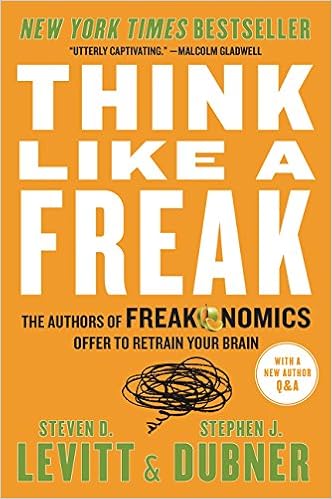
A big part of what inspired me to explore this topic is a new book I’m reading called “Think Like A Freak.” It’s a book by Stephen Levitt and Stephen Dubner, the two authors behind the best-selling “Freakanomics” books that I’ve enjoyed so much in the past.

There’s a lot to digest in this book and I’m still not done reading it yet, but the primary takeaway is fairly simple. It teaches you to step back from a situation, look at all the complex incentives and motivations surrounding it, and think in new, unorthodox ways to further your understanding. These posts on reasons and excuses are an exercise, of sorts, in understanding things from a new perspective.

I’ve already explored the basics of reasons and excuses. Now, I’d like to expand on those basics and create a new concept of sorts, one not unlike the idea of “caveman logic,” which I’ve cited so often on this blog. Please don’t mistake this for a real scientific concept. I’m as much a scientist as I am an astronaut ninja. This is just me, an aspiring erotica/romance writer, creating a term to encompass a larger concept.

With that said, ladies, gentlemen, and those of unspecified gender, I introduce to you the concept of “Excuse Banking.” It’s not in a dictionary. You won’t find it in any textbooks or erotica/romance stories yet, but it’s an idea that has affected us all to some extent.

Again, this is a term I’m inventing right now with no expertise and nothing but a blog to explore it. I understand that’s like a hobo walking into MIT and trying to build a star ship, but I want use this term to explore the more intimate aspect of reasons and excuses. As anyone who has read my books knows, I’m all for more intimacy.

First off, here’s a quick and dirty definition of what excuse banking is:

  • A form of rationalizing one’s actions by using one or more justifications that have been remembered, accepted, and understood as something of personal value;
  • A series of actions meant to mitigate or eliminate the emotional or mental stress of a decision or action that may occur in the future; and
  • The process of shaping ideas, beliefs, and morals in a manner that facilitates difficult ethical decisions.

In reading over these definitions, it should be easy to recall situations where excuse banking applies to you or someone you know on some level. Have you ever loaned someone money? Have you ever helped them with a chore? Have you ever done a favor and asked for nothing in return?

Well, in doing so, you’re effectively making deposits into the excuse bank that you can use as currency, so to speak. Sometimes those deposits gain interest over time. Sometimes they depreciate. In either case, we use this currency to either garner favors through reciprocity or mitigate stressful, demanding situations we may have at a later time.

Much like caveman logic, the idea of excuse banking reflects the understanding that our brains are wired a certain way. That wiring, unfortunately, is akin to an operating system that never gets upgraded. As far as our brain wiring is concerned, we’re still cavemen living in hunter/gatherer tribes in the African savanna.

That wiring, regardless of whether you believe it’s a product of nature or supernatural deities, is the guiding force behind everything from our social behavior to our sexual fantasies. For this particular topic, I’ll focus on the social behavior and save the sexual fantasies for my novels.

Like every other cognitive function, our social behavior does have a basis in neurobiology. That behavior helps guide what we do and why we do it. The behavior, and the wiring behind it, have two primary imperatives that take priority over pretty much everything else. Those priorities are, once again, survival and reproduction.

Nature may be blunt, imperfect, and messy at times, but you can never accuse it of misplacing priorities. When it comes to helping a species thrive, survival and reproduction have to be major priorities. Whether it involves surviving a bear attack or successfully making love to one hundred beautiful cavewomen, those priorities guide a significant part of our thoughts and actions.

It’s for that reason, as I stated in a previous post, that our process for making decisions is so different compared to what we believe. We like to think we’re rational creatures, assessing a situation logically like Spock or Dr. House, and then acting in accord with the utmost reason and morality. That’s the ideal and the basis of multiple superheroes, TV doctors, and scientists.

However, due to that pesky biological wiring that hasn’t been upgraded since the stone age, we do it ass-backwards. We first make a decision, often based on emotion and instinct, and then look for ways to justify it. It’s a good way to ensure we survive bear attacks long enough to get laid. It’s not a good way to promote rational decisions, much to the chagrin of Dr. House.

This is the domain in which excuse banking manifests. Regardless of whether or not we believe that this is how we make our decisions, excuse banking ensures we have a way to justify our actions and decisions, especially if they cause us physical or emotional distress.

We do this because there’s a 100-percent chance that at some point in our lives, we’re going to face a difficult decision. Maybe we have to decide whether to lie to a girl to get her attention. Maybe we have to decide whether or not we should trust the guy who claims to be a Nigerian prince wanting to help us collect an unclaimed lottery place. At some point, we will confront these decisions. It’s an inevitable fact of life.

Excuse banking is a way of hedging our bets, so to speak. It encompasses the actions, beliefs, and social connections we make prior to these decisions. We may have different reasons for seeking these connections, but they have the same secondary function. They help deposit excuses that we might be able to use in future situations.

The process of banking excuses is almost always secondary, in that sense. Nobody goes out of their way to do or believe something because they want an excuse to justify their actions. Nobody overtly think, “I’m going to work at this soup kitchen and provide medicine to sick orphans so I don’t feel as guilty when I strangle puppies with my bare hands.” Those that do are probably sociopaths or reality TV hosts.

Like real banking, sometimes the excuses we bank generate interest. This is especially true when actions involve forming a strong social network of people who support you, even when you screw up. They act as a safety net and over time, that net can become reinforced.

Also, like real banking, banked excuses require fees of sorts. You have to pay a price in order to bank a certain excuse. It can be the time and energy we put into crafting social networks. It can be the resources we expend to join a group, mold an identity, or sell our skills. Some fees are small. Some are much larger, but tend to be more flexible.

That’s where excuse banking starts to diverge from actual banking. Unlike hard currency, excuses can be malleable to a certain extent. You can turn past favors, past charity work, and all that money you gave to PETA into excuses you can use in multiple situations.

This is especially true of excuses built around beliefs. Since beliefs are intangible, unmeasurable, and unverifiable, they are extremely malleable. Take circumcision, a topic I’ve covered before, sometimes to an exceedingly personal degree. Absent a tangible medical condition, there’s no logical reason as to why we would cut off part of an infant’s penis.

However, if you inject a sincerely held belief that your particular religion has a tradition regarding circumcision, then that requires a hefty withdraw from the excuse bank. That excuse better be malleable and low cost as well. When it comes to beliefs, though, the cost is usually close to zero and it’s hard to beat that.

Now that’s not to disparage anyone’s sincerely held religious beliefs. I’m not saying that all religions exist as systematic forms of excuse banking. Human beings just aren’t that simple. If they were, then erotica/romance writers like me would have little to work with. Excuse banking is just one of those understated, unseen processes that emerges from our faulty brain wiring.

When put into a proper context, excuse banking can help make sense of an inherently irrational world populated by very crazy people, some of which have their own radio shows. At a time like this, when the concept of “alternative facts” is a thing, we need every tool we can get.

This is just one from an aspiring erotica/romance writer. I don’t know how useful it will be or if it’ll make anyone horny, but we can only hope.

29 Comments

Filed under Reasons and Excuses