Category Archives: politics

It’s Election Day America! Go VOTE!

Today is Election Day, America.

I know you’re tired of all the ads.

I know you’re sick of politics on every level.

Now, it’s time to vote. I don’t care how cynical you are. I don’t care how jaded, disillusioned, or alienated you feel. You’re American, damn it! This is what it means to be an American!

You don’t lie down and accept the current state of affairs. You don’t just whine, bitch, and moan about it on social media. You get off your ass, you go to the polls, and you do something. It may not feel like much. Given the many flaws of our voting system, it often doesn’t amount to much. But it’s still worth doing.

It’s not because your vote is the most important vote in the country.

It’s not because this election is the most important election of your life.

Voting is simply the right thing to do in a democracy, full stop. And before any of you smartass libertarians chime in and say America is a republic, not a democracy, let me just say one thing.

First off, fuck you! Fuck you and your never-ending effort to enable the worst reactionaries of every political ideology in the name of your bullshit notion of actual freedom.

Second, America is a democracy. Specifically, it’s a republic with democratic representation. It cannot be a functioning republic without democracy. And it can’t be a democracy without a functioning republic. That functionality only manifests when you actually vote.

It doesn’t have to have a deeper political meaning beyond that. But if that’s still not enough for you, then I’m sorry. You’re a shitty excuse for an American and you might be better off moving to a country that treats voting, laws, and human rights the same way you treat toilet paper.

If it sounds like I’m being more harsh than usual, that’s because I am. I’ll even admit that my faith in American democracy, the state of the world, and the human race as a whole has never been lower. I’m at a point right now where I don’t expect things to get better. I don’t have hope for a better future. I expect things to get worse and I expect entropy to inevitably do its thing to this country I love.

But I’m still going to vote.

I’m still going to do my part for America today.

I don’t need a reason beyond what I’ve just laid out. If you need me to give you more, then that’s your problem.

We’re still Americans. We still love our country. We still value its ideals, no matter what our political leanings might be.

So be a good American and go vote!

Leave a comment

Filed under Current Events, politics, Uncategorized

September 11th Vs. The Oklahoma City Bombing (And Why One Overshadows The Other)

I remember exactly where I was on September 11th, 2001.

I also remember where I was when I first heard about the attacks on the World Trade Center and the Pentagon.

Talk to anyone who was alive on that day and chances are they’ll have a story. They can recount where they were, how they found out, and the plethora of emotions they experienced. There’s no question that this was a historic event that traumatized a generation. Even those born after the events of 9/11 have felt that trauma. And people around my age often agree.

After this day, America was never the same. The world was never the same. Many argue that things have gotten progressively worse since that day. And honestly, I’m inclined to agree.

However, the events of September 11th, 2001, were not America’s first experience with terrorist attacks. There have been others, but none were as destructive or as deadly. That doesn’t negate the tragedy and the loss of human life. But they do tend to get lost in terms of a larger historical context.

But there’s one particular terror attack that has been more overshadowed than most. It was deadly. It was traumatizing. And it scarred countless people for years to come.

On April 19th, 1995, a truck bomb was detonated in downtown Oklahoma City just outside the Alfred P. Murrah building. It ended up killing 168 people and injured nearly 700 more. And some of those deaths were young children who had been at the daycare center operating within the building.

It was, by every measure, a horrific attack. Before 9/11, it was the deadliest terrorist attack on American soil. While I don’t remember exactly where I was on that day, I still remember it being a big deal. Even though I don’t live anywhere near Oklahoma City, my school and my community held vigils. We even had this elaborate tree on which we placed cards commemorating the victims.

For weeks and months after this event, there was a great deal of fear and panic. If one truck bomb could do this kind of damage, what’s to stop other similar attacks? And if it came from some well-funded terror cell operating internationally, how could we possibly feel safe?

But then, the story surrounding Oklahoma City shifted when federal authorities identified the primary suspect. It was not some terrorist group who had trained overseas. It was not an operation conducted by a rogue nation or some anti-American government. It was perpetrated by a white American man named Timothy McVeigh.

He was not Osama Bin Ladin or Saddam Hussain. He was an all-American man born in upstate New York. He’d also served in the military and fought in the first Gulf War. He did not fit the image of a stone-cold terrorist. He did not match the narrative that most Americans surmised from such a devastating attack. The idea that a white male American veteran would commit a terrorist attack against his own country wasn’t just unthinkable. It made no sense.

Now, McVeigh did have his own twisted reasons for carrying out this attack. He was an extreme reactionary, having fallen in with militant right-wing organizations that had been operating in America for decades. They’re anti-government, anti-liberal, pro-gun, and often racist. I won’t delve too much into the details surrounding McVeigh’s ideology. But it’s disturbing in terms of how mainstream it still is in modern right-wing groups.

And I think it’s because of those parallels that the Oklahoma City bombing got completely overshadowed after 9/11. Because that terror attack, in addition to having a higher death toll, better fit the narrative that most Americans assume. The perpetrators weren’t homegrown. They were all foreign born, having embraced a radical religious ideology that is not at all mainstream in the United States.

It’s much easier to frame terrorists like that in a typical good versus evil dynamic. And it was much easier for the recourse that followed to play out. Unlike Oklahoma City, the 9/11 attacks prompted a quick response against the Taliban, who had harbored Al-Quida. It allowed the news media to play endless stories about America striking back against the evil foreign terrorists who dared to strike our country and kill our citizens.

That certainly made for a better narrative. But a better narrative also left little room for nuance. There’s no question that what happened on 9/11 was an atrocity. And that atrocity warranted a response. But whereas American committed themselves to never forgetting the events of that fateful day, they seem all too willing to forget about the Oklahoma City bombing.

One is simple in that it was an outside force who attacked us.

The other is complicated because it came from a fellow American who’d been radicalized by a dangerous, homegrown ideology.

One requires a forceful response on a foreign land. The other requires introspection and a deeper understanding of what’s happening within certain parts of American culture. Naturally, the recourse that requires less thinking is going to win out. That doesn’t make it right or wrong. But it does obscure our collective perceptions.

I don’t doubt that there’s a real threat posed by Islamic terrorists. Subsequent attacks all over the world after 9/11 have demonstrated that. However, in terms of likelihood and proximity, most Americans are far more likely to be attacked by an extremist in the mold of Timothy McVeigh.

I don’t even need to travel very far to encounter people who share his extremism. If I were to drive about an hour from my house into some of the more rural parts of my region, I’ll come across communities that are deeply conservative and extremely reactionary. Get any one of them talking about the government, gun control, or anyone whose political leanings are slightly to the left of Ronald Ragean, and they’ll seethe with a hatred that is neither rational nor justified.

I’ve had to deal with these people when they are agitated. They are dangerous in their own right. And I’m a lot more wary of them than I am of any foreign-born terror threat. But if I were to articulate this to them or even others who share my leanings, and chances are I’ll get some strange looks. I might even be attacked for thinking my fellow Americans are a greater threat than foreign terrorists.

But I still consider myself a proud American. I want my country to succeed. And I want us to confront any and all threats, be they foreign or domestic. The Oklahoma City bombing on April 19th, 1995, proved that the domestic threat is very real, just as September 11th, 2001, proved that the foreign threat is very real.

Yet we always fear one more than the other. And we’ve committed to never forgetting one while eagerly ignoring the other. But we shouldn’t. If we, as Americans, are to truly become the great country we strive to be, we must remember and learn from both traumatic events, especially if the lessons from one are a lot harder to swallow than others.

Leave a comment

Filed under Current Events, politics

Why Americans Should NEVER Talk To The Police: A (Relevant) Legal Perspective

These are strange, distressing times for America. As an American myself, I’ve never been more concerned or pessimistic about the future of the country I love. There are many reasons for that. But rather than get overly political and go on another rant, I want to offer some important advice to any American who might find this.

Regardless of what you see in the news or in rage-baiting headlines, you still have rights under the Constitution.

The current people in power have shown time and again that they are very willing to undermine those rights. You cannot let them. As an American, it is your responsibility to protect and defend those rights. Believe it or not, you do have the law on your side, even if those enforcing it would have you believe otherwise.

To understand, I’d like to refer to an old YouTube video from 2012 that I often share with people who don’t understand the law, the Constitution, or rights in general. It’s a lecture from a former criminal defense attorney at a law school. He makes the case better than anyone before or since that you, an American citizen, should never under any circumstances talk to the police.

It doesn’t matter if you’re innocent. It doesn’t matter if you’ve never broken a single law in your entire life. Thanks to the Constitution, specifically the 5th Amendment, you have the right to not talk to the police. And you should use it. If you want to know why, just watch this video and share it with everyone you know.

Hopefully, you now understand and will act accordingly, should you ever encounter the police or any law enforcement official. There are plenty of other videos on YouTube that document police encounters. But this one is still the most informative from a purely legal perspective.

Also, I would supplement this video with a few other details that are worth mentioning. If the police ever knock on your door, don’t open it unless you have a screen door separating you and the officers. Unless they have a warrant, they cannot legally enter your home by force.

And if possible, record your encounter and let the officers know that you’re recording. It doesn’t matter if they have body cameras. Make sure you document every detail of the encounter. And make sure the video you’re recording is stored somewhere other than your phone. If you ever have any legal issues, that video will be instrumental.

Lastly, and this is something that I doubt the men in the video could’ve foreseen, but these rights apply to everyone in the United States, regardless of their citizenship status. It doesn’t matter what anyone in the reactionary media say. The language of the 14th amendment is very clear.

All persons born or naturalized in the United States, and subject to the jurisdiction thereof, are citizens of the United States and of the State wherein they reside. No State shall make or enforce any law which shall abridge the privileges or immunities of citizens of the United States; nor shall any State deprive any person of life, liberty, or property, without due process of law; nor deny to any person within its jurisdiction the equal protection of the laws.

Note the bold text. It says person and not citizen. Anyone who claims otherwise is an idiot, a liar, or both.

I really wish I didn’t have to make a post like this for my fellow Americans, as well as those aspiring to be American. But these are the times we currently live in. They suck. They’re probably going to get a hell of a lot worse. But at least for now, the Constitution says you have rights. And now, more than ever, you should cherish and defend them.

Leave a comment

Filed under Current Events, politics

To Those Behind The Jubilee YouTube Channel: Please STOP!

Seriously, for the good of America, the world, and the human species as a whole, just stop what you’re doing.

I hope I don’t need to go into specifics. If you know what I’m talking about, you can probably fill in the blanks based on the first sentence alone. But if you’re blissfully unaware, I’ll only offer the basics.

Jubilee isn’t just the name of a beloved X-Men character. It’s the name of a YouTube channel that specializes in debates/clickbait. They claim they seek to provoke greater discussions and create better connections between those with different points of view.

That’s bullshit.

Everyone working for this channel knows it’s bullshit. If they’re capable of putting their pants without assistance, they have to know.

They’re not in the business of thought-provoking discussions. They’re in the business of clickbait/rage-bait/anything that will get them trending on social media. They invite controversial figures, mostly “influencers” who operate on the extremes of the political spectrum. And they put them in a room surrounded by people who are diametrically opposed to their viewpoints. Then, they engage in timed debates on various controversial issues.

Now, in the pre-internet era, this would’ve been harmless. Even if you put it on TV, it probably wouldn’t have too great an impact. It would just be a temporary spectacle. But this isn’t just a world dominated by the internet. This is a world where extreme voices can make the most noise and gain both attention and power.

That’s not merely an exercise in free speech. That’s enabling assholes by giving them a large platform, a big audience, and an opportunity to completely change/destabilize public discourse on important topics. I liken it to letting random strangers have a say in important medical decisions while your doctor tells you things you don’t like hearing. Yes, people are free to share their opinions on such matters, but listening to those opinions you prefer is going to have serious consequences.

Now, I admit I did watch a number of these Jubilee debates. I’ll even concede that some of them are entertaining and memorable. But at no point do I ever feel like these debates are productive. I guarantee that not one person changed their mind or even reconsidered a position by watching these debates. If anything, all they do is make everyone more extreme and entrenched.

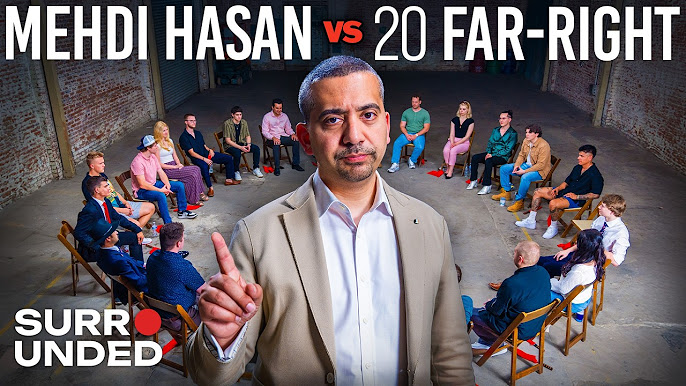
Certain debates have been plenty controversial, given the figures they’ve invited onto this show. But the one that prompted this post involved journalist Mehdi Hasan, who was tasked with debating 20 far-right conservatives.

Now, I don’t want to provide a link to this video. The last thing I want is for this channel to get any extra clicks at my expense. I’ll just say that the label “far-right conservatives” was too generously. Even calling them outright fascists would’ve been too kind. These people who “debated” Mr. Hasan are just assholes in the highest order.

Their politics have nothing to do with policy. They revolve entirely around being a dick to whoever they want, facing no consequences, and getting paid/empowered by their dickish behavior. These aren’t just people who want to live in conservative utopia. They want a world where they’re masters on a planation and everyone else is a slave who does their bidding.

But to write them off or claim they’re not representative of conservative values is missing the point. The fact remains that Jubilee sought them out. Jubilee platformed and emboldened them. Their rhetoric wasn’t just stupid, hateful, and irresponsible. In this current system of clickbait, bots, and algorithms, their assholery will be rewarded.

Sure, one of the participants lost his job for basically espousing Nazi talking points. But then, he used a go-fund-me to raise thousands of dollars to ensure he’ll be rewarded. And any system or society that effectively rewards people who champion Nazi shit is doomed to fail.

Now, as someone who makes YouTube videos who will never have the audience of Jubilee, I understand the desire to get more views, clicks, and subscribers. But at what point is it worth empowering people who champion Nazi shit? No amount of money is worth it. History has shown what happens when assholes like this are emboldened. We cannot let that history repeat itself.

Once again, I call on everyone behind the Jubilee channel to take a step back, think hard about what you’re doing, and realize this shit isn’t just irresponsible. It’s dangerous. If you want to host more debates with Skip Bayless and passionate sports fans, then go for it. That’s far less likely to involve Nazi shit. But what you did with Mehdi Hasan was far beyond any line that should never be crossed.

You have the power to stop.

You have the power to delete the video or at the very least, apologize for it.

Use that power wisely. Because the people who talk Nazi shit sure as hell won’t.

Leave a comment

Filed under politics, rants, YouTube

Wondering If (Not When) I’ll Be Able To Retire

When I was a kid, my parents worked hard. Even at a young age, I could tell. My dad would wake up extra early, often before the sun rose, to prepare for work. My mother would do the same, often leaving just as my school bus arrived. They didn’t always work late, but they worked long enough days that required me to go to daycare or an afterschool program for many years. And even when I was old enough to be home alone after school, I was expected to help out and do a few chores before they got home.

It wasn’t until after high school that I came to appreciate how hard they worked to provide for their family. So, a few years back when they finally got a chance to retire, I gladly celebrated with them. They had more than earned the opportunity to stop working, enjoy their golden years, and dedicate their time to someone other than their employer.

Since then, I can’t deny they’ve made retirement look very enticing. My father, who once woke up at the crack of dawn every morning, now regularly sleeps in past 8:00 a.m. My mother, who spent decades working in an office and navigating rush-hour traffic, now spends her mornings in a bath robe drinking tea and reading the paper.

They don’t worry about what their clients, supervisors, colleagues, or customers will throw at them next.

They don’t worry about driving through rush-hour traffic, agonizing over deadlines, or dreading their next performance review.

Retired life is just life, as they see fit. And I’m glad they have a chance to enjoy it because not everyone gets that chance. And after a spike during the COVID-19 pandemic, fewer people are retiring. Their reasons for doing so vary, but each passing year seems to bring more challenges to retirement. There are even some influential voices who scoff at the very idea of retirement altogether.

In many ways, I consider myself lucky. Unlike many of my peers, I don’t have any student loan debt. I managed to pay that off by living at home during a good chunk of my 20s and basically dedicating over half my paychecks for my first job towards paying it down. That, alone, puts me in a very small percentile of people in my age range.

But even without my student loan debt, I’m not at all certain my current retirement plans will allow me to retire the same way my parents did. And even if I did, I’m not sure how long that plan would last for me when accounting for inflation, economic trends, and the never-ending political battle over social security.

If I were to retire at 67, which is the age in which Americans my age qualify for full social security benefits, I would probably be fine for a few years. The money I’ve saved, the lifestyle I enjoy, and the monthly costs in my general area would be manageable.

However, if there’s a major economic downturn, as there often in any given decade, or a significant bump in inflation, which happens regularly on a global scale, then my current retirement plan would not be sustainable after a number of years. I would either have to get more benefits from the government, spend more of my savings, or find another way to earn money.

None of those options are more than temporary solutions, nor are they as appealing as my parents’ retired life. At the moment, I don’t know and can’t know how viable my retirement plan is in the long run. I also have to assume that I’m not going to strike it rich at any point in the future. Short of winning the lottery, becoming a best-selling author, or seeing my YouTube channel explode in popularity, I just don’t think such wealth is in the cards for me.

I still have many productive years ahead of me. And I don’t doubt for a second the world will be a very different place by the time I’m nearing retirement age. For all I know, artificial intelligence will have completely reshaped the economy in ways I cannot begin to imagine.

Advances in biotechnology might ensure people like me don’t have to worry about the ravages of old age. Something like that is sure to further complicate any plans for retirement. I’m sure there are many wealthy, well-connected people who would love nothing more than to have workforce that stays young, healthy, and able to work for decades if not centuries on end. If that somehow becomes the norm by the time I reach retirement age, then something will have gone horribly wrong with the world and retirement would be the last thing on my mind.

But for now, I’m not going to work under the assumption that advanced AI or biotechnology will create a wholly utopian world where nobody has to work, no matter their age. And even if that technology does exist in some form, I’m not going to assume I’ll be in a position to take advantage of it before the rich and well-connected.

Again, I don’t know what the next 30 years has in store for the world. I don’t even know what things will be like 5 years from now. But I honestly would like to retire at some point. I would like to enjoy my golden years as much as my parents, not having to build a good chunk of my week around work. I’m currently planning and saving as best I can to give me that chance.

Will those plans ultimately pan out as I hope? Only time will tell.

I’m certainly hoping for the best and I’m working just as hard for it. But I’m also bracing for the worst. I just hope it doesn’t take the form of me working until my dying breath.

Leave a comment

Filed under Jack Fisher's Insights, politics

The Uncomfortable (But Relevant) Truth About The OJ Simpson Trial

This is a video from my YouTube channel, Jack’s World.

In this video, I recount and discuss the famous/infamous trial of OJ Simpson. If you’re around my age, you remember how impactful this was. And to this day, we’re still grappling with the events surrounding this trial.

But now that OJ Simpson himself has passed away, the time is right to confront the many comfortable truths this trial revealed. Enjoy!

Leave a comment

Filed under Current Events, history, Jack's World, politics, real stories, YouTube

Why You Should Be Skeptical (And Suspicious) Of Those Who Talk About Falling Birthrates

In general, I try not to discuss politics outside of appropriate spaces. And those spaces are usually small, confined, and located within areas where nobody close enough to punch one another. That’s not just a byproduct of having followed the news too closely for the past 10 years. I’ve just learned over the years that talking politics with random people is a quick way to make enemies, get angry, and generally lose what little faith in humanity you might have had.

There’s a time and a place to have political discussions. That time is almost never and that place is almost nowhere, unless you actively work in institutions that deal in such policies. You just have to be aware that certain discussions about certain issues are bound to get heated. And it’s next to impossible to change anyone’s mind about a particular position through these discussions.

However, in my personal experience, which I understand is limited, I’ve noticed there are a few hot-button topics that often double as red flags for certain people. It’s not that the topics themselves aren’t relevant. They usually are. But when certain people single them out as a major area of concern, it warrants a certain level of caution. Because many of those people may not be arguing in good faith.

There are many issues and topics like that. But one in particular, which has become relevant in multiple countries, has to do with falling birthrates. Now, in terms of the actual numbers, there is cause for concern. If you actually look up population trends in numerous countries, you’ll confirm that this is a global trend. And falling birthrates certainly do incur a host of social, political, and economic problems for any given society.

That being said, there’s a right way to approach this issue, as well a wrong/misguided/deeply disturbing way. The right way is more academic than political. You study the factors surrounding the trend. Analyze which of those factors are influenced by certain policies. Then, you take the appropriate prescriptive measures.

But that’s not the approach certain people make. I don’t want to name names, but most of these people are closely aligned with the conservative, right-wing, or reactionary part of the political spectrum. They also tend to be staunch traditionalists who argue society has deviated too much from the morals, values, and social norms we used to have. And addressing the problem of falling birthrates, along with a host of other problems, requires that society reverse that trend.

Now, the people making these points may very well be sincere. They may genuinely believe that people would be happier and more prosperous if they lived like we did in whatever nostalgic past era they idolize, whenever and wherever it might be.

However, in terms of the actual substance of this argument, it’s total bullshit.

And in terms of larger implications, it might even be a mask for a more nefarious agenda.

To understand why, it’s worth asking two important questions with respect to birthrates and those who obsess over it.

Question #1: Who benefits most directly from increasing birthrates?

Question #2: What other agenda does addressing this issue serve?

In the case of falling birthrates and ways to address it, there are certain policy prescriptions that tend to get emphasized over others. Those who like to frame declining birthrates as a serious issue tend not to talk much about the rising costs of childcare, housing, and food. They also tend not to talk much about the fact that wages, on a global scale, have remained relatively stagnant.

Instead, the reactionary crowd will highlight social issues like LGBTQ rights, declining marriage rates, feminism, and a lack of religious affiliation. Even if they touch on some of the economic issues, they won’t label them as a high priority. They’ll just frame women, teenagers, and sexual minorities as deviants or aberrations who are not contributing to society in a meaningful way.

They may claim they’re just concerned about the future of society. But in general, their concerns can often be boiled down to furthering draconian policies on women, workers, and young people. And the people and organizations who benefit are usually who you might expect.

Rich, well-connected business owners need a growing population to buy their products and/or get locked into their network of services.

Powerful, well-connected political organizations need a growing population to sustain the social and economic status quo that put them into power.

Religious organizations need a steady increase in population to ensure more adherents, which in turn means more influence and tax-free money for them.

The ones who don’t benefit are usually women who can’t access or afford family planning. It also negatively impacts LGBTQ+ communities because they’re denigrated for not contributing to the population/consumer/worker base. It also negatively effects workers who get stuck in cycles of poverty because they have too many kids that they cannot afford.

Again, this is not to say that falling birthrates aren’t an issue. There are certainly steps society can take to address this issue. And those steps will definitely vary from country to country. But for certain people of certain political leanings, it’s a cover for regressive, reactionary policies that benefit nobody except those who are already rich and powerful.

Be aware of that because, in most cases, serving the interests of those at the top of an imperfect system only hinders any efforts to address those imperfections.

Leave a comment

Filed under abortion, political correctness, politics, sex in society

A Message To “Christians” Complaining About (Actual) Christian Tenants

In general, I try not get involved in religious discussions. Even though I talk about religion every now and then, I always make it a point to distinguish the individual from the ideology. There many good and decent people who identify as Christians, Muslims, Hindus, and plenty of other faiths. I have religious people in my own family. I love and respect them. And I make it a point to avoid talking about religion or any politics related to it.

That being said, there are some instances where I just can’t be that understanding. And in recent years, I’ve noticed the number of those instances increasing at an alarming rate. In the coming years, I may look back on 2025 as a major tipping point for me. Because that’s when the disconnect between religion and its adherents just became too vast to overlook.

The big moment came just the day after the new Presidential administration was sworn in. That’s when Bishop Mariann Budde delivered an impassioned sermon at Washington’s National Cathedral in which she urged the newly elected President to exercise mercy, compassion, and empathy for everyone. This is not a wholly unreasonable request. It’s not even overly religious, in general. It’s just basic human decency. Isn’t that exactly what you’d want for anyone who occupies a position of power or influence?

Well, apparently that was too radical, too offensive, and too un-American for many “Christians.”

And yes, I put that word in quotes for a reason. Because the people who took offense to this sermon have as much right to call themselves a Christian as I do to call myself a Wookie. In this instance, I cannot be understanding or accommodating. Because this bishop wasn’t being disrespectful or condesending. She was literally just preaching some of the most basic teachings of Jesus Christ.

You don’t need a PHD in theology to understand those teachings. Pretty much every translation of every bible says the same thing. Jesus taught his adherents to love and care for one another. He emphasized having mercy for others, even when they wrong you. That is not a radical interpretation. It’s one of the few values that Jesus and most denominations agree on.

And yet, Bishop Budde faced a severe backlash, not just from the President, but from many people who dare to identify as “Christian.” I’ve even seen a few make these long, semi-coherent rants trying to quote mine the bible or other “Christian” principles to justify their outrage. But the mere fact that this was their recourse, arguing with a Bishop who just asked people to be merciful, speaks to a disgusting hypocrisy.

Now, there’s a lot I could say about that kind of hypocrisy. I used to foolishly believe that hypocrisy was one of the few traits that most people cannot tolerate in the long run. Sadly, I was wrong. Between shifts in politics, trends, and simply dealing with these people more directly, I no longer believe that. This kind of hypocrisy isn’t a bug. It’s a feature.

What else could justify people who call themselves “Christian,” yet are deeply offended by the literal teachings of Jesus or any sermon that dares to demand adherents to exercise empathy? What happened with Bishop Budde isn’t even a one-off. There are pastors who have been forced out of their positions because parishioners complained that their teachings were too progressive, liberal, or “woke.”

Just take a moment to wrap your head around that kind of mentality. Someone who calls themselves a Christian, goes to church, listens to a sermon, and doesn’t like what a bishop or pastor says. But their first instinct isn’t to re-evaluate what it means to be a Christian. It’s to whine, complain, and protest like a kid who just found out they actually have to be good in order to get presents on Christmas.

Instead of introspection, their first instinct is to get angry and whiny. That’s childish.

Their next instinct is to go out of their way to find some justification for why the Bishop or pastor is wrong and they’re right. That’s just self-centered and self-serving.

If they’re too lazy to do that (and most of them are), their final recourse is to call whoever delivered that message some agent of evil or part of some sinister agenda. That’s just plain fucking stupid, as well as overtly narcissistic.

It basically reveals that these “Christians” don’t give a damn about teachings, principles, or anything of the sort. They just want their pastors and bishops to tell them what they already believe. They want to be vindicated in everything they feel, even if it’s wrong, dumb, cruel, or sadistic. Most importantly, they want a version of their faith that justifies them doing whatever it is they’re currently doing or whatever it is they seek to do.

Even if they seek to do the exact opposite of everything Jesus taught, they want to be justified. They want to be able to commit every sin that Jesus preached against, but still be able to call themselves “Christian” without any cognative dissonence.

I don’t doubt for a second that, in their own twisted minds, they think they’re the “true Christians.” They think that call for empathy and compassion was somehow wrong, flawed, or inappropriate. To those people, I cannot be kind or subtle with my sentiments.

If you believe that what Bishop Budde said about mercy and compassion was wrong or even just inappropriate, then you are not a Christian. You never have been. You never were. And unless you actually come to grips with what Jesus actually taught, according to the bible, you never will be.

Leave a comment

Filed under Current Events, politics, religion

How To Tell If You’re In A Cult And Why it Matters

This is a video from my YouTube channel, Jack’s World.

This video is about cults and how to tell if you might be in one. It was a difficult video to make in that I tried to be sensitive to the difference between a cult and a religion. I also tried to be fair in discussing those who get roped into cults. These people are often victimized by these groups and it is important to keep that in mind when discussing this topic.

I also highlight the BITE model when determining the practices of cults. If you’d like to know more about this model, please see the link below.

Leave a comment

Filed under history, Jack's World, philosophy, politics, psychology, religion, YouTube

An Important Hypothetical Question To Consider (Before Any Debate)

I’ve been using the internet for a good chunk of my life. I’m old enough to remember the days of slow dial-up, AOL chatrooms, and messy Geocities websites. And while I don’t miss those days, there are certain elements of my internet experience that have remained fairly constant.

One of them has to do with debates. And if you’ve ever talked politics, comics, anime, or movies with anyone on any medium, you know how heated that can get.

Believe me, I know this as well as anyone. I still haven’t forgotten how heated some debates got on the old comic book message boards I used to frequent. Some want to say social media ruined discourse by making it too easy to engage in such debates. But I respectfully disagree.

This sort of tension between people always existed. Human beings have always had their share of strongly held opinions that they were debate, discuss, and defend far past the point of reason. It doesn’t matter how smart, educated, or well-informed they are. The passion with which they hold their views has always been strong. The internet and social media simply made it more prominent.

I’m bringing this up for two reasons. For one, I see a lot of debates and arguments online, especially in comments sections and on social media. I freely admit that I engage in some of that discourse. It’s rarely productive. And I’ve yet to meet anyone who has been convinced to change their position on something based on a point someone made in a Facebook comment.

Second, I live in the United States of America and this year happens to be an election year. Debates about politics, issues, and policies are bound to get more heated. And that’ll only escalate the closer we get to Election Day on November 5, 2024. I fully expect to see plenty of discourse that will make me lose my faith in democracy, the future, and humanity in general.

For those reasons, and plenty others I don’t care to articulate, I want to present a simple hypothetical to anyone seeking to debate others in any capacity on any issue, be it political or otherwise. It’s not a thought experiment. It’s just a simple perspective that I hope provides greater context into the nature of discourse. It goes like this.

You and one other person are standing in a room. You both hold opposite positions on a particular issue. You spend five minutes making your case to the other person. Then, the other person spends five minutes making theirs. You are not at all swayed by their argument and they are not at all swayed by yours.

But before you start any further discussion, a third person enters the room and pulls out a special phone containing critical, indisputable information about the issue.

In one scenario, the phone contains information that vindicates your position.

In another scenario, the phone contains information that completely disproves your position.

In which scenario do you actively fight for possession of the phone?

What I just described is situation that I hope adds context to the what, why, and how of debating others. Because if you approach this hypothetical in good faith, it puts you in a difficult position. Either you admit you seek vindication and are willing to fight for it or you actively avoid the implication that your position is wrong.

Call it confirmation bias.

Call it cognitive dissonance.

Call it an impossible scenario that will never play out because there are too many issues that cannot be completely verified beyond any and all doubts.

If you’re honest with yourself, you know how you’ll react in that scenario. And if you’re honest about how most people operate in heated discourse, you’ll know how your opponent would react in this scenario.

However you feel about what I just presented, I only ask that you keep it in mind as you engage in further discourse moving forward.

Leave a comment

Filed under philosophy, political correctness, politics, Thought Experiment