
It’s easy to be cynical these days.
It’s easy to be downright fatalistic, at times.
I know I’ve been both, especially during the last election. In hindsight, I regret being so dire. That was not helpful to anyone and I sincerely apologize to those who felt my rhetoric was too dark.
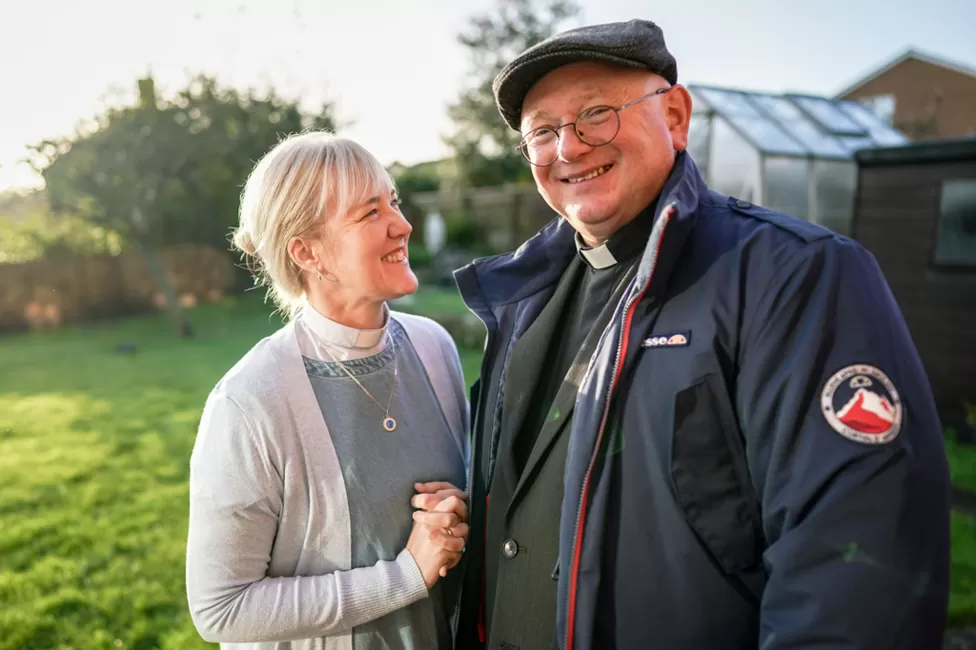
In an effort to balance all the distressing, dire news that seems omnipresent, I’d like to share a rare, but beautiful story that I came across. It’s a real, actual love story involving two real living people. It’s not overly sordid. It’s just a genuinely sweet love story involving a monk and a nun who fell in love.
I admit that sounds like a plot from a romance movie or a cheesy novel that someone like me would probably read, but it’s actually something that happened. Robert was a Carmelite monk in Oxford and Lisa Tinkler was a Carmelite nun. They had chosen to dedicate their lives to this strict, religious order. They each had religious experiences in their youth and, by most accounts, took their vows seriously.
Then, they met. Sparks flew. The chemistry was subtle, but real. And ultimately, love did what it did and they eventually got married.
But don’t think for a second this cost them their faith. If anything, their faith was a big part of it. Even as someone who tends to be very critical of organized religion, I find that genuinely beautiful. They live a life that seems antithetical to finding true love, but they still found it. Even if you’re not a romantic, you can’t deny there’s something genuinely sweet in that.
There’s a lot more I could say about a story like this, but I’ll just this article from the BBC tell their story. If you’re still cynical after reading it, then you’re just being difficult.
BBC: The Nun and the Monk Who Fell in Love and Married
Twenty-four years after becoming a nun, it was a brief touch of the sleeve of a monk in the parlour of the convent in Preston, Lancashire, that changed everything for Sister Mary Elizabeth.
The prioress of the order had taken her to meet the friar Robert, who was visiting from a priory in Oxford, to see if he wanted anything to eat. But Sister Mary Elizabeth’s superior was called away to take a phone call, so the two were left alone.
“It was our first time in a room together. We sat at a table as he ate, and the prioress didn’t come back so I had to let him out.”
Sister Mary Elizabeth had lived a devout, austere and mostly silent life as a nun, spending most of her days in her “cell”. As she let Robert out of the door, she brushed his sleeve and says she felt something of a jolt.
Twenty-four years after becoming a nun, it was a brief touch of the sleeve of a monk in the parlour of the convent in Preston, Lancashire, that changed everything for Sister Mary Elizabeth.
The prioress of the order had taken her to meet the friar Robert, who was visiting from a priory in Oxford, to see if he wanted anything to eat. But Sister Mary Elizabeth’s superior was called away to take a phone call, so the two were left alone.
“It was our first time in a room together. We sat at a table as he ate, and the prioress didn’t come back so I had to let him out.”
Sister Mary Elizabeth had lived a devout, austere and mostly silent life as a nun, spending most of her days in her “cell”. As she let Robert out of the door, she brushed his sleeve and says she felt something of a jolt.
“I was a little bit shocked. I wore a veil so he never even saw my hair colour. He knew nothing about me really, nothing about my upbringing. He didn’t even know my worldly name,” she recalls.
Before entering the Carmelite order – an ancient order of the Roman Catholic church – at the age of 19, Sister Mary Elizabeth had been Lisa Tinkler, from Middlesbrough.
Though her parents had not been religious, an aunt’s pilgrimage to Lourdes awakened something in six-year-old Lisa, such that she asked her father to build an altar in her bedroom.
“I had a little statue of Our Lady on it and a little Lourdes water bottle. Actually, I thought it was the bottle that was holy and not the water – so I was just filling it from the tap and drinking the water,” she says.
Lisa would make her own way to one of the Roman Catholic churches in her home town and sit alone in the second pew – where she says she developed an overwhelming love for the Virgin Mary, mother of Jesus, and ultimately a feeling she had a vocation.
A weekend retreat at a monastery while she was still a teenager convinced her of her calling. The monastery was run by Carmelite nuns from an order that had origins in the 12th Century and where the life was particularly spartan, secluded and strict – but she decided that was precisely the life she wanted to lead.
Though Lisa had wanted to join immediately, her mother – who was troubled by her daughter’s decision – secretly wrote to the monastery to delay her departure for a few months, so Lisa could spend one more Christmas at home. She joined in the new year.
“From then I lived like a hermit. We had two recreation times a day, about half an hour, when we could speak, otherwise you were on your own in your cell. You never worked with anybody, always on your own,” she says.
Over the years, Sister Mary Elizabeth felt her vocabulary diminish as she had little more to talk about with the other nuns – who were all decades older than her – except the weather and the nature in the garden. She saw her mother four times a year through a grille.
“When I had my 21st birthday, my cake and my cards were all passed through the drawer. And when my nephew was born he was passed through a kind of turntable,” she chuckles, looking back on it all quite fondly.
She describes the way she felt her “interior world” open up as the outside world closed to her. There was a sense of feeling content and fulfilled. But, that day in the convent parlour, it all changed with the touch of a sleeve and a message asking if she would walk away from monastic life and get married.
Sister Mary Elizabeth didn’t give Robert an answer to his question and did not know what to do.
He may have known nothing about her, but she knew a little about him.
On his visits from Oxford to the Carmelite retreat centre in Preston he had occasionally come to say mass at the nearby monastery and Lisa had watched his sermons from behind a grille.
Through hearing his anecdotes as he preached, she got snippets of a life growing up in Silesia in Poland near the German border, and about a love of mountains. Though she says at the time it did not feel like it had a profound impact on her.
Now, suddenly, that had changed.
“I didn’t know what it feels like to be in love and I thought the sisters could see it in my face. So I became quite nervous. I could feel the change in me and that scared me,” she says.
Sister Mary Elizabeth eventually plucked up the courage to say to her prioress that she thought she had feelings for Robert, but the response she got was disbelief.
“She couldn’t understand how it had happened because we were in there 24/7 under her watch all the time. The prioress asked how I could have fallen in love with so little contact,” she says.
Sister Mary Elizabeth had imagined the reaction of her family, or of her bishop, if she left. She also wrestled over whether her relationship with God would change.
But the interaction with her superior caused her to do something uncharacteristically impetuous.
“The prioress was little bit snappy with me, so I put my pants and a toothbrush in a bag and I walked out, and I never went back as Sister Mary Elizabeth,” Lisa tells me now.
Robert had messaged her to say he was planning to visit Preston again that evening. This time, it was to meet a Carmelite friend for advice at a nearby pub, the first person from the order he had trusted to tell of his and Lisa’s predicament.
Lisa guessed they would be meeting at the Black Bull about a mile up the road, so that was where she decided to head.
But instead of it being a joyful moment, Lisa was thrown into deep turmoil that November night in 2015.
“The rain was lashing down as I was walking along the Garstang road. The traffic was coming towards me with bright headlights and I just thought ‘I could just finish this,'” she says, referring to a momentary suicidal thought.
“I was really struggling, I thought I should just stop this from happening and Robert could get on with his life. But I also wondered if he really meant what he said about getting married.”
But Lisa kept walking until she found herself on a Friday night drenched, without a coat, in her habit outside the Black Bull. She only plucked up the courage to go inside when she saw the monk inside through an open door.
“When I saw her, my heart stopped,” says Robert.
“But actually I was paralysed by fear not by joy, because I knew in that moment that I had to be entirely for Lisa, but I also knew we were not practically ready for that,” he says.
Robert had been a Carmelite friar for 13 years by this point. He was a thinker, academic and theologian who came to monastic life in a search for meaning during what he describes as a crisis of faith and identity.
Looking back now, he feels his roots made that confusion almost inevitable – growing up in a region that recently transitioned from Germany to Poland, with a Lutheran father and Catholic mother.
But it was a dark period after a failed relationship that led him to continue his search for fulfilment in England where, in spite of the Lutheran Protestant theology he had settled on, it was in a Carmelite Roman Catholic monastery where he found his solace.
“I didn’t know much about Carmelites before and had not considered being a monk. In fact, I was always very suspicious of this kind of expression of faith,” Robert says.
But he says the order taught him how to embrace darkness, difficulties and crisis to the point where he felt settled. However, the encounter with Lisa – who he barely knew then as Sister Mary Elizabeth – turned his life upside down.
“That touch of Lisa’s on my sleeve started a change, but while I felt something gradually growing in my heart, I don’t think I ever reached a point where I felt I was crazily falling in love, because in becoming a monk or a nun they teach you how to deal with emotions like love,” says Robert.
He explains that his message to Lisa asking if they could marry was almost an intellectual tussle with himself.
“When she appeared at the pub the little demon in me was terrified. But my fear was not religious or spiritual, it was purely about how I would start a new life at the age of 53,” he says.
The transition was difficult, particularly at the beginning. Lisa remembers a moment just before Christmas, soon after they had both left their monastic lives.
“I looked at Robert and he was distressed and crying. At that moment we both hit rock bottom and it felt like we should just take something like Romeo and Juliet and just end it,” says Lisa.
“It was so hard because he both felt so alone and so isolated and didn’t know the way forward. But we just held hands and we got through it,” she says.
They describe the moment at the job centre when they both burst into tears when asked about their transferrable skills – and another time when they were driving from Preston to Yorkshire.
“I had ordered a book in Polish about nuns who had left their orders for various reasons. I read and translated it for Lisa in the car, but she had to pull over on the M62. We both needed to cry because their stories were so emotional and we could relate to them,” says Robert.
What brought them peace was the thing that guided them to their monasticism in the first place – connecting with their personal faith.
“All through your religious life, you’re told your heart is supposed to be undivided and given to God. Suddenly I felt like my heart was expanding to hold Robert, but I realised it also held everything else that I had. And I didn’t feel any different about God, and that was reassuring to me,” says Lisa.
Lisa first found work at a funeral home and later as a hospital chaplain. Though he was upset by a letter from Rome telling him he was no longer a member of the Carmelite order, Robert was soon accepted into the Church of England.
They both did get married, and now share a home in the village of Hutton Rudby in North Yorkshire – where Robert has been made a vicar of the local church. They are still on a journey to adjust to life outside the monastery.
Lisa in particular, who had been isolated for 24 years and not had the academic life Robert had before, talks of feeling like an observer in the outside world. Only now is she working out what hair styles and clothes work best for her after a life in a habit.
They both still yearn for elements of monastic life, Lisa even says that if it was not for Robert, she would return to being a Carmelite nun tomorrow.
“We became so used to the silence and the solitude, that’s hard to find in the business of the world, you get pulled in so many different directions, so it’s a constant struggle for me and Robert to remain centred and grounded,” says Lisa.
But they have found a solution that works.
“I often think I live in a monastery here with Robert, like two Carmelites where everything we do is given to God. We anchor ourselves in prayer but love can make a sacrament of everything you do and I realise nothing has really changed for me,” she says.
Lisa says they both agree there are three of them in the marriage.
“Christ is at the centre and comes before everything. If we were to take him out of the equation, I think it wouldn’t have lasted really.”



 Jack Fisher's Official Publishing Blog