Category Archives: technology

The First (But Not Last) AI Actress Is A Thing

Have you heard of Tilly Norwood? She’s a beautiful young actress who is just starting to make her presence felt in Hollywood. She hasn’t been in much, but she’s already negotiating with talent agents to get bigger roles.

There’s just one major issue. Tilly Norwood isn’t a real person. She’s an entirely AI-generated persona.

Naturally, that doesn’t sit well with real life actors and unions. There is already a concerted effort to prevent Tilly Norwood from being cast in anything beyond your typical AI slop content. I completely understand this sentiment. I don’t blame anyone who works in Hollywood for being concerned about this. However, having covered the rise in AI for years, I’m comfortable making this prediction.

Tilly Norwood will eventually be cast in major movies and TV shows.

Other AI actors like her will be cast, as well.

Traditional actors and actresses will hate it. A sizable chunk of the audience will hate it as well. But this is going to happen. It was always going to happen the moment generative AI reached a certain level of refinement. A big reason for that involves money, as tends to be the case in Hollywood and most other industries. But there’s another reason that’s worth highlighting.

Dollar for dollar, movies and TV shows are getting more expensive to produce. This isn’t just due to inflation, unions, and the “personalities” that tend to comes with Hollywood. The logistics involved with making media has become bloated and inefficient. We’re no longer in an era in which media can only go through certain channels, be it TV and movie theaters. Thanks to streaming media, as well as online content like YouTube and Tiktok, the competition for eyeballs has never been greater.

Unless you’re a big budget blockbuster with a massive distribution network, such as Disney or Warner Bros., it’s harder to make content that turns a profit. The scale, resources, and personnel required to produce a movie or show is such that it’s limiting. Add to that the general enshitification of streaming media and the current model for producing content just isn’t sustainable.

Generative AI, as much as it is derided, offers a significant cost advantage. On top of that, an AI actor or actress is less likely to get accused of harassment, arrested for public intoxication, or go on some anti-sematic rant during a routine traffic stop. And for certain Hollywood agents, you can’t put a price on that kind of assurance.

But the question remains. Will audiences accept AI actors? Will the content they produce actually be worth watching?

A lot of people will probably refuse to watch anything with Tilly Norwood or anything like her out of principle. But what happens when AI gets to a point where it’s hard to tell if a person is AI generated? There are already AI tools like SORA and Veo3 that make extremely realistic videos of people who look and sound real. This is one element of AI that is not in the distant future. It’s here and it’s evolving fast.

It’s not yet clear what kind of career Tilly Norwood will have. She may never show up in anything mainstream. But like it or not, she marks the first step in a new trend with AI. We don’t know where it will lead. Hollywood is already undergoing significant change. Technology like this is only going to accelerate that change in ways we can’t imagine.

Leave a comment

Filed under Artificial Intelligence, movies, technology, television

My Excitement (And Hopes) For Buying My First New Car

I’ve never been much of a “car guy.” I’m not someone who gives much thought or passion to whatever I’m driving. To me, my car is just my car. It’s my way of getting around. Given where I live, it’s painfully necessary. Public transportation is present, but woefully inadequate.

Simply put, I need to have a car. And I’ve never cared much for style or features. I only care that it runs.

As a result, I’ve only ever owned two cars in my adult life. Both were bought used and with a fair amount of miles on them. My first car was a used Buick. It wasn’t pretty and it had few features, aside from air conditioning. But the previous owner hadn’t driven it much and it was fairly reliable. So, I drove that for years.

My second car was actually my parents’ old car. It was a Honda sedan and had far better features than my Buick, such as seat warmers, a GPS navigation system, and an AC that actually worked on hot days. After putting well over 60,000 miles on it, they sought to sell it and trade up for a new one. When I expressed interest, they gladly accommodated me. They even gave me a nice discount.

I’ve been driving that car ever since. And it has definitely shown its age. It’s so old that it still has a 6-CD changer. It’s also had increasingly expensive repair bills in recent years. It’s at a point where keeping it for much longer is going to be costlier than buying a new car.

And that’s why I’m genuinely excited about my next car. Because for once, I’m not just looking for something that runs. I’m looking to purchase a new car off the lot for the first time in my life.

That may not sound like such a novel concept. But since I’m not being a car guy, it’s going to be a new experience for me. I’ve been saving up money for quite some time now. I may not be able to afford anything luxurious, but I should be able to buy something that’s decent, up-to-date, and has features appropriate for this decade.

In addition, I hope that buying a new car will help change another perspective I’ve developed over the years. In general, I do not like long drives. If any trip means driving for more than two hours at most, I look for alternatives. It’s not that I can’t endure those drives. I just prefer not to.

I don’t know if it’s because of the cars I drive or if it’s just how I’m wired. But if I’m driving for more than a couple hours, my back starts hurting and so does my right shoulder. It becomes so painful and strenuous that I have to pull over at times, just to stretch. I also get very anxious when stuck in traffic, more so than most people.

Perhaps a new car with better seats and better features will change that. Maybe a car that has adaptive cruise control will make longer drives less strenuous and more enjoyable. Maybe I would be more inclined to go on more trips and visit more loved ones. In my area, I don’t live too far from major train stations. But the schedule is limited and the service isn’t always reliable. If a new car can change that, then maybe that’ll change how I approach other things in my life.

That’s my primary hope for this car. A part of me also hopes this is the last car I’ll ever buy. Because by the time I’m ready to let it go, self-driving cars will have advanced enough to make that unnecessary. But those hopes are remote. Unless I move somewhere with vastly better public transportation, I’ll likely need a car for many years to come.

I don’t need it to be fancy, futuristic, or big. I just need it to be reliable and comfortable. That way, I can see driving as less of a strain and more of a simple chore. If that opens up other opportunities along the way, then that’s just a nice bonus.

Leave a comment

Filed under technology

The James Webb Telescope MIGHT Have Discovered Extraterrestrial Life (And What It Could Mean For Humanity)

Even if you’re not an avid fan or regular consumer of science fiction, the prospect of discovering extraterrestrial life is intriguing. I believe that, on some level, we want to discover beyond any reasonable doubt that we’re not alone in the universe. Given the sheer size and breadth of the universe, the idea that we’re the only intelligent species just doesn’t sit well.

And it’s largely because of that same size and breadth that most scientists agree. The odds are very likely that there’s life in the universe beyond Earth. It’s not a total certainty. It’s largely derived from the law of averages. Since we started discovering extrasolar planets, the opportunities for life to emerge throughout the universe are vast. It’s just a matter of finding one other instance where the right circumstances were in place.

That effort has been frustrating and prone to plenty of cynicism. But thanks to better technology and tools, namely the James Webb Telescope, science finally has an effective means of studying extrasolar planets in greater detail. Given the vast distances, there’s an inherent challenge to gathering adequate data. But with each advancement and each discovery, we’re getting closer.

And in April 2025, the James Webb telescope discovered what might be the best evidence to date that life exists outside our planet. Granted, this evidence isn’t as cinematic as you’d get in a movie like “Contact.” But from a purely scientific standpoint, this is pretty damn compelling.

The planet in question is an explanet called K2-18b. It’s located approximately 124 light years from Earth, which is not that far in stellar terms. It’s also considerably bigger than Earth. In terms of mass, it’s over eight times larger and it orbits a red dwarf star, which are comparably smaller and cooler than our sun.

But it has been confirmed to be in the habitable zone of that star. It’s also suspected to be a hycean planet, which is basically an planet covered by oceans under a hydrogen atmosphere. Compared to any other planet in our solar system, this is truly an alien world.

And yet, the James Webb Telescope detected what appear to be chemical signatures for dimethyl sulphide and dimethyl disulphide, two chemicals only known to be produced by life. Now, that doesn’t mean that K2-18b is home to some advanced alien civilization. These chemicals are primarily produced by microbes. And at best, K2-18b could simply be an ocean world populated primarily by microbes.

Even if that ends up being the case, it’s still a remarkable discover. It’s still alien life that emerged entirely on another world. It would be definitive proof that life is not exclusive to Earth. And in terms of biological complexity, we are not alone.

Would this realization really shake humanity to its core?

Given the current state of the world, I think that’s expecting too much.

There’s no question that confirming that there’s life on another world would be an incredible discovery. It would definitely have some impact on how we see ourselves as a species. However, I think that impact would be very limited. Human beings barely understand the microbes that live in their gut or belly button. They probably wouldn’t give much thought to microbes on another planet.

It also wouldn’t confirm that there’s other intelligent life in the universe. It could very well be possible that microbial life is quite common in the universe. But intelligent life that’s on par or greater with humans is exceedingly rare or non-existant.

Personally, I don’t think that’s the case. I do believe there is intelligent extraterrestrial life in the universe. We just don’t have the tools, effort, or know-how to find it. Again, the universe is very big. We’ve barely searched our own galactic neighborhood, let alone the universe.

But discovering microbial life on another world might be a necessary step in that process. Simply confirming that life on other words is possible drastically increases the likelihood that intelligent life exists, as well. After all, Earth was once populated only by microbes. It took billions of years of evolution for humanity to evolve. And the universe has been around a lot longer than our solar system.

At the moment, this discovery hasn’t been confirmed. It may very well end up being wrong. But to date, this is the closest we’ve ever come to confirming life on other worlds. And even as our world feel like a chaotic mess, I think it provides a good and necessary perspective.

Leave a comment

Filed under Aliens, Current Events, technology

Why People (Wrongly) Claim AI Art Is “Soulless”

This is a video from my YouTube channel, Jack’s World.

There have been many concerns and criticisms regarding artificial intelligence. One area that has been impacted more than most involves art.

Generative AI has caused serious disruptions to the world of art. And in 2025, this became a much larger controversy with “Ghiblification” trend that began with Open AI. This has led to more vocal criticisms about AI art being “soulless” in nature.

However, that criticism is worth scrutinizing. And in this video, I attempt to offer what I feel is a more balanced perspective on this issue. Enjoy!

Leave a comment

Filed under AI Art, Artificial Intelligence, Jack's World, technology, YouTube

A Brief Message To Owners Of A Tesla

First off, I get it.

I understand why you bought your Tesla. For a time, it was one of the coolest cars you could own. It was the first electric car that succeeded. It had so many forces working against it from the beginning. But it found a way to seize a sizeable chunk of the car market.

Without the Telsa, America’s current infrastructure for electric vehicles wouldn’t be where it’s at. It used to be exceedingly rare to see charging stations. Before 2020, I only ever saw them at truck stops and rest stops along major highways. Now, I see them pretty much everywhere, from shopping centers to malls to residential buildings.

That is a good thing, overall. We, as a society, should move away from gas powered vehicles. It’s not just better for the environment. These cars are simpler and easier to maintain, having fewer moving parts and points of failure. And with battery technology improving by leaps and bounds every year, electric vehicles are poised to become better than gas-powered cars in every measurable way.

All that being said, it’s worth remembering that owning a Tesla also means supporting a man like Elon Musk. As someone who used to admire the man, I don’t blame you for sharing that sentiment. He cultivated a brand on top of a cult of personality for years. But then, after COVID-19, he underwent a transformation that either changed him or simply revealed who he always was. And who he is now is not someone worth supporting.

He is not the real life version of Tony Stark.

He is not the man who will take us to the stars.

He’s a lying, thin-skinned, hypocritical, greedy narcassist who treats his workers like shit, breaks promises, and is so lacking in self-awareness that it’s dangerous.

The fact that this man now has access and power capable of undermining nations, wars, and peoples’ livelihoods should be cause for concern. To aid him is to enable a man who is so insecure, shallow, and dense that he won’t think twice about parroting Nazi talking points and racist conspiracy theories. That means he’s either so stupid that he doesn’t know the harm he’s doing or he’s always been a bigoted piece of shit and he’s just not hiding it anymore.

Whatever the case, owning and supporting Tesla will indirectly support him. That doesn’t mean you should try to sell your Tesla right now. If you bought it before you knew the kind of man that Musk was, then I don’t blame you. That’s not on you and you don’t deserve scorn for that.

However, if you bought your Tesla knowing this about him and actually want to support him, then I do blame you. You’re not just supporting an egotistical sociopath who would gladly burn the planet to a crisp if it meant saving his entitled ass. You’re actively helping make the world a worse place for everyone not rich, well-connected, and incapable of basic empathy.

What you choose to do with your Tesla, knowing who it’s supporting, is entirely up to you. I’ll continue supporting electric cars. I’m also actively rooting for other automakers to usurp Tesla’s dominance and tank the stock price of the company to which so much of Musk’s wealth is tied.

I’m also hoping his reactionary, Nazi-like antics catch up with him at some point. He might never go broke, but we can collectively make sure his name is reviled and scorned for generations to come. That might be the only way people like him ever face any consequences for what he does.

Lastly, if you actually bought a Tesla Truck, then you have no excuses. You’re either an idiot who got conned by a wannabe tech bro or you’re just a douche-bag who wants to let the world know it.

Leave a comment

Filed under futurism, technology

Happy (Terminator) Judgement Day!

Today is August 29, 2024.

Officially, it’s just an ordinary day. It has no historical or legal significance of any kind.

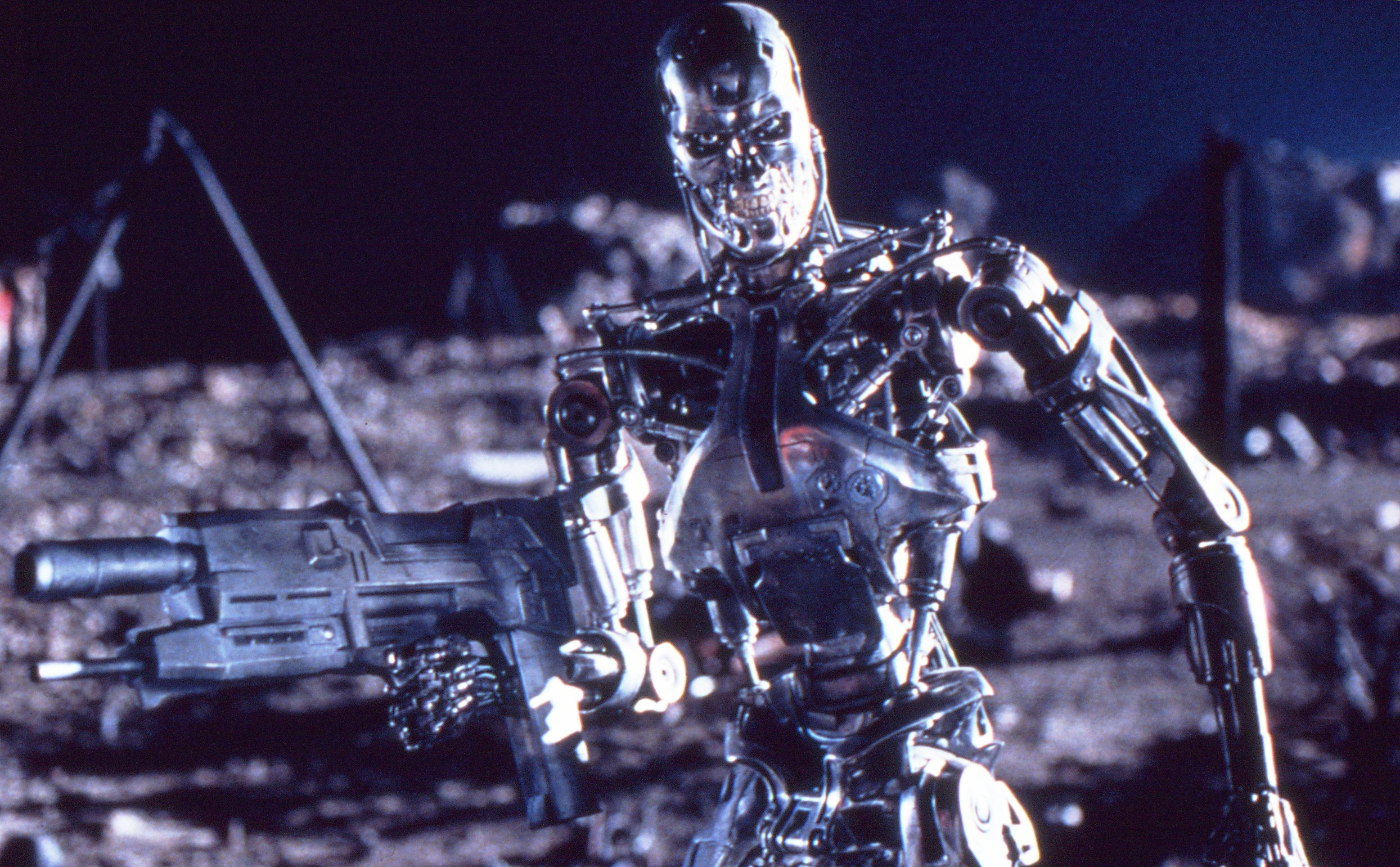
But if you happen to be a serious movie buff, or a big fan of the Terminator franchise, it is the official canon date of Judgement Day. According to the events documented in “Terminator 2, Judgement Day,” Skynet became self-aware at 2:14 a.m., Eastern Standard Time, on August 29, 1997. Shortly afterwards, it launched a full-scale war on the whole of humanity.

While it is true that this date has fluctuated over the years due to numerous time travel anomalies and sub-par sequels, the August 29, 1997, date tends to be the most well-known and accepted. And in recent years, I think that date has become even more noteworthy and not just because it celebrates the greatest action movie of all time.

In recent years, artificial intelligence has emerged as something far greater than a standard movie trope. It is now a rapidly growing field, as well a multi-billion-dollar industry. I’ve discussed the possibilities in the past and tried to put more recent advancements like ChatGPT into a proper context. But even I have been astonished at how quickly artificial intelligence has gone from an intriguing possibility to something that’s very real.

At this very moment, anyone with an internet connection can utilize what is essentially a limited AI for various tasks in a manner that would’ve seemed like a futuristic dream less than 10 years ago. It’s very likely that in the next 10 years, AI will advance in plenty of other ways, some which we can’t possibly predict.

But these AI systems are nothing like Skynet. They’re very narrow in terms of their scope and capabilities. They’re not going to become self-aware or gain human-level intelligence. But make no mistake. At some point, we will have an AI that is as smart as an average human, if not smarter. This is not a technological feat that requires a huge breakthrough that defies or redefines physics. It’s largely an engineering and logistical challenge.

Whether it happens next year or several decades from now, it will happen. We will eventually create an AI that’s as capable and self-aware as Skynet. At that point, what happens next has been a huge point of contention and speculation.

Unless someone is stupid enough to give this future AI access to a nuclear weapons system, I don’t see it launching a full-scale nuclear war like Skynet did. Even if it wanted to, I doubt it would be given that level of access. That doesn’t mean it’ll be friendly. The first self-aware AI may very well be hostile in that it sees humanity as a threat. If it does choose to pursue conflict with us, that could result in some truly unprecedented dangers.

It’s unlikely it will manifest like the war we saw unfold in multiple Terminator movies. It’s also unlikely it’ll operate in any body that resembles Arnold Schwarzenegger. Whatever form it does ultimately take, it will still likely mark a turning point for technology and human history, as a whole.

Whether we call it Judgement Day, the technological singularity, Doomsday, or just another day that ends in Y, it’s a date we should take seriously. Because with all technology, there are risks and benefits. There are also best-case scenarios to go along with the worst case. “Terminator 2, Judgement Day” offered us a cinematic experience of how bad it can get if AI becomes hostile.

But we also shouldn’t let that obscure how good it could potentially be if utilized properly. I would even argue that, as the world continues to face unprecedented dangers and uncertainty, we need to advance AI. It might very well be our most important tool in solving critical issues having to do with climate change, medicine, ecological destruction, power generation, and surviving the eventual destruction of our planet.

As such, we should continue to proceed carefully. We should remain cautious as we journey into the future. As Sarah Conner once said, there is no fate but what we make. And when it comes to developing an AI that will eventually become self-aware, let’s make that fate a good one for everyone, be that human or machine.

Leave a comment

Filed under Artificial Intelligence, ChatGPT, technology

My Experience (And Plans) Using AI Writing Tools

Since I started this website, I wanted it to act as a hub for my writing, particularly my novels and my sexy short stories. I still want this site to serve that purpose. I see from the regular traffic this site gets that my sexy short stories do have an audience. And I’d like to continue providing that audience with new content, even if my efforts to write larger novels have stalled.

Now, if you’ve been following me over the years, you might have realized I haven’t been putting out as much writing as I used to. For that, I apologize. I promise, there are reasons for that, some of which are personal and prefer not to share. Others simply amount to lacking time and energy.

And once I started my YouTube channel, Jack’s World, my time and energy became even more divided. My channel has actually grown faster than expected, having eclipsed 1,000 subscribers in late 2023. And the videos I make for my YouTube channel generate considerably greater traffic than most of the content I put on this website. As such, expect me to continue giving my YouTube channel priority.

However, I still want to make time for writing sexy short stories. I don’t want to completely abandon that audience. It has just been incredibly difficult to make time to write those stories. And making that time has become even more difficult with each passing month, it seems.

Then, I discovered some new AI tools that could possibly help with that. And after spending the past month experimenting with them, I’d like to share my experience. I’d also like to present a disclaimer of sorts so that those who look forward to my sexy short stories aren’t caught completely off-guard.

Now, if you’ve been following me for any length of time, you probably know I have a keen interest in artificial intelligence and its many implications. Recently, that interest became a lot more real with the mainstreaming of major AI tools like ChatGPT. Like many others, I’ve experimented with ChatGPT and many other tools. It’s been quite an experience. But for the most part, I haven’t really found a use for them beyond simple novelty.

That changed when I discovered some AI tools that specialize in helping people write. These tools aren’t just spelling and grammar checkers like Grammarly. They actually “read” what you wrote and attempt to complete the next few sentences using a model similar to those like ChatGPT. The main difference is that this AI is calibrated to help with writing.

It may sound like a fancier version of autocorrect. I promise you it’s much more than that. I know because in using it, I found it to be surprisingly helpful. It didn’t just supplement my usual writing. It felt like having a personal assistant who understood what I was trying to do and offering unlimited suggestions or ideas whenever I asked.

The AI tool I used in this case was called NovelAI. It’s actually not the best or most well-known AI of its kind. I picked it largely because it was one of the first tools I discovered and it was relatively cheap to experiment with. I only paid for one month of premium use.

But within that month, I actually managed to write more short stories than I had in the previous 10 months. On top of that, I did those over the course of the holidays, a good chunk of which I was both busy and very sick. So, I probably could’ve written a lot more. But overall, I was impressed by what NovelAI allowed me to do.

In terms of actually using it, this actually took some adjusting. This AI program, and others like it, aren’t some magical computer programs in which you could just write a few sentences and have it write 5,000 words with ease to complete it. That’s not how they work. You, the writer, still have to get things going. You still have to establish the characters, setting, and tone.

For me, that usually meant writing three to six paragraphs to get the story started. That part rarely took more than a half-hour. But once I got that setup in place, the AI really helped accelerate the rest. From there, just pushing a button got the AI to spit out several sentences. Sometimes, they were good. Sometimes, they were not. Sometimes, it was complete gibberish.

But that’s actually not a bad thing. Because, like most programs, the more you use it, the better you get at maximizing its strengths. On top of that, the AI gets better at recognizing and adapting to your style. NovelAI even has various settings you can adjust to get different kinds of output. It took a few days of experimenting to get a feel for it. But once I did, I got into a great rhythm.

I managed to churn out multiple short stories in a fraction of the time it usually took me. Even with the complications of the holidays and being sick, I managed to craft over two dozen short stories. I’ll be sharing some of them in the coming weeks and months. I’ll be sure to disclose in the beginning that an AI helped me write them. But I’ll be very interested in seeing the response I get.

If the response is negative, then I’ll certainly take that into consideration with how I plan future short stories. But if it’s positive, then I’ll continue experimenting with other writing AI programs. As good as NovelAI was, it’s not the most well-known or well-regarded writing AI. Later this year, once I assess the impact of the stories I’ve written, I’ll try using another and see if that works better.

I’m also aware that there are those out there who don’t like anything made by AI on principle. Some of my friends and relatives have those views. To them, as well as anyone else who shares that sentiment, I only ask that you keep an open mind. The AI I used did not write these stories for me. I wrote large chunks of it. It just helped me fill in the details in way that saved me time and energy. It supplemented my creative efforts. It did not usurp them.

And if, in the end, the result is still a good, enjoyable story, then I think that made this experience worthwhile. It’s an experience I think many others will explore as AI becomes more advanced and more mainstream. In time, maybe I’ll use it to help me write another novel. Whether or not it ends up being good remains to be seen.

For now, only time will tell. I have plenty of more stories I’d like to tell and if AI helps me get them out there, then I genuinely think that’s a good thing.

Leave a comment

Filed under AI Art, Artificial Intelligence, technology

Why You Should NOT Trust Elon Musk (Or Any Promises He Makes)

As we get older, we often learn the hard way that the people we admire and those we’ve placed our trust in are painfully human. With very few exceptions, people are complicated. They have their flaws, failures, warts, and regrets. It doesn’t matter how high their profile or how long their list of accomplishments. They’re just as human as us. And sometimes, that same high profile can exacerbate their worst tendencies.

That’s what I’ve come to learn about Elon Musk, someone who I used to reference in admiration on this site. Like many others, there was a time when I respected and admired Musk for his efforts to forge a better future through technology and investment. Whenever he spoke on these issues, I listened closely and took his words seriously. I still believe the work he did making electric cars more mainstream and pursuing brain/computer interfaces are a net positive for the world.

However, recent years have caused me to re-evaluate many of my opinions on this man. It’s not just that I’ve become more jaded and cynical over the years. I’ve watched, along with many others, as Elon Musk has proven himself to be out of touch, egotistical, petty, ruthless, and increasingly unhinged with respect to his political leanings.

He’s also a billionaire who, like many others before him, has shown no qualms about ruthlessly exploiting his workers, even during a global pandemic. Let’s not forget about that.

Now, I freely admit my attitude towards billionaires has soured a great deal in recent years. I’m now of the opinion that billionaires really shouldn’t exist in a civilized society. I also believe it’s impossible to become a billionaire without being ruthlessly exploitative. But that’s beside the point.

Even if Musk wasn’t a billionaire, he still wouldn’t be someone worthy of his reputation among supporters. The past four years have shown that he is not the future tech visionary he pretends to be. He is also not a self-made billionaire in any sense, considering how much of his wealth was inherited.

At his core, Elon Musk is a sales pitch man, plain and simple. He’s about as honest as a used car salesman trying to sell cars that he knows aren’t what he claims them to be. This is not just my opinion of the man. You need only look up the long list of predictions/promises he’s made over the past 15 years.

He claimed he could get humans to Mars by 2024. He hasn’t even made it back to the Moon.

He claimed fully autonomous self-driving cars would be ready by 2018. He was wrong about that too.

He claimed COVID-19 would go away by April 2020. He was distressingly wrong in that prediction.

It’s an age-old tactic of many sales pitchmen. Make big, bold promises that you can’t possibly deliver, but deliver just barely enough to keep people from calling you a total fraud. And on the things Musk has delivered, there’s still a lot to be desired on that front.

Then, there are Musk’s politics, which he just loves sharing on social media to a disturbing degree. Some have claimed that the COVID-19 pandemic radicalized him. It was around 2020 when his politics became much more reactionary, so much so that it got him in trouble. And once he bought Twitter outright, he essentially emboldened everyone who shares in his reactionary outlook, including a few who have done serious harm.

There’s a lot more I can say about his political leanings, but that’s a rabbit hole nobody can dive into without losing too much of their soul. I’ll just say that people far smarter than me have been much more thorough in debunking the myths surrounding Musk’s persona. I’ll even concede that Musk is still capable of worthwhile efforts, even if he’s not a likable person in general.

But, as someone who used to buy into the hype on which this man built his fortune, I want to make one thing clear. Elon Musk is not someone you should trust.

If he makes a bold promise, don’t assume for a second he’ll deliver until he actually does.

If he makes a confident statement about politics, don’t assume it’s anything other than self-serving aggrandizement.

If he makes a bold prediction, don’t take it seriously until you remind yourself how many other predictions he’s gotten wrong.

And, most important, don’t forget for a second that Elon Musk is not normal in the sense that he’s a billionaire. You just can’t be normal and become a billionaire through wholly ethical means.

It still remains to be seen what Elon Musk’s legacy will be in the grand scheme of things. It’s very likely that, whatever it ends up being, it’ll be skewed by both his supporters and detractors. But while it’s being built, it’s worth being cautious, skeptical, and even a little extra cynical when it comes to this man.

1 Comment

Filed under futurism, Neuralink, rants, technology

Revealing Attitudes Towards AI Art (When People Don’t Know It’s AI Art)

When I was a kid, there was a general attitude towards any movie or TV show that was animated. Unless it was “The Simpsons,” then animation was largely associated with kids. Even when there was a concerted effort to appeal to older demographics, animation was still seen as less mature form of storytelling. Even when it was exceptionally well done, this stigma persisted.

Eventually, animation and animated content, in general, matured to a point where the stigma really doesn’t work anymore. Cartoons aren’t just for kids. We now have shows like “Bojack Horseman” and “Rick and Morty” that have helped change the popular perception of animation. On top of that, the added influence of Japanese anime, from “Dragonball Z” to “Ghost In The Shell,” have helped attitudes about animated content evolve even more.

This shift all happened within my lifetime. It’s a simple recognition that attitudes, perceptions, and trends are always changing. And they’re going to continue to change, regardless of how we might feel about certain issues now.

This brings me to AI generated art. It’s a topic that, depending on where you discuss it, can generate a lot of debate, disagreement, and consternation. I’ve been in more than one discussion with someone who claims AI generated art can only ever be a bad thing in the long run because it enables trolls, assholes, grifters, and bad actors.

I’ve also been in similar discussions with those who claim AI art isn’t even art. It’s, according to them, nothing more than a fancy calculator that crunches numbers on where to place certain pixels on a screen. While I think that’s a gross oversimplification, I don’t think it takes away from the end result. Whether it’s produced by a human or a computer, the end result is still the same. An artistic rendering is created. But regardless of what form it takes, we have certain attitudes about it.

As I write this, I think the prevailing sentiments toward AI art are negative. Show someone an AI generated image and they might concede that it looks nice. But they’ll still have an aversion to it, knowing it’s created by AI. And if you how them a human-generated piece of art, even if it doesn’t look nice, that same person will still ascribe more value to it than they would an AI generated image. That’s just where we are right now.

But in a recent study by Scientific Reports, an interesting insight was uncovered. When the researchers conducted a survey that included approximately 200 people, they found that when people weren’t aware that an image was AI generated, then their attitudes about it were more positive. In many cases, they could not discern between the artwork generated by humans and those generated by AI. But as soon as they were aware that something came from an AI, their sentiments changed.

It’s probably not too surprising, but it’s also revealing. It speaks to where we currently are in our perspectives on anything created by an AI. It still has this synthetic, uncanny valley feel to it. We still inherently ascribe more value to something that is created by a human over that of a machine. And while that is certainly understandable, given that human generated art requires more labor and passion, how much will that value persist in the coming years?

That’s not an unreasonable question because the quality of AI art has changed considerably in the past few years. And it’s likely to continue improving in ways we’re not ready for. Not too long ago, it was somewhat easy to discern when something was created by an AI. The issues it had with rendering hands and fingers are well-document. However, those issues have been addressed and improved considerably, especially with newer models.

As such, you don’t need to be a wide-eyed utopian futurist to predict that AI art generators will improve to a point where it’s genuinely difficult to tell if it was created by a human. This study already showed how close we are. The participants weren’t able to surmise on a surface level that they were dealing with a mix of AI and human-generated art. With improved tools, even the most discerning and tech savvy among us might not be able to figure it out.

At that point, our attitudes towards AI art will have to change. Think what you want about AI and whether it’s capable of creating real art, let alone appreciate what goes into it. But if it’s capable of making something we can’t discern from its human-made counterparts, then those negative sentiments we have are entirely arbitrary, as well as subjective.

And those same attitudes might not be shared by younger people who have grown up in an environment surrounded by the internet, AI, and AI generated content. They might not have any issue with seeing AI generated art as real art. And anyone who just despises AI art as a concept might find themselves in the same group as those who still think all cartoons are just for kids.

It’s hard to know where these trends will lead as AI technology advances. It’s already affecting how we see art, knowledge, and what it means to be intelligent. And how we feel today might not be at all in line with how future generations will feel in the decades to come. Only time will tell.

I’ll simply note that humans, in general, are a visual species. We seek to create, admire, and cherish art, regardless of the source. For that reason, I think there will certainly be a place for any kind of art, whether it comes from a human or an AI.

Leave a comment

Filed under AI Art, Artificial Intelligence, psychology, technology

How Much Are You Willing To Spend/Risk On Emerging Longevity/Anti-Aging Treatments?

We’re all born with youthful energy. As kids and young adults, this energy helps fuel us as with build lives for ourselves and our families, be they our close relatives or any children we might have. But over time, that energy fades. Our health, our looks, and our overall energy for living fades. It is an inescapable fact of life.

One of my old health teachers once summed it up with this endearing quote that I remember to this day.

“Once your body is done growing, it starts dying. The only part you can control is how rapidly that process unfolds.”

This has become more and more relevant for me, personally. I am no longer young by most measures. My teenage years and my early 20s feel like a lifetime ago. Who I was then is very different from who I am now. And while I have gotten much better at taking care of myself since I turned 30, I know that’s just slowing the aging process. It doesn’t stop it.

At some point, my body and mind will start to break down.

At some point, I’ll start succumbing to the many ailments often associated with age.

I am not looking forward to that. I prefer to delay that as much as possible. I’ve always been somewhat self-conscious about my looks and my health. I don’t deny that the prospect of aging is scary to me. That’s one of the reasons I often keep a close eye on advancements in biotechnology. And with each passing year, I also find myself paying more attention to advances in the fields of longevity.

I know there are many conflicting perspectives when it comes to body image, beauty standards, and the idea of aging gracefully. For everyone in human history, you didn’t really have a choice. You just had to accept that you were going to get older. Your looks, your energy, and your body was going to fade. But if this technology is able to mature, there might be other options in the future.

Whether or not I’ll live long enough to take advantage of those opportunities, it’s hard to say. It may already be too late for someone my age. Even if new treatments emerge, there’s a good chance they’ll be reserved for the rich and well-connected. Unless I win the lottery, I doubt I’ll be in a position to utilize them.

But that might not be the case for my nieces and nephews, who are still young children at the moment. It might not even be the case for those just graduating college at the moment. In the same way artificial intelligence has had a sudden surge of advancement, longevity might experience a similar surge, thanks in no small part to AI.

As I write this, science has uncovered so much about the mechanics of aging. We know considerably more today than we did 20 years ago. We’re sure to uncover more in the coming years. At some point, we may even develop effective treatments that don’t just slow aging. We might find a way to actually reverse it.

This sort of technology isn’t some far-off sci-fi fantasy on par with a warp drive. Reversing aging doesn’t break the laws of physics. It doesn’t even break the laws of biology, given how some animals never seem to age. It’s just a matter of developing the right tools, the right treatments, and the right approach. I have no idea what form that will take. I doubt it will be something as simple as a pill, an injection, or something you could buy at a pharmacy.

But if such a treatment were available, it’s worth asking how much you’d be willing to risk in order to take advantage of it. Because, like any emerging medicine, there is risk early on. When something is unproven in the long-term, you will be putting your mind and body at risk by embracing it so quickly. Even if it’s tested to a point where very major health organization gives it the thumbs-up, there’s always a chance something could go wrong. That’s just how medicine and biology works.

Some people might not be willing to take that risk.

For me personally, I totally would. Even if my health and appearance is generally good, I would definitely take a chance at a treatment that would help preserve both for a longer period. I would certainly expect side-effects. But if it delivers good results, I’ll endure those.

But there’s also the cost to consider. Even if a treatment is shown to be effective at keeping you feeling young, beautiful, and energetic, it doesn’t do you much good if it costs you every penny you have and then some. Sure, you’d have your youth and your looks, but you’d be broke and in debt. Is that worth it?

Personally, I wouldn’t be willing to spend everything or go that deep into debt, just to look young and remain healthy. Few good things ever come from indebting yourself to that extent.

But others might feel differently. Some might not want that kind of longevity, even if it were available. That’s perfectly fine. We should certainly respect anyone who makes such a choice. But we should also put real thought and effort into attacking aging the same way we attack any disease. Regardless of how we age or how we choose to approach it, we’re subject to the chaotic ravages of time.

Emerging technology will give us more options than we’ve ever had at any point in our existence as a species. How we choose to exercise those options remains to be seen. I might not get that choice. But I sincerely hope that some reading this do.

Leave a comment

Filed under biotechnology, CRISPR, technology