
As a longtime comic book fan, I like to think I know a bit more about comic book characters than fans who only know them through the movies. That said, even non-comic book fans probably know who Wonder Woman is. She’s one of the most iconic fictional characters of the last 70 years, ranking right up there with Superman and Batman. Most know her as a badass warrior princess from a secret island run by other badass warrior women. What isn’t quite as well known is that Wonder Woman’s origin is actually closely tied to the world of BDSM.
It’s true. That’s not just some twisted interpretation of early comics talking. It’s well-documented that Wonder Woman’s creator, William Marston, had some rather unconventional views about sex, gender, and feminism. In some respects, he was ahead of his time. In others, he just represented an alternative voice at a time when it was hard for those voices to be heard.
So how exactly does BDSM fit into Wonder Woman’s origin? Well first and foremost, it’s important to note that most of these origins have been ignored, undone, or nullified in some elaborate way within the modern comics. Pick up a Wonder Woman comic today and you won’t find many signs of BDSM or radical feminist undertones. You’ll see a woman being a badass warrior fighting monsters, aliens, and super-villains. While there’s nothing inherently wrong with that, it does underscore the vision of Wonder Woman’s creator.
So what exactly is that vision? Well, Vice.com did an article last year with Noah Berlatsky, who wrote a book about Wonder Woman entitled, “Wonder Woman: Bondage and Feminism in Marston/Peter Comics.” If you’re at all interested in Wonder Woman or older concepts of BDSM, I highly recommend it. In this book, Berlatsky says:
“But Marston has a real feminist agenda, I think, not just in the sense that he wants to put women in power, but in the sense that he wants to overturn the patriarchal idea that power should rule, or that the strongest should rule. Marston sees erotic submission as important not because it puts men down but because submission is actually for him a virtue. Erotic submission is about releasing control to the one you love, for him. So, yes, I think that is opposed to the values patriarchy tells us are important, and I think it has feminist implications, or can have feminist implications when coupled to a belief in women’s power, and women’s right to power, as in Marston’s worldview.”
Let that concept sink in for a moment. Think about just how radically different this is from our Western concept of submission and domination. Some may argue it’s part of human nature. Some may argue it’s a result of Western culture in general, which places such heavy emphasis on individual autonomy and freedom. Is the logic really that twisted though?
Submission, for Marston and for the early incarnation of Wonder Woman, isn’t seen as an act of weakness or defeat. It’s seen as an act of love and respect. We in the Western world have a hard time believing that submission can be anything that someone does willingly and with love. Marston, through Wonder Woman, shows that there can be elements of love and understanding through such acts. It is a concept that routinely plays out with BDSM and one that still remains taboo within our Western culture.
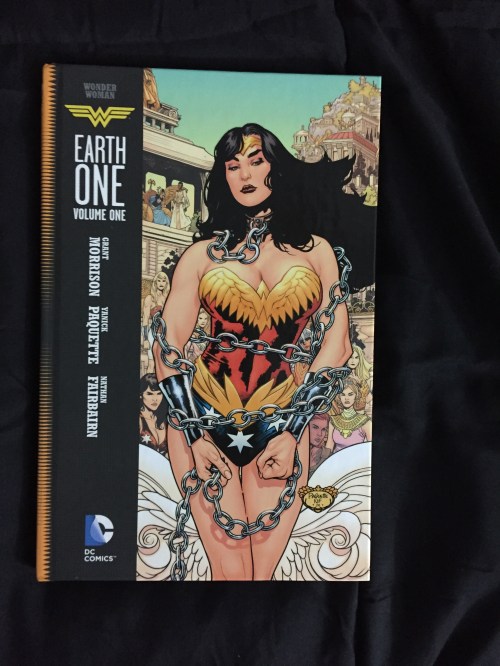
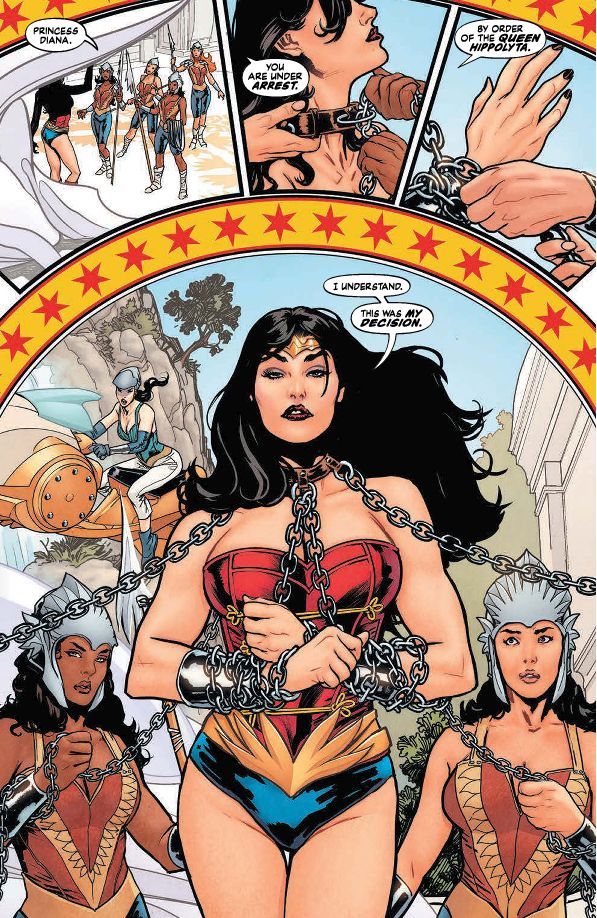
As such, many of these elements are no longer part of Wonder Woman’s mythos. However, some writers are making a concerted effort to revisit these concepts. Earlier this year, famed comic book writer, Grant Morrison, penned Wonder Woman: Earth One. For those of you seeking a version of Wonder Woman different from the movies and more in line with William Marston’s original vision, I highly recommend this book. It goes out of its way to capture that original concept of loving submission, in some cases quite literately.

Morrison stated in an interview with Newsarama that he sought a different approach to telling Wonder Woman’s story. This time, he underplayed the warrior aspect of Wonder Woman and the Amazons. That element is still there, but it’s secondary to the overarching themes of Marston’s ideas about submission and love. As a result, it creates a story that feels as groundbreaking now as it did in 1940.
For the past few decades, Wonder Woman’s BDSM origins have been underplayed or marginalized. However, with BDSM becoming more mainstream, thanks to the success of “50 Shades of Grey,” there may come a time when these radical ideas that are far older than most people think are revisited.
It is still a radical idea, the concept of submission being an act of love. It’s an idea I’m just starting to explore in my own books, particularly “The Big Game.” It’s kind of sobering to know that this idea was being explored seven decades ago and then got swept under the rug. Perhaps that means books like mine are coming out at just the right time as society learns more about these unorthodox, but not-so-radical concepts.





 Jack Fisher's Official Publishing Blog