Tag Archives: going to work

Why We Should Embrace A Four-Day Work Week

If you’ve ever worked a full-time job, chances are that job had set hours during certain days of the week. It may vary from job to job, but in most developed countries there’s this concept of a standard work week. And it goes like this.

You work five days a week, often Monday through Friday.

You work eight hours a day, usually around 9:00 a.m. to 5:00 p.m.

You typically don’t work major holiday or overtime. But if you do, you get paid overtime.

That’s seen as a “normal” work week these days. I put “normal” in quotes because what constitutes a normal workday has changed a great deal over the years. But I prefer not to focus on the history of the work week. I just want to ask a simple question about the work week as we currently accept it.

Is the five eight-hour workday schedule really the most effective approach to work?

It’s an honest question and one I think the COVID-19 pandemic has made more relevant. Beyond revealing how much work we can be done remotely and from the comfort of our homes, it also revealed that our concept of a normal work schedule is somewhat skewed. And it might be a good time to re-evaluate our understanding.

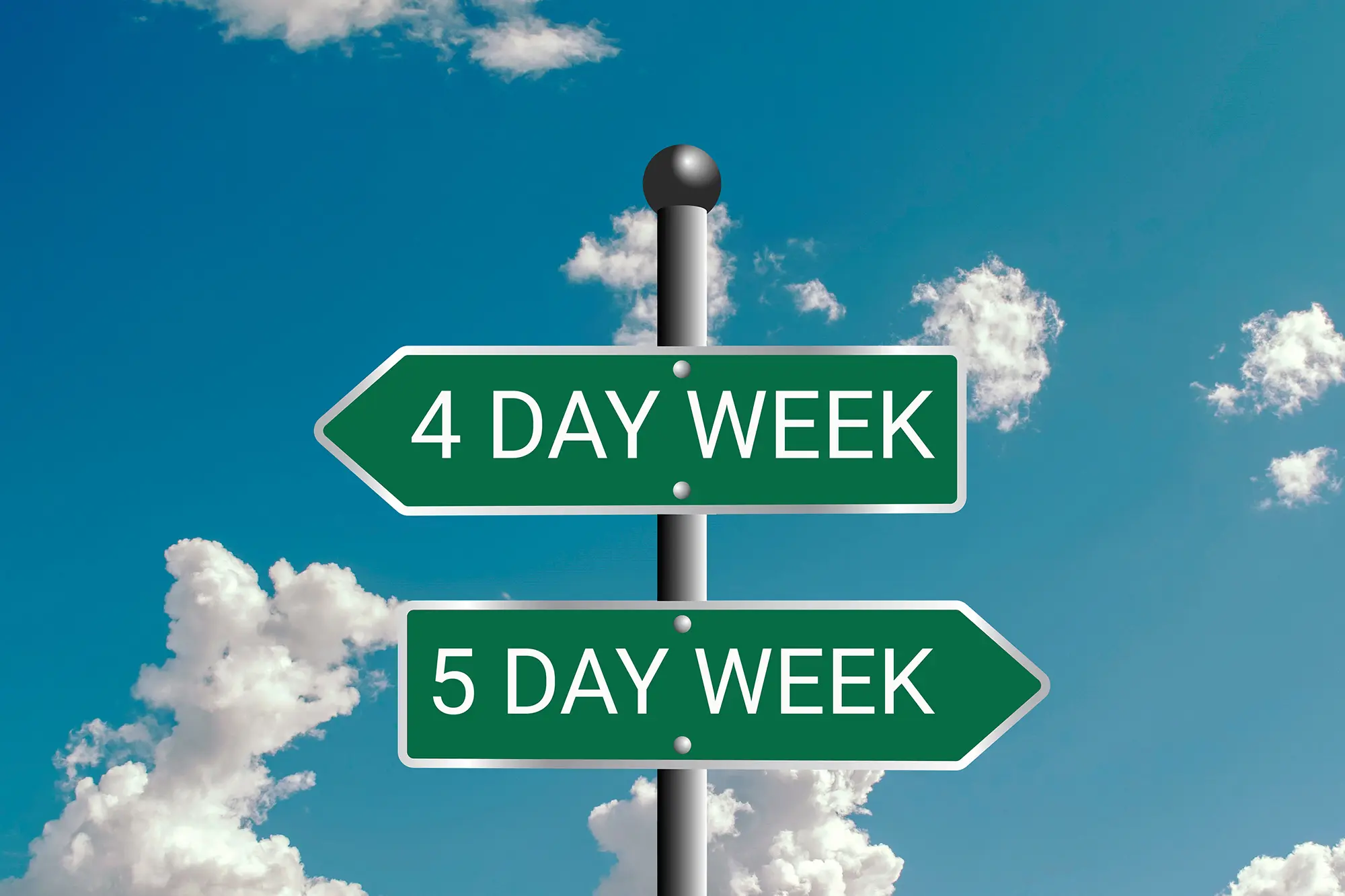
Some are already doing that. A number of companies in various parts of the world are starting to experiment with a four-day work week. It doesn’t always entail less work. In some cases, people opt to work four ten-hour days instead of five eight-hour days. The duration of the shifts don’t change. It’s just the structure.

And according to the conclusions of multiple studies, the results have been a massive success for everyone involved.

Overall productivity remained unchanged or actually improved.

Worker satisfaction increased, as did overall work/life balance.

The same amount of work got done, even when fewer hours overall were worked.

There were practically no real downsides. People got an extra day off, but were just as productive. They were also happier, overall. Even if you’re a ruthless business tycoon with no sympathy for others whatsoever, these results are encouraging. After all, happier and more fulfilled workers means less turnover and less conflicts overall. Unless your company runs on the tears and suffering of others, that’s generally good for business.

Even in the absence of these studies, I can personally attest to the appeal and the merits of a four-day work week. While I wasn’t lucky enough to have that schedule with any of the full-time jobs I worked, I do know it was a popular option in one particular company.

Since I don’t know if my former employer visits my site, I won’t say their name or their industry. I’ll just say that this company utilized a lot of shift-work. There were some typical nine-to-five shifts, but most varied considerably in order to ensure 24/7 coverage of our operations. I typically worked five days a week, usually 10:00 a.m. to 6:00 p.m.

However, there was an option for those with kids to work four ten-hour days. The day of the week they got off varied. My supervisor actually encouraged those who used this option to coordinate and decide amongst themselves which day of the week they would take off. Some preferred having Monday off. Some preferred having Friday off. One even preferred having Tuesdays off.

It was probably the most popular shift, but one that wasn’t widely adopted. It was always framed as a shift reserved for those with young children who needed an extra day to take care of doctor’s appointments, personal matters, and what not.

Personally, I would’ve definitely preferred working four ten-hour days. Even if it meant those four days were longer, I would’ve gladly worked that time in exchange for a longer weekend. It would’ve made a lot of things easier, especially when I was young and just out of college. Even today, it would make a lot of things easier. An extra day would give me more time to rest, run errands, work out, and work on my personal life.

I suspect many feel the same way. Just think about how excited/relieved you are every time you have a long weekend to look forward to. But honestly, is a three-day weekend really that long? It’s still less than half of the week. And can you honestly say you get less done on a shorter work week?

Now, I understand that not all work is the same. There are certain jobs for which a four-day work week just isn’t practical. By the same token, there are also types of work for which a five-day work week isn’t practical, either. We just still use that schedule because it’s considered standard and “normal.” We’re so used to it that we don’t even question it.

But we should. The results of the studies I mentioned imply that there are better ways to get just as much work done with less time in a manner that is just as productive, if not more so. So why not embrace that?

I suspect a part of it has to do with how the five-day, 40-hour work week is engrained in a lot of labor laws. That is not a trivial detail that we can just overlook. But laws can be changed. And in this case, there’s a better and more efficient option available.

In a world with so many diverse people and so many diverse forms of work, it makes sense to be flexible. If a shorter work week means equal or greater amounts of efficiency, then the only thing stopping us is outdated assumptions about what constitutes “full-time work.”

I sincerely hope that changes in the coming years, especially as people continue to realize the value of a good work/life balance. Just because we’ve been structuring our jobs a certain way for decades doesn’t mean we should keep doing it that way. If a four-day work week is better by every measure, then we’re only making our jobs more miserable by clinging to outdated practices.

Leave a comment

Filed under Current Events, health, politics, psychology

Telework, Online Learning, And What A Global Pandemic Can Teach Us About Both

See the source image

In general, people don’t radically change their habits unless there’s a huge incentive and/or a major disruption. By that, I don’t just mean habits relating to drug addiction, exercise regiment, or bedroom kinks. I’m mostly referring to peoples’ overall tendency to keep doing things the way they’ve been doing them, even if they have major flaws.

While it’s rare to get huge incentives to change those tendencies, it’s just as rare to face the kind of disruption that would force people to re-evaluate how they do things. People are, broadly speaking, pretty stubborn. It takes a lot of time and energy to abandon old habits in exchange for new ones. There’s no guarantee they’ll work. Sometimes, they’ll fail miserably.

In terms of disruptions, it’s hard to top a global pandemic. There’s just no way to overstate how big an impact something like that can have on a society. Pandemics have changed the course of history, as well as the course of society. They are the million-ton sledgehammer to whatever stable social system we have in place.

The ongoing crisis surrounding the Coronavirus/COVID-19 pandemic is the biggest disruption our society has faced in over a century. It has jarred us all from our comfort zone, to say the least. Between cancellations of major events and concepts like social distancing, we’ve had to reassess how we go about our daily lives.

As frustrating and frightening as it has been, these kinds of disruptions also present rare opportunities. We may never face a situation like this that affords such opportunities, so we would be wise to take advantage of it. In this case, it has to do with how we go about work and school.

We all have this time-tested notion of what it means to have a job and get an education. Having a job means going to an office or work site, doing your work there, and then coming home after a certain amount of time. It varies from person to person, but that’s the general approach.

Going to school is similar. You get on a bus, go to some building across town, stay there for six or seven hours while going to multiple classes, and then you come home. That’s what we think of when we think about getting an education and going to school.

Now, thanks to a global pandemic, this time-tested system has been disrupted. Going to crowded facilities is now a health hazard. Kids can’t go to some big school facility and workers can’t go to some crowded office for a third of their day. Instead, people are having to telework or utilize online classes. For now, this is just a temporary measure while we endure all this massive social upheaval.

At the same time, it also gives us a rare opportunity to see just how necessary it is to go somewhere else to do our work or get our education. It’s a relevant issue that goes beyond our current crisis. These questions are worth asking.

How necessary is it for us to go to some office or school to achieve what we seek?

Is that system really the best we can do?

What are the limitations of telework and online schooling?

What can be done to mitigate those limitations within the current infrastructure?

Can people be more productive with telework and online schooling?

How effective is our current system at supporting these options?

Now, I’m the last person who should defend the current school system. My past experiences with public school give me a somewhat heavy bias in assessing it. However, I doubt I’m alone in saying the current system has room for improvement.

When it comes to telework, I have less experience. In the past, I’ve had instances when I’ve been successful with telework. It depends on the situation and what I’m working on. I suspect that’s common for many jobs. An accountant and a brain surgeon work in very different spheres. One is easier to do at home. The other is a lot messier, to say the least.

It’s worth taking note of just how much we’re able to function over the next few weeks with respect to telework and online schooling. If a sizable chunk of the population demonstrates they can get the job done this way, be it with telework or online schooling, then that’s valuable insight that we should not ignore.

I understand that there are some jobs that cannot be done from home. There are also some things you can’t learn remotely. However, looking back at my experience in school, I’d say about 80 percent of what I learned could’ve been learned online. In terms of work, over half of what I did could’ve been done from home with a laptop and an internet connection.

There’s no reason we should be locked into this mindset that work involves leaving our house or that learning has to take place within a school. There are other ways to do these things and certain people might function better that way.

During a massive upheaval like this, things cannot and should not go back to exactly how things were. We have an opportunity to find a new approach to school and work. I say we take advantage of it as best we can.

1 Comment

Filed under Current Events, Environment, futurism, human nature, technology

How To NOT Be Miserable On Mondays

It’s Monday and let’s face it. For most people with a steady job, Monday’s suck. It’s not just that the weekend is over. It’s the longest possible time between you and next weekend. Logistically speaking, it’s as bad a day as you can have that doesn’t involve going to the dentist.

I certainly felt that way about Mondays. I still do on occasion, but it was a lot worse when I was in high school. I know I belabor how much I hated high school, but it’s still worth emphasizing. I was always miserable, depressed, and despondent on Mondays. I was also insufferable to be around. I know because other people, including friends and family, told me that on multiple occasions.

Over time, I got tired of being that guy. I hated being the person people actively avoided on Mondays. The only thing that makes misery worse is spreading it to others. It can quickly become a self-reinforcing cycle in which everyone suffers. Nobody deserves that.

As such, I decided to change my attitude. It didn’t happen overnight. In fact, it took years. It didn’t really become noticeable until after I graduated college, but I cannot overstate how beneficial it was. If you can change your attitude on how miserable you are on Monday, then a whole lot of other challenges become less daunting.

With that in mind, I’d like to share a few tips on how to make Mondays better. Whether you’re working, in school, or retired, I encourage everyone to try making the least liked day of the week just a bit less miserable. Life is hard enough. We don’t need to go out of our way to make certain days even harder.

Tip #1: Be as positive as you can, even if you have to fake it.

Tip #2: Surround yourself with people who are positive or try to be that person within a group.

Tip #3: Start the day doing something you enjoy to boost your mood or try something new that does the same.

Tip #4: Treat yourself to a breakfast that’s bigger and more filling than you usually have.

Tip #5: Wear your favorite clothes that make you feel attractive and confident. Looking good helps you feel good.

Tip #6: Listen to music that’s loud, energetic, and upbeat on a high volume.

Tip #7: Do, watch, or listen to something that makes you laugh. It really is the best medicine.

Tip #8: Don’t look at clocks or keep track of time. Try and lose yourself in the day.

Tip #9: Talk to people and have simple conversations, but avoid topics that involve how much you hate Mondays.

Tip #10: Watch videos like this to put you in a better mood.

If you have other tips, please share them in the comments. The more we have to make Mondays less miserable, the better.

Leave a comment

Filed under Uplifting Stories