This is a video from my YouTube channel, Jack’s World.
In these cynical days, it’s become common for people to claim the internet was a mistake. It’s blamed for all the worst parts of our current state of affairs. It makes us hate each other. It locks us into our screens. And it brings out our worst selves.
I call bullshit on all of it. The internet was NOT a mistake. And in this video, I explain why.
I’ve been using the internet for a good chunk of my life. I’m old enough to remember the days of slow dial-up, AOL chatrooms, and messy Geocities websites. And while I don’t miss those days, there are certain elements of my internet experience that have remained fairly constant.
One of them has to do with debates. And if you’ve ever talked politics, comics, anime, or movies with anyone on any medium, you know how heated that can get.
Believe me, I know this as well as anyone. I still haven’t forgotten how heated some debates got on the old comic book message boards I used to frequent. Some want to say social media ruined discourse by making it too easy to engage in such debates. But I respectfully disagree.
This sort of tension between people always existed. Human beings have always had their share of strongly held opinions that they were debate, discuss, and defend far past the point of reason. It doesn’t matter how smart, educated, or well-informed they are. The passion with which they hold their views has always been strong. The internet and social media simply made it more prominent.
I’m bringing this up for two reasons. For one, I see a lot of debates and arguments online, especially in comments sections and on social media. I freely admit that I engage in some of that discourse. It’s rarely productive. And I’ve yet to meet anyone who has been convinced to change their position on something based on a point someone made in a Facebook comment.
Second, I live in the United States of America and this year happens to be an election year. Debates about politics, issues, and policies are bound to get more heated. And that’ll only escalate the closer we get to Election Day on November 5, 2024. I fully expect to see plenty of discourse that will make me lose my faith in democracy, the future, and humanity in general.
For those reasons, and plenty others I don’t care to articulate, I want to present a simple hypothetical to anyone seeking to debate others in any capacity on any issue, be it political or otherwise. It’s not a thought experiment. It’s just a simple perspective that I hope provides greater context into the nature of discourse. It goes like this.
You and one other person are standing in a room. You both hold opposite positions on a particular issue. You spend five minutes making your case to the other person. Then, the other person spends five minutes making theirs. You are not at all swayed by their argument and they are not at all swayed by yours.
But before you start any further discussion, a third person enters the room and pulls out a special phone containing critical, indisputable information about the issue.
In one scenario, the phone contains information that vindicates your position.
In another scenario, the phone contains information that completely disproves your position.
In which scenario do you actively fight for possession of the phone?
What I just described is situation that I hope adds context to the what, why, and how of debating others. Because if you approach this hypothetical in good faith, it puts you in a difficult position. Either you admit you seek vindication and are willing to fight for it or you actively avoid the implication that your position is wrong.
Call it confirmation bias.
Call it cognitive dissonance.
Call it an impossible scenario that will never play out because there are too many issues that cannot be completely verified beyond any and all doubts.
If you’re honest with yourself, you know how you’ll react in that scenario. And if you’re honest about how most people operate in heated discourse, you’ll know how your opponent would react in this scenario.
However you feel about what I just presented, I only ask that you keep it in mind as you engage in further discourse moving forward.
Let’s be honest. It’s very difficult to have honest, civil discourse with anyone these days. I won’t say it’s impossible, but it sure feels that way sometimes. Try expressing any opinion about any issue that’s even mildly controversial. Chances are you won’t spark a civil discussion. You’ll likely trigger a flame war, especially once Godwin’s Law comes into play.
Now, I’m not going to blame all of this on the internet and social media. I don’t deny that it plays a role, but let’s not miss the forest from the trees here. We, the users of these tools, are the ones driving the content. We’re the ones who guide these discussions towards angry, hate-filled outrage. The medium is only secondary.
There are a lot of reasons why civil discourse is so difficult, but I want to highlight just one that has become far more prominent in recent years. It’s an objectively bad trend and one I genuinely believe we need to reverse. It involves this inability to distinguish shaming someone from criticizing them.
It goes like this. Two people connect, either in person or via the internet. They have a disagreement. When there’s criticism, it tends to go like this.
Person A: I hold Opinion X.
Person B: I hold Opinion Y.
Person A: Why do you hold that opinion? I don’t understand how you could.
Person B: Well, it’s because of X, Y, and Z.
Person A: I don’t disagree with Y and Z, but I take issue with X.
Person B: Why is that?
Person A: Well, it goes like this…
Ideally, both people in this exchange get something out of this discourse. Person A offers Person B another point of view. Person B has their opinion challenged and they’re now in a position to defend it. In doing so, they may reaffirm or question their position. They may even convince Person A of the merit of their position.
That’s a healthy level of discourse, guided by fair and civil criticism. There’s certainly a place for that. I even see it on social media from time to time. However, that’s not what makes the headlines. It’s the shaming that usually generates the most noise. Shaming is very different from criticism, both by definition and by practice. At its worst, it goes like this.
Person A: I hold Opinion X.
Person B: I hold Opinion Y.
Person A: What? You’re a horrible human being for holding an opinion like that! You must be a fucking asshole fascist Nazi prick!
Person B: Fuck you! Your opinion is a goddamn atrocity! Only a true fucking asshole fascist Nazi prick would even entertain it! You should be fucking ashamed!
Person A: No, you should be ashamed! You should lose your job, your money, and all manner of sympathy for the rest of your fucking life!
Person B: No, you should be ashamed! You should cry like a baby, get on your knees, and beg everyone like me to forgive you! And you should also lose your job, money, and any semblance of sympathy until the end of time!
I don’t deny that’s an extreme example. I wish I were exaggerating, but I’ve seen stuff like this play out. I’ve seen it in comments section, message boards, Twitter threads, and Facebook posts. It’s not enough to just criticize someone for holding a different opinion. People have to outright shame them to the point where they’re mentally and physically broken.
In some cases, people look for that kind of rhetoric. Some people just love trolling others by posting opinions they know will piss people off and start a flame war. They don’t care about civil discourse. They just care about riling people up. It’s what gives them a cheap thrill.
Those people are trolls. The best thing anyone can do is ignore them.
They’re also in the minority. They may be a vocal minority, but they are the minority. Most people, in my experience, are inclined to be civil. They’ll give people a chance, even if they don’t agree with them. Things just go off the rails when they interpret criticism as shaming. It’s not always intentional, either. Some people just frame their criticism poorly, which sends all the wrong messages.
Whereas criticism is impersonal, shaming evokes some very basic emotions. There’s a tangible, neurobiological process behind it. It’s linked heavily to guilt, an objectively terrible feeling that most people try to avoid at all costs. Shame attempts to impose guilt. While there are some things we should definitely feel guilty about, holding certain opinions is rarely one of them.
Does someone deserve to be shamed for how they voted in the last presidential election?
Does someone deserve to be shamed for believing “Star Wars: The Last Jedi” was a terrible movie?
Does someone deserve to be shamed for thinking certain female characters in media are too sexualized?
Does someone deserve to be shamed for thinking they shouldn’t believe every claim a woman makes about being sexually harassed?
These are difficult, emotionally charged issues. With that kind of complexity, there’s going to be many points of criticism. Some have real merit and they should be discussed. That’s how we learn and make sense of our world and the people in it. Once shame enters the picture, though, the merit tends to vanish.
The problem is that once the shaming starts, it escalates quickly. It doesn’t even need to escalate that much before a person stops listening and gets defensive. At that point, there’s basically no going back. It’s less about understanding someone else’s perspective and all about defending yourself.
That’s not a metaphor, either. Like it or not, people take their opinions seriously. Attacking them with words, even if it’s through a computer screen, still feels like a physical attack on some levels. You’re not just attacking an opinion, anymore. You’re attacking a person. You’re throwing metaphorical punches that have non-metaphorical meanings to those you’re attacking.
With that in mind, look at it from a purely instinctual level. When someone is physically assaulting you, is your first inclination to engage in a reasoned, civil discussion? For most people, it’s not. You go into survival mode and that often involves attacking the attacker.
You throw your punches.
They throw theirs.
They call you a fascist, Nazi-loving bully.
You call them a worse fascist, Nazi-loving bully.
There’s no logic or reason to it. Once emotions override everything, criticism becomes a moot point. It’s all about hitting back to defend yourself. It’s not about being right. It’s about survival, at least from your brain’s perspective.
If there’s one silver lining, it’s that people get burned out quickly on this kind of discourse. You can only hear two sides call each other fascist for so long before the rhetoric loses its impact. It also gets boring. It takes too much energy to sustain that kind of hatred towards someone you don’t know. Most people who aren’t trolls have better things to do with their time.
As I write this, I understand that we live in contentious times. I see the same heated debates online and in person as everyone else. I know that civil discourse is a scant and precious commodity at the moment. That’s exactly why we should make the effort, regardless of what opinions we hold.
Once we stop shaming each other for daring to think differently, we’ll realize just how much we have in common. We don’t have to agree with one another. We don’t even have to like one another. We can and should still be civil with one another. That’s the only way we’ll make any real progress.
A while back, a relative of mine told a story about a college professor and a smart-ass student. The student claimed he was a hardcore nihilist. He genuinely believed that there was no inherent purpose to humanity, life, or the universe. His professor didn’t respond at first. However, that didn’t stop him from making a point and sending a message.
Shortly after that initial encounter, the professor handed out grades on the first paper. He gave the self-professed nihilist a zero. When the student protested the grade, the professor just shrugged and reminded him that he was a nihilist. If he thought nothing mattered, then why should he care about his grades?
Regardless of whether this story is true, it makes an interesting point. That professor, who I suspect a PHD in trolling, exposed his arrogant student’s hypocrisy. He claimed to be a nihilist, but he still cared about his grades. He may have overestimated the extent of his nihilism, but the professor proved it only went so far.
It’s a lesson that’s a lot more relevant today because nihilism, in general, has become oddly fashionable. We have popular TV shows like “Rick and Morty,” “True Detective,” and “Bojack Horseman” that each espouse a certain degree of nihilistic philosophy. Iconic villains like Heath Ledger’s Joker in “The Dark Knight” also embody the random chaos that often reflects the chaos of a nihilistic worldview.
That hasn’t stopped some people from taking those complex philosophical concepts more seriously than most. It also happens to complement the ongoing rise of trolling, both on the internet and in real life. That makes sense because the mentality of a troll has to be nihilistic to some extent. When your goal is to cross lines and demean people for the thrill of it, you can’t be too concerned with greater meaning.
That’s not to say there aren’t trolls who are genuine sadists. I’ve encountered more than a few who would qualify. For the most part, though, nihilism is an excuse rather than a motivation. Some pretend they just want to watch the world burn when they say something that’s horribly offensive or laughably absurd. They’re just trying and failing to be as charismatic as Heath Ledger’s Joker.
It’s a phony brand of nihilism and one that defeats itself when you apply the slightest bit of scrutiny. It often leads to empty arguments on otherwise serious issues. It usually breaks down like this.
Someone will say something absurd, wrong, or just flat out offensive.
Someone else calls them out on it.
An argument ensues that usually involves an escalating amount of hatred, insults, and frustration.
Ultimately, the person who made the triggering remark claims they’re just in it for the kicks, the cheap thrills, and to taste the tears of their enemies.
In the end, they try to come off as this enlightened, above-it-all intellectual who has somehow transcended the petty arguments that the non-nihilists of the world keep having. They pretend they’re above it all or just don’t care. Again, it’s an excuse. They’re not full-on nihilists in the traditions of Rick Sanchez or Friedrich Nietzsche. They’re just assholes trying to hide from the fact that they’re assholes.
These same people who claim to care nothing about the greater meaning of the universe rarely practice what they so poorly preach. They still pay their taxes. They still work jobs that they probably hate to make money so that they can function in this undeniably flawed society we live in. If they were truly nihilists, they wouldn’t see the point in any of that.
If they got sick, they wouldn’t go to a doctor to get better. What’s the point?
If they lost all their money, they wouldn’t worry. What’s the point?
If their lives were utterly ruined by their behavior, they wouldn’t complain about it. What’s the point?
The phony nihilists pretend they can be Rick Sanchez or Heath Ledger’s Joker. However, they never come close to turning themselves into a pickle or setting fire to a giant pile of money. Those are things that a hardcore nihilist would do and they wouldn’t bother arguing about it. Again, and this is the question that phony nihilists avoid answering, what’s the point?
More and more, nihilism is being used less as a philosophy and more as a rhetorical tactic from trolls. In an era where it’s easy to troll and people are extremely divided, I understand why this brand of phony nihilism is emerging. I can even see why it has an appeal. It allows people to skip the part where they have to justify their beliefs or take responsibility for the actions. It’s more about convenience than conviction.
I don’t expect the trend of phony nihilism to stop anytime soon. If anything, it’s going to intensify as the world becomes increasingly complex on every level. There are over 7.7 billion people on this planet and it’s getting exceedingly difficult to feel like you matter in such a world. Falling into a nihilist trap is easy and even comforting for some.
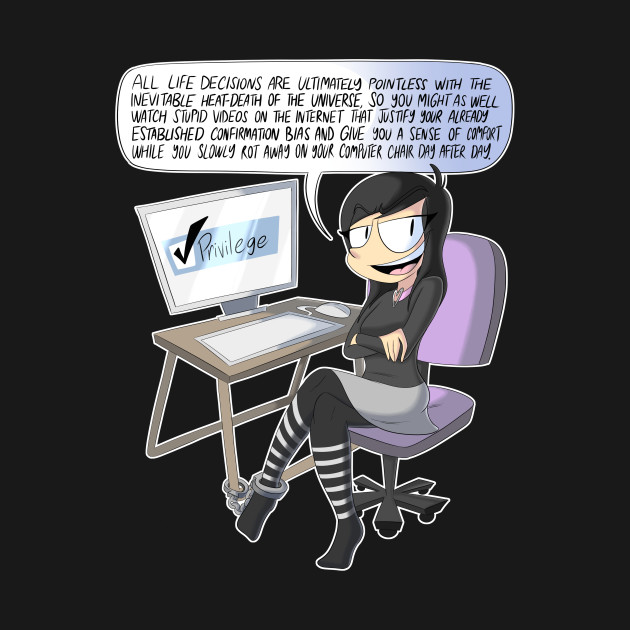
It’s still not an excuse to be an asshole. Even if you think nothing truly matters and we’re all just globs of matter waiting for the heat death of the universe, you’re alive in this world with billions of other people trying to find their place in it. Being an asshole, whether it’s out of nihilism or some other philosophy, is never justified.








 Jack Fisher's Official Publishing Blog
An Important Hypothetical Question To Consider (Before Any Debate)
I’ve been using the internet for a good chunk of my life. I’m old enough to remember the days of slow dial-up, AOL chatrooms, and messy Geocities websites. And while I don’t miss those days, there are certain elements of my internet experience that have remained fairly constant.
One of them has to do with debates. And if you’ve ever talked politics, comics, anime, or movies with anyone on any medium, you know how heated that can get.
Believe me, I know this as well as anyone. I still haven’t forgotten how heated some debates got on the old comic book message boards I used to frequent. Some want to say social media ruined discourse by making it too easy to engage in such debates. But I respectfully disagree.
This sort of tension between people always existed. Human beings have always had their share of strongly held opinions that they were debate, discuss, and defend far past the point of reason. It doesn’t matter how smart, educated, or well-informed they are. The passion with which they hold their views has always been strong. The internet and social media simply made it more prominent.
I’m bringing this up for two reasons. For one, I see a lot of debates and arguments online, especially in comments sections and on social media. I freely admit that I engage in some of that discourse. It’s rarely productive. And I’ve yet to meet anyone who has been convinced to change their position on something based on a point someone made in a Facebook comment.
Second, I live in the United States of America and this year happens to be an election year. Debates about politics, issues, and policies are bound to get more heated. And that’ll only escalate the closer we get to Election Day on November 5, 2024. I fully expect to see plenty of discourse that will make me lose my faith in democracy, the future, and humanity in general.
For those reasons, and plenty others I don’t care to articulate, I want to present a simple hypothetical to anyone seeking to debate others in any capacity on any issue, be it political or otherwise. It’s not a thought experiment. It’s just a simple perspective that I hope provides greater context into the nature of discourse. It goes like this.
What I just described is situation that I hope adds context to the what, why, and how of debating others. Because if you approach this hypothetical in good faith, it puts you in a difficult position. Either you admit you seek vindication and are willing to fight for it or you actively avoid the implication that your position is wrong.
Call it confirmation bias.
Call it cognitive dissonance.
Call it an impossible scenario that will never play out because there are too many issues that cannot be completely verified beyond any and all doubts.
If you’re honest with yourself, you know how you’ll react in that scenario. And if you’re honest about how most people operate in heated discourse, you’ll know how your opponent would react in this scenario.
However you feel about what I just presented, I only ask that you keep it in mind as you engage in further discourse moving forward.
Leave a comment
Filed under philosophy, political correctness, politics, Thought Experiment
Tagged as bias, cognitive dissonance, comments section, conservative, debate, democracy, democrat, discourse, Donald Trump, Election Day, hate speech, human psychology, internet comments, liberal, news, political debate, political discourse, politics, psychology, republican, sociology, the internet, Trump