Tag Archives: comic book industry

How AI Art Could Upend/Destroy The Comic Book Industry

This is a video from my YouTube channel, Jack’s World.

This video covers some recent news surrounding accusations about major comic publishers utilizing AI art and the larger implications that this new technology will have on the industry. Artificial Intelligence promises to impact a lot of industries, but the comic industry is uniquely vulnerable. And it’s definitely worth confronting as the technology continues to improve.

1 Comment

Filed under AI Art, Artificial Intelligence, DC Comics, Jack's World, superhero comics, YouTube

Bracing/Preparing For The End Of Comixology

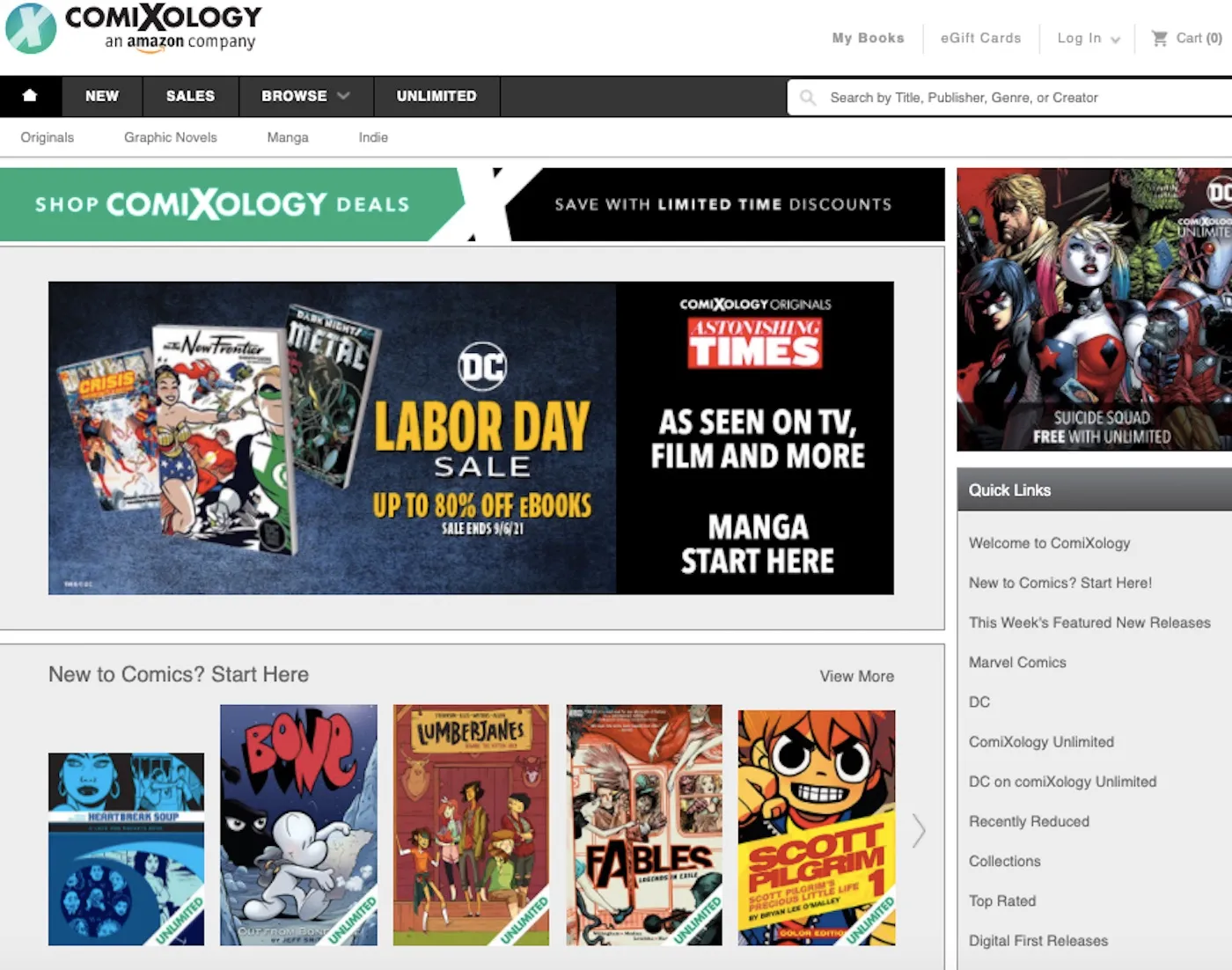
Just a few years ago, Comixology was the center of the world for comic fans like myself. It was the primary hub through which we accessed the comics we know, love, and consume on a weekly basis. It made Wednesday mornings the best day of our week. Instead of trying to figure out how you’d get to a comic book store, you just rolled out of bed, turned on your computer, and purchased the books you wanted for the week.

I started waking up at 4:30 a.m. every Wednesday morning, just to get a head start on new books. Once Comixology started publishing new comics the same day they came out in stores, the floodgates opened for me. I suddenly had the perfect avenue to enjoy comics as I saw fit. And I genuinely loved it. Comixology had a special place in my heart.

Then, February 2022, that all changed. And years from now when we’re looking back on the history of comics, we might look at this moment as the beginning of the end for Comixology. Because that was the day that once-iconic website that we came to know and trust over the course of a decade disappeared. Instead, it was folded into Amazon’s Kindle store, a hub that was not designed for comics and not at all equipped to provide the same experience.

I remember that moment well. I just kept constantly trying to get back to the old site, only to be redirected to Amazon at every turn. I kept saying “I hate this!” again and again. I reached out to Comixology support, who have always been so responsive. They didn’t respond this time. They made public statements claiming they were committed to improving the interface. Absolutely none of those promises have been kept and it’s been over a fucking year.

Now, the story of how Comixology got folded into Amazon is a long one that I won’t recount. Amazon has actually owned Comixology since 2014. But that really wasn’t an issue because it didn’t change the site, the experience, or the service. If you didn’t see the Amazon logo on the front page, you probably wouldn’t have known that Comixology was an Amazon-owned company.

But for reasons that probably have to do with greed, arrogance, callousness, and cost-cutting, Amazon decided Comixlogy had to be completely integrated with their Kindle store. In addition, over half the staff working at Comixology was fired. And even though Amazon is a trillion-dollar company, the experience still sucks. The web reader still sucks. And I’ve yet to find a single person who prefers to the new site over the old Comixology site.

It’s now at a point where the future of Comixology, as a whole, is very much in doubt. Amazon didn’t care enough to keep the workers who made Comixology great, nor do they seem to care about providing the same experience that past customers grew to love. And once big corporations stop caring, you can assume things will never get better.

It’s at a point now where major publishers are taking notice. For years, Comixology was the perfect middleman for publishing companies. They provided the digital storefront while the publishers provided the comics. They share in some of the profits and everyone is happy, including the customers. Now, that dynamic is all screwed up and unhappy customers are not good for business.

Now, Marvel and DC Comics are investing heavily in their own digital comics services. I’ve sung the praises before of Marvel Unlimited, the Netflix-like service that essentially allows fans to binge Marvel’s vast catalog of comics. DC Comics is developing a similar service called DC Infinite. At the moment, these services don’t offer the newest issues. You usually have to wait 30 days for them to come out on the site.

But with these publishers shutting down applications that once integrated with Comixology, I think the stage is set. Publishers now have an incentive to cut ties with Comixology completely and develop their own apps. That will be quite devastating to the many smaller publishers and indie comics that once relied on Comixology’s brand to get their work out there. But I fear it’s already too late for them.

This likely means that if you’re a Marvel or DC fan, getting your favorite comics every week will eventually require you go through them instead of Comixology. That means learning how to use Marvel Unlimited and DC Infinite fast. It also means looking at your current collection and gauging which comics you’ll be able to keep and which will be at risk. That’s going to be tedious and you may lose some stuff you legitimately paid for. But don’t expect Amazon to care enough to fix it for you.

I’m already preparing. As soon as Marvel Unlimited starts offering some way of getting new comics the date of publication, I’ll have a very good reason to ditch Comixology. I still rely on it for a number of non-Marvel and non-DC titles I follow. But alternatives are already popping up. Hopefully, they get to a point where they offer a better value than Comixology/Amazon.

This transition is going to suck. There’s no way around it.

Chances are it’s also going to mean more money than we’d be spending if Comixology had remained unchanged. There’s no way around that, either.

But that’s the world we live in. It sucks and it will get worse before it even begins to get better. I take no pleasure in saying this, but this is where we are right now.

Leave a comment

Filed under Comic Books, Jack Fisher, Superheroes, DC Comics, Marvel, rants, Uncategorized

An AI-Generated Comic Was Denied Copyright Protection (And Why That’s A Big Deal)

Every now and then, a story slips under the radar of a much larger, but closely related story. The larger story makes more headlines and attracts more attention, but the smaller story might end up having a far more lasting impact.

That seems to be happening a lot with news involving artificial intelligence and the various AI tools that have emerged in recent years. I’ve already talked about plenty, giving my opinion on the rise of ChatGPT and showing off some AI-Generated artwork I made. There’s so much going on in this field that it’s hard to keep up with, let alone discuss.

But recently, one of those little stories caught my attention. It involves the same AI-Generated art I mentioned earlier and comic books, something for which I’ve shared my passion for in many forms. And it’s a story that I don’t think is getting enough attention.

It has to do with a comic called Zarya of the Dawn, a comic created by Kris Kashtanova. It’s not published by Marvel, DC, Dark Horse, Image, or any other mainstream comic publisher. You can actually download it right now for free. But what makes this comic different isn’t the story, writing, or style. It’s how it was made.

This comic was written by a person.

However, all the artwork inside was created with AI-generating art tools, most notably MidJourney.

That, in and of itself, is quite remarkable. The visuals within this book are certainly eye-catching. They might not rank on the same level as a Jim Lee or a Jack Kirby, but it’s a solid visual spectacle that brings to life a story.

For people like me, who cannot draw and don’t have the money to pay artists to depict the stories we want to tell, this is truly remarkable. I would go so far as to say it’s genuinely exciting. It shows just what’s possible with these tools. A writer with no drawing skills was able to produce this comic using only an AI art generating tool with text prompts. And the end result is stunning.

But this is where the story takes a turn. When Kashtanova attempted to copyright this comic, the US Copyright Office issued a surprising decision that might very well set a major precedent moving forward. Because the comic used AI to create the artwork, it could not be granted copyright protection. This was the exact statement, according to Ars Technica:

“We conclude that Ms. Kashtanova is the author of the Work’s text as well as the selection, coordination, and arrangement of the Work’s written and visual elements. That authorship is protected by copyright. However, as discussed below, the images in the Work that were generated by the Midjourney technology are not the product of human authorship.”

That bolded part is my doing because that’s the section with the biggest implication. This is the US Copyright Office stating outright that images and artwork created by AI can’t get copyright protection. That means that every piece of AI art you create for whatever reason can’t be owned by you in any legal sense. Because technically, you didn’t make it. The program made it for you.

Without getting too deep into the legal issues, I don’t think enough people realize the ramifications this might have for the future of the comics industry and for the art industry as a whole. On the comics side, there are actually two sides to consider.

On one, this technology will allow ordinary people with little to no art skills to produce comics with quality artwork. People who never once had the skills or means to make comics could suddenly start producing them on their own without a publisher or a skilled artist.

That means many great comics that wouldn’t have otherwise been made can be made. Great stories that once only existed with words could be brought to life through beautiful renderings.

But on the other side, the absence of copyright protection is an issue. Yes, these comics could bring to life amazing stories. However, the creators won’t be able to monetize their work, nor would they be able to stop others from using it for their own ends.

That means that, in theory, you or I could create a beautiful comic with this technology. It could find a massive audience and become a beloved story with countless fans. Then, a big company like Disney or Warner Brothers could come in, take the story and the depictions, and basically turn it into their own entertainment product. And since they have more resources and better lawyers, the creators likely wouldn’t get a penny of the profits.

This story also doesn’t account for how those same companies might use this technology to further undercut their workers and creators. Comic companies already have a not-so-great reputation for screwing over writers and artists who create iconic characters. Just look at what happened between Jack Kirby and Marvel for a hint of those issues.

If these same companies can use this same AI technology to produce more comics while not having to pay their artists or writers as much, they will do it. They’re a business. They’ll jump at any chance to pay less to get more. It’s cold, callous, and uncreative. But that’s the world we live in.

Add other tools like ChatGPT into the mix and it’s entirely possible that an AI could create an entire comic from scratch. And everything within it, from the art to the story to the characters, could not be copyrighted in any way. At a certain point, the AI might get so good that it would be hard to tell if there was ever a human creator to begin with.

These are all strange scenarios, equal parts exciting and distressing. We’re already seeing so much change as a result of these new tools, but I don’t think we’ve even seen a fraction of what’s possible. As AI technology improves, art generation and storytelling will change a great deal. The comics industry is more vulnerable than most, as Zarya of the Dawn just proved.

It’s hard to know what this will lead to. But whatever happens, it all started with this story and the precent it set.

Leave a comment

Filed under AI Art, Artificial Intelligence, ChatGPT, superhero comics, technology, writing

Upheavals At DC Comic: My Concerns And Hopes

Let’s face it. Pretty much every industry not associated with health care, masks, streaming media, and Zoom calls has been hit hard this year. That’s especially true for certain segments of the entertainment industry. Basically, if you’re a movie studio, a movie theater, a comic shop, or a mall, this year has been like 100 punches to the gut, jaw, and genitals by a crack-fueled Ivan Drago.

That’s how bad global pandemics are. They pull no punches and will hit anything that attempts to prosper, both directly and indirectly.

Those blows extended to the comics industry, as well. As a lifelong comic book fan, I certainly felt it. I haven’t forgotten the weeks on end of having no new comics to enjoy for the first time in over a decade. It was not a pleasant experience. As elated as I was to see New Comic Book Day return, I didn’t doubt for a second that there would be some lasting scars.

Well, now it seems some of those scars are starting to fester and the first one to feel the pain is DC Comics. According to The Hollywood Reporter, the entire DC Comics operation has been hit with major layoffs and restructuring. It’s still intact, but make no mistake. This is the single biggest purging of personnel from a major comics publisher since the mid-1990s.

THR: DC Comics, DC Universe Hit By Major Layoffs

Monday’s WarnerMedia layoffs have affected a significant number of high-level figures at comic book powerhouse DC, multiple sources tell The Hollywood Reporter.

Among those said to be losing their positions are editor-in-chief Bob Harris, senior VP of publishing strategy and support services Hank Kanalz, VP of marketing and creative services Jonah Weiland, VP global publishing initiatives and digital strategy Bobbie Chase, senior story editor Brian Cunningham, and executive editor Mark Doyle, who oversaw the rollout of the Black Label graphic novels. Jim Lee remains the CCO.

Roughly one third of DC’s editorial ranks are being laid off, according to sources.

Insiders also say the majority of the staff of the streaming service DC Universe has been laid off, a move that had been widely expected as WarnerMedia shifts its focus to new streaming service HBO Max.

I can’t understate how big a deal this is to the larger world of comics, but I don’t want to overstate it, either. This situation is objectively bad. There’s no way around it. It’s also not the definitive end of DC Comics. That’s a narrative I don’t want to fuel.

That hasn’t stopped some of the whiniest, dumbest segments of the comics crowd from claiming otherwise. I won’t name names, but they are affiliated with a certain movement in comics that has only become less credible and more insufferable with time. The box office return of the “Captain Marvel” movie is proof enough of that.

Don’t be fooled by what some asshole voices on social media claim. This restructuring is not because DC Comics had too much diversity. It’s more a byproduct of DC Comics having lost its sense of vision, scale, and identity. This is something that happens from time to time in comics. After a while, the whole line loses its sense of self and needs some revitalization.

I can say, as a longtime comic fan, that DC has become somewhat stale in recent years. Even before the pandemic, I felt as though it had lost momentum outside its mainstays. It has primarily been relying on the strength of Batman, Wonder Woman, Superman, Green Lantern, and Flash. As iconic as those characters are, they just can’t sustain the entire line.

There are many reasons for that. I think DC Comics, as a whole, hasn’t had a consistent vision since the days of DC Rebirth. It just got bogged down too much with competing visions, like DCeased and Injustice: Gods Among Us. It also endured way too many delays with its last big crossover event, Doomsday Clock.

The onset of the pandemic just exacerbated a problem that was starting to grow. As bad as things are now, there’s also an opportunity to set things on a better path. That’s my greatest hope for whatever restructuring DC pursues next. It still has plenty to build on. The success of the Harley Quinn show is proof enough of that. It’s just a matter of what form that will take.

That said, I do have major concerns. Comic lines have gone through upheavals before, but never during a global pandemic. This is uncharted territory for the comics industry, as a whole. This is not the era of newsstands and comic shops where top books could easily sell hundreds of thousands of copies. Paperbacks alone are not going to make this industry succeed.

Comics, in the current system, work best as a garden from which new characters, stories, and ideas can blossom. The fruits of that system can later become the basis for TV shows, movies, merchandise, and so much more. DC Comics already has a major media partner in its owner, AT&T. The structure is there. They just have to carve their niche into it.

I understand that’s easier said than done. Right now, a lot of factors are working against DC and the comics industry, as a whole. When all is said and done, comic shops may become much more diminished and trade paperback sales may dwindle to just a handful of titles. I’m not looking forward to that kind of status quo.

The ultimate setup may one day involve DC Comics just abandoning its publishing system, as a whole, and shift to licensing its characters to other companies, such as IDW. That’s very much a last resort, but one that may be more likely if DC can’t get its comics in order.

I want to be hopeful, but I’m also going to brace for the worst. If 2020 has taught me anything, it’s that things can always get worse and the things we love are always capable of succumbing to forces beyond our control. It’s a sad, nihilistic mindset, but one that a global pandemic tends to affirm. Only time will tell and I’ll be waiting with baited breath.

Leave a comment

Filed under DC Comics, media issues, superhero comics

How To Save The Comic Industry (In Four Easy Steps)

The comic book industry is in a state of crisis. I know you can say that about a lot of industries amidst a global pandemic, but the comics industry has been extremely hard hit. Shipments of new comics have ceased. Comic shops are likely to go out of business without that influx of new product. The industry that I’ve loved since I was a kid has never been this vulnerable.

It’s very depressing. I certainly have felt that after multiple weeks of no new comics. A handful of people, namely the whiny agenda-pushing loser types, have been talking doom and gloom about the comics industry for years. However, this hit has nothing to do with some overly political T-shirt that Mockingbird wore.

Even after the pandemic ends, this industry that I love will never be the same. It can’t go back to the way it used to be. This crisis has shown, among other things, that the current model that the comic industry utilizes just isn’t sustainable. It needs an overhaul of some kind.

I’m certainly not smart enough to know what that overhaul entails. I doubt few people are. However, as a long-time fan and follower of the industry, I have a few ideas. To keep it simple, here are four steps to saving the comic book industry in a post-pandemic world.


Step 1: Emphasize Quality Over Quantity

This is a simple metric. There are just too many books coming out all at once. However, this is a problem that predates the current crisis. It’s a problem that has lingered since the industry almost crashed completely in the early 1990s. It came down to simple economics. Publishers made too many books that not enough people bought. Even if they were only a dollar apiece, there’s only so much consumers can consume.

This is not a sustainable business model. Companies like Marvel and DC Comics grew the most when they were just publishing a dozen or so titles a month, with a few mini-series on the side. You could, conceivably, follow every major event in the Marvel or DC universe for less than $40, adjusted for inflation. That kind of easy access is what helped create the massive fandom that these franchises enjoy today.

That said, this isn’t the mid-1960s. The world is changed. Markets and consumer habits have changed. However, there’s still a place for comics in the publishing world. It’s just a matter of making those products more valuable. Books like DC’s Earth One series are basically single-issue graphic novels that tell a rich, complex story at a higher price and it’s worth every penny.

At a time when people are strapped for cash and looking for value, the comics industry is in a perfect position to tap into it. Make every comic count. Make every dollar feel like it was well-spent. It won’t just keep new fans happy. It’ll help create an entirely new generation of fans who are less inclined to go to crowded movie theaters.


Step 2: Embrace Digital (In A Novel Way)

This step plays directly off the first in that it embraces new technology. Decades ago, comics were easy to access because you could buy them at news stands and grocery stores. As a kid, I got most of my comics from the grocery store at first. They were easy and, much to my parents’ delight, cheap ways of putting a smile on my face.

These days, you can’t find comics in grocery stories. However, digital comics have grown a great deal and are more accessible than ever, thanks to companies like Comixology. Most comics are already released digitally on the same day they come out in shops. That’s great, but it’s basically just an extra convenience for those who don’t live near comic shops. That can’t be the extent of how digital comics impact the industry.

At the moment, digital comics are only a small part of overall comic sales, but they’re growing rapidly. In conjunction with that growth, the industry needs to embrace the other opportunities that digital offers. Services like Marvel Unlimited are nice, but they’re just giving us products that were already released. Why not give us something we can’t get anywhere else?

I’m not sure what that something is, be it a motion comic or something that sets itself apart from a traditional paperback. I’m not smart enough to figure it out, but digital offers so many rich opportunities. The first company to figure it out will make millions and entice a new generation of fans.


Step 3: Make Comic Shops More Than Comic Shops

I love comic shops. Some of my fondest memories have occurred in comic shops. I don’t want them to go away. However, embracing digital comics doesn’t mean the same as ditching these important brick-and-mortar structures. It just means changing their role in the overall comics infrastructure.

When I was a kid, there were two types of stores. One were the stores you could hang out in and the other were the stores in which the owners kicked you out if you lingered for more than 10 minutes. The future of the industry needs to embrace the former rather than the latter.

Comic shops can’t just be about selling comics and merchandise. Too much of that is online and relying on that model is doomed to failure. Instead, comic shops need to be part comic shop and part coffee shop. Make it a place where you don’t just browse the racks for new material. Make it a place where you can sit down with friends, get some coffee, get a snack, and enjoy comics in a communal manner.

Once comic shops are an experience again, people will visit them and not just because there are new comics to buy. If comics can become a popular hang-out once more, then they’ll have a place in a new market.


Step 4: Empower Creators (Instead Of Screwing Them Over)

As much as I love comics, I don’t doubt that it has engaged in some shady business practices. There are many stories about comic creators getting screwed over by major publishers. While every industry has shady practices, the comics industry relies too heavily on brilliant creators to screw them over.

While Marvel and DC have their Disney/WB overlords to please, they can’t just rely on being farms for intellectual property. There has to be a new and better way for compensating creators. Alan Moore may be a cankerous blow-hard, but he really did get screwed over when DC flat out broke their promise to him.

Broken promises always cost more in the long run, especially with respect to comics. It’s not enough for the publishers to just acknowledge the contributions of creators. They need to have a way to profit. It’s not impossible. Apple does it with their app store, creating a means for creative developers to profit from their creations while still making Apple billions.

When both benefit, everyone benefits. It’s really that simple.


I know the comics industry is undergoing rapid change. I don’t doubt I’ll be upset with some of those changes. However, I also understand that the industry needs to change in this increasingly chaotic world. These are just some ideas on how to go about it.

Whatever happens, I hope this industry that I love continues to thrive. I don’t know how, but I do know that a lot of people love it and they’ll find a way to make it work.

Leave a comment

Filed under DC Comics, Marvel, superhero comics