
In general, I try not get involved in religious discussions. Even though I talk about religion every now and then, I always make it a point to distinguish the individual from the ideology. There many good and decent people who identify as Christians, Muslims, Hindus, and plenty of other faiths. I have religious people in my own family. I love and respect them. And I make it a point to avoid talking about religion or any politics related to it.
That being said, there are some instances where I just can’t be that understanding. And in recent years, I’ve noticed the number of those instances increasing at an alarming rate. In the coming years, I may look back on 2025 as a major tipping point for me. Because that’s when the disconnect between religion and its adherents just became too vast to overlook.
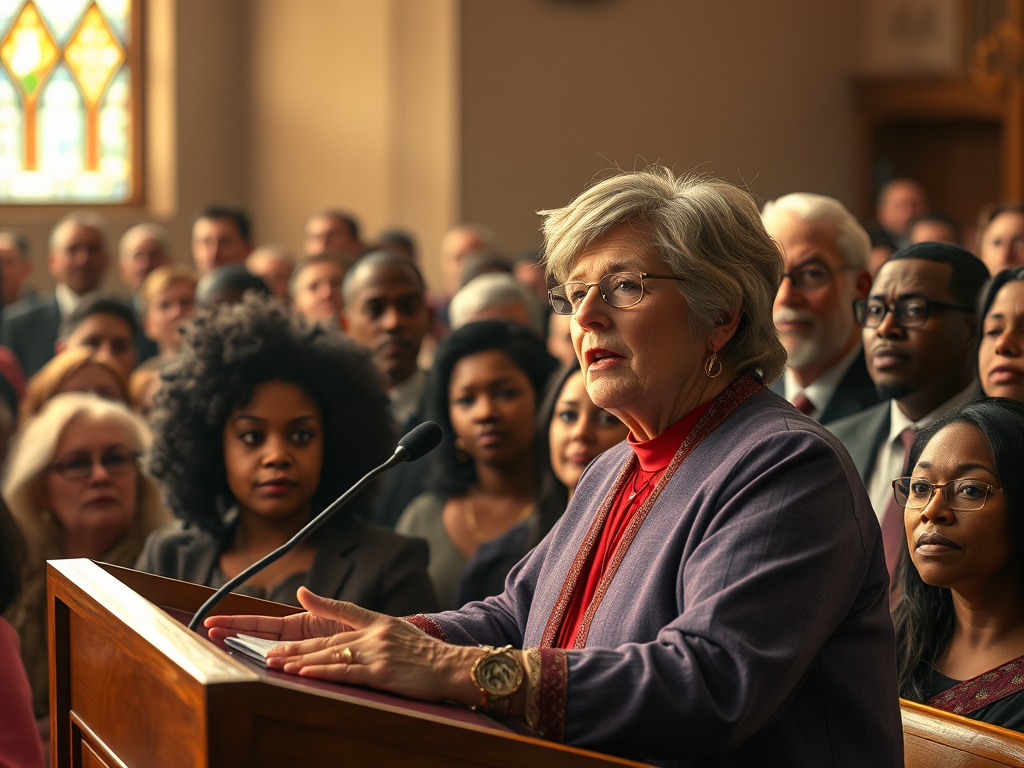
The big moment came just the day after the new Presidential administration was sworn in. That’s when Bishop Mariann Budde delivered an impassioned sermon at Washington’s National Cathedral in which she urged the newly elected President to exercise mercy, compassion, and empathy for everyone. This is not a wholly unreasonable request. It’s not even overly religious, in general. It’s just basic human decency. Isn’t that exactly what you’d want for anyone who occupies a position of power or influence?
Well, apparently that was too radical, too offensive, and too un-American for many “Christians.”
And yes, I put that word in quotes for a reason. Because the people who took offense to this sermon have as much right to call themselves a Christian as I do to call myself a Wookie. In this instance, I cannot be understanding or accommodating. Because this bishop wasn’t being disrespectful or condesending. She was literally just preaching some of the most basic teachings of Jesus Christ.
You don’t need a PHD in theology to understand those teachings. Pretty much every translation of every bible says the same thing. Jesus taught his adherents to love and care for one another. He emphasized having mercy for others, even when they wrong you. That is not a radical interpretation. It’s one of the few values that Jesus and most denominations agree on.
And yet, Bishop Budde faced a severe backlash, not just from the President, but from many people who dare to identify as “Christian.” I’ve even seen a few make these long, semi-coherent rants trying to quote mine the bible or other “Christian” principles to justify their outrage. But the mere fact that this was their recourse, arguing with a Bishop who just asked people to be merciful, speaks to a disgusting hypocrisy.
Now, there’s a lot I could say about that kind of hypocrisy. I used to foolishly believe that hypocrisy was one of the few traits that most people cannot tolerate in the long run. Sadly, I was wrong. Between shifts in politics, trends, and simply dealing with these people more directly, I no longer believe that. This kind of hypocrisy isn’t a bug. It’s a feature.
What else could justify people who call themselves “Christian,” yet are deeply offended by the literal teachings of Jesus or any sermon that dares to demand adherents to exercise empathy? What happened with Bishop Budde isn’t even a one-off. There are pastors who have been forced out of their positions because parishioners complained that their teachings were too progressive, liberal, or “woke.”
Just take a moment to wrap your head around that kind of mentality. Someone who calls themselves a Christian, goes to church, listens to a sermon, and doesn’t like what a bishop or pastor says. But their first instinct isn’t to re-evaluate what it means to be a Christian. It’s to whine, complain, and protest like a kid who just found out they actually have to be good in order to get presents on Christmas.
Instead of introspection, their first instinct is to get angry and whiny. That’s childish.
Their next instinct is to go out of their way to find some justification for why the Bishop or pastor is wrong and they’re right. That’s just self-centered and self-serving.
If they’re too lazy to do that (and most of them are), their final recourse is to call whoever delivered that message some agent of evil or part of some sinister agenda. That’s just plain fucking stupid, as well as overtly narcissistic.
It basically reveals that these “Christians” don’t give a damn about teachings, principles, or anything of the sort. They just want their pastors and bishops to tell them what they already believe. They want to be vindicated in everything they feel, even if it’s wrong, dumb, cruel, or sadistic. Most importantly, they want a version of their faith that justifies them doing whatever it is they’re currently doing or whatever it is they seek to do.
Even if they seek to do the exact opposite of everything Jesus taught, they want to be justified. They want to be able to commit every sin that Jesus preached against, but still be able to call themselves “Christian” without any cognative dissonence.
I don’t doubt for a second that, in their own twisted minds, they think they’re the “true Christians.” They think that call for empathy and compassion was somehow wrong, flawed, or inappropriate. To those people, I cannot be kind or subtle with my sentiments.
If you believe that what Bishop Budde said about mercy and compassion was wrong or even just inappropriate, then you are not a Christian. You never have been. You never were. And unless you actually come to grips with what Jesus actually taught, according to the bible, you never will be.






An Important Hypothetical Question To Consider (Before Any Debate)
I’ve been using the internet for a good chunk of my life. I’m old enough to remember the days of slow dial-up, AOL chatrooms, and messy Geocities websites. And while I don’t miss those days, there are certain elements of my internet experience that have remained fairly constant.
One of them has to do with debates. And if you’ve ever talked politics, comics, anime, or movies with anyone on any medium, you know how heated that can get.
Believe me, I know this as well as anyone. I still haven’t forgotten how heated some debates got on the old comic book message boards I used to frequent. Some want to say social media ruined discourse by making it too easy to engage in such debates. But I respectfully disagree.
This sort of tension between people always existed. Human beings have always had their share of strongly held opinions that they were debate, discuss, and defend far past the point of reason. It doesn’t matter how smart, educated, or well-informed they are. The passion with which they hold their views has always been strong. The internet and social media simply made it more prominent.
I’m bringing this up for two reasons. For one, I see a lot of debates and arguments online, especially in comments sections and on social media. I freely admit that I engage in some of that discourse. It’s rarely productive. And I’ve yet to meet anyone who has been convinced to change their position on something based on a point someone made in a Facebook comment.
Second, I live in the United States of America and this year happens to be an election year. Debates about politics, issues, and policies are bound to get more heated. And that’ll only escalate the closer we get to Election Day on November 5, 2024. I fully expect to see plenty of discourse that will make me lose my faith in democracy, the future, and humanity in general.
For those reasons, and plenty others I don’t care to articulate, I want to present a simple hypothetical to anyone seeking to debate others in any capacity on any issue, be it political or otherwise. It’s not a thought experiment. It’s just a simple perspective that I hope provides greater context into the nature of discourse. It goes like this.
What I just described is situation that I hope adds context to the what, why, and how of debating others. Because if you approach this hypothetical in good faith, it puts you in a difficult position. Either you admit you seek vindication and are willing to fight for it or you actively avoid the implication that your position is wrong.
Call it confirmation bias.
Call it cognitive dissonance.
Call it an impossible scenario that will never play out because there are too many issues that cannot be completely verified beyond any and all doubts.
If you’re honest with yourself, you know how you’ll react in that scenario. And if you’re honest about how most people operate in heated discourse, you’ll know how your opponent would react in this scenario.
However you feel about what I just presented, I only ask that you keep it in mind as you engage in further discourse moving forward.
Leave a comment
Filed under philosophy, political correctness, politics, Thought Experiment
Tagged as bias, cognitive dissonance, comments section, conservative, debate, democracy, democrat, discourse, Donald Trump, Election Day, hate speech, human psychology, internet comments, liberal, news, political debate, political discourse, politics, psychology, republican, sociology, the internet, Trump