

Greetings from New York! Been having a great time here thus far. Seen some amazing sights. Even saw some very sexy sights that I dare not describe. Hope to see more. Hope it inspires new books. Of the greatness of a city is measured by its sexiness, then New York is pretty damn great!
Category Archives: Uncategorized
Hello From NYC!
Filed under Uncategorized
Quick Vacation Message
Just thought I’d make a quick announcement to the precious few regulars of this blog. For the next several days, I’ll be on vacation. I’m heading up to New York City to have some fun and meet up with some family. So aside from a few SFW pictures, I won’t be posting much on this blog. I’m hoping that a nice vacation will give me a few sexy topics for posts or books.
So I guess I’ll be back in a few days. Also, if you’re a literary agent or publisher in New York who wants to talk business, call me!
Filed under Uncategorized
A Sexy Thought Experiment

Here’s a sexy thought that anyone can do comfortably clothed. It’s a thought I think everyone has to some degree once they start contemplating their sexuality. I imagine it’s a thought parents have as they watch their children approach sexual maturity, albeit with silent horror. It’s not a kind of thinking that matches up with reality just yet, but it has the potential to be so it’s worth contemplating. So here it is:
What will happen to our understanding of sex if we’re able to remove all its known consequences?
Admit it. This thought has intrigued/troubled you to some extent. It’s a thought that I think people have entertained throughout human history. What would it be like to live in a world where nobody has to worry about getting pregnant or getting some terrible disease when they have sex? Would it be like nearly every bad porno we’ve ever seen? Would society implode, like some social conservatives claim? Would our understanding of marriage, love, and relationships remain intact?
These are all intriguing/distressing questions. How much of our sexual expression is restrained or shaped by our understanding of these consequences? If tomorrow morning, someone announces they’ve cured every infectious disease and created the perfect birth control product, what would change? Would people have more sex? Would they have riskier, more elaborate forms of sex? Would they have sex in ways that even aspiring erotica writers cannot contemplate? It’s hard to say, but it is worth contemplating because this is the 21st century. These are no longer entirely empty questions.
To provide some perspective, it wasn’t until recently that science has advanced to a point where people can control the consequences of sex. When it comes to birth control, the most common method of birth control throughout human history was simply pulling out. That didn’t always work because human beings can’t always be expected to exercise such discipline. It wasn’t until 1957 when the FDA approved the first birth control pill, giving women a genuine medical mechanism for controlling when they became pregnant. It wasn’t perfect. It did have side-effects, but it was a major advance.
There are more advances on the horizon. Today, the options for birth control are varied and becoming more varied with every year. Methods like IUDs (intrauterine devices) provide some of the most effective, reliable forms of contraception on the market today. Since there has always been demand for women to control their fertility, basic economics ensure that even more effective methods will emerge in the future.
Then, there are diseases, the ultimate libido killer. For most of human history, society was at the mercy of these diseases. Encouraging restraint had a real, legitimate purpose because many of these diseases could kill you. You didn’t even need religious zealots telling you that promiscuity was dangerous. These diseases were everywhere and pretty scary. They could actually kill you if left untreated.
As with birth control, it wasn’t until the 20th century that we gained an actual medical method of fighting these diseases. Enter antibiotics, courtesy of Alexander Flemming and the advent of penicillin. For the first time, we had a way to treat these terrible, life-threatening diseases. It’s gotten to a point where a few shots and a round of pills will cure most people of the diseases that ravaged ancient societies.
From a medical standpoint, sex has never been cleaner, so to speak. There are still dangerous diseases out there. However, only one disease, AIDS, is definitively deadly and even that condition has become more manageable over the past decade, so much so that it’s no longer the death sentence it once was. Other diseases can be debilitating, but modern science continues to advance. It’s advancing to a point where we may very well enter an era where every infectious disease is either curable, treatable, or completely preventable.
It’s a promising world, one where suffering and hardship are significantly reduced. Our world is already so much safer and healthier than it has been in the past. People today have more freedom to safely explore their sexuality than ever before. However, a lot of our sex education classes basically amount to this.
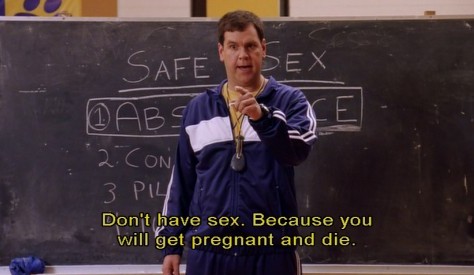
It’s a sign that, despite all these amazing advanced, certain parts of society are reluctant to embrace this world. They see these advances and worry that their children will live in a world where recklessness has no consequences. That, or they’re jealous that they’re too old to enjoy that world. It may be a combination of the two.
As I said before, for most of human history, there was a legitimate reason for people to exercise restraint in their sexual expression. However, society has tacked on a lot of other reasons that medical science can’t sure.
Religion and culture have ascribed this arbitrary “holiness” to chastity that has no basis in reality. These same forces hijack the human capacity for guilt and shame to scold those who dare explore their sexuality in ways that society deems inappropriate. This is a major theme in my book, “The Final Communion.” It offers an extreme example of what this kind of sentiment can do to people.
While religion and culture will continue to fight ardently to preserve their current state, we can take comfort in the knowledge that they tend to fail miserably in the long run. No matter how many obstacles or consequences are ascribed to sexual expression, be they legitimate or not, the drive to express these feelings remains strong. It’s one of the most powerful forces in nature. For that reason, it’s impossible to know for sure how society will change.
With all this context in mind, I’ll rephrase the thought experiment. Flash forward to some arbitrary point in the future. In that future, birth control is easy and accessible to everyone. In order to ensure that nobody need suffer the consequences, men and women are given injections around puberty that provide 100 percent effective contraception. In terms of disease, there are now special smart-drugs that can target or prevent any major or minor disease with perfect efficiency.
Now, an entire generation can grow up in a world where they never have to worry about the consequences of sex and they can explore it freely and openly. What kind of society will this generation create? We may not get there in our lifetime, but it will manifest at some point. It’s an important question to ask and one that I hope to explore in future books.
Filed under Jack Fisher's Insights, Uncategorized
Trends in Sexual Activity: Why Are People Having Less Sex?
We hear it all the time. Older generations complain constantly that young people are out of control. They’re too deviant. They’re too rebellious. They’re out there in the streets, running around naked, worshiping demons, and having sex like jackrabbits on crack.
Talk to anyone over the age of 45 and they’ll probably tell you that young people these days are more deviant than their generation. They’ll say young people are detached, distant, and selfish. They’re more concerned about texting on their phones than spending time with family, working on the farm, or volunteering at their church. Is there some merit to their criticism? Yes. Is their sentiment valid? No. In fact, it may be the opposite.
Last week, the Washington Post did an article highlighting the trends in sexual activity among Millennials. Some of these trends don’t fit the whining and complaining that older generations bemoan. It turns out, young people today are having significantly less sex than Baby Boomers or the Gen X crowd. The portion of youth that remains sexually inactive has more than doubled over the past 30 years. That’s a pretty big shift and nobody really knows why.
There are some theories. The article highlights concerns about sexually transmitted diseases, which grew significantly in the 80s and 90s. However, that alone doesn’t account for the data. Others suggest that the easier availability of porn, thanks largely to the internet, has made it easier for people to fulfill their needs without a partner. This is probably only partially true at best. Anyone who lived before the age of the internet will tell you that even without porn, they found ways to get off. They may not tell you before a few drinks, but it is true. People still masturbated before the internet.
I’m not a scientist. I don’t have any expertise in this area other than writing books centered around sexy themes. That said, I have learned through my many years of hearing people complain about sexual trends to notice a few themes.
Anything that’s happening in the sexual landscape of a culture basically becomes this big ink blot test. People are having more sex? This must be due to some perverse religious trend, some devious new form of media, or some widespread rebellion against authority. People are having less sex? This must also be due to some perverse religious trend, some devious new form of media, or some widespread rebellion against authority. People see this and use it to inject whatever conclusion they feel fits their agenda. They do the same with politics, religion, and tastes in fast food.
So what do I think? Well, I think like most things involving the complexities of human society, trends in sex have multiple influences. It’s not just smartphones, media, or diseases alone that affect these trends. It’s a combination of many forces, some more powerful than others. So if I had to give more weight to one force in particular, I’d favor the one that tends to govern most human affairs to a significant degree: economics.
Let’s face it. Sex and being in a relationship is expensive. Men and women expect a lot more these days and not just in terms of fancy dates. Between the cost of divorce and the conflicting expectations, getting sex requires a lot of time and energy. In an era where young people have to work a lot harder to achieve the same level of financial stability of their parents, there’s just not as much to dedicate to sex.
It’s not a very sexy explanation. I admit that. People are having less sex because they can’t find good jobs or are shackled with too much debt? That’s not a satisfying explanation and it doesn’t lend itself to a simple solution. People like things that are satisfying. Ironically, it’s kind of like sex. If it isn’t satisfying, they look elsewhere. In this case, however, what isn’t satisfying may also be valid.
Money does affect relationships in a major way. According to the Walls Street Journal, millenials in particular are shackled with a lot of debt, mostly from college loans. Few things kill your sex drive more than the knowledge that you can’t pay your bills and barely have enough money to survive. In terms of our basic needs, survival does take priority over orgasms most of the time.
Is it the only explanation? No. I don’t claim that this is the sole explanation for the decline in sexual activity among young people. There are likely other factors in play, such as changes in feminism and growing awareness of sexual assault. It’s hard to quantify just how much those factors affect the results. It may even be impossible in some ways.
Be this as it may, the success of the porn industry and the continued success of erotica give me hope that people of all generations still have a healthy libido. I hope to nurture it with my books. In the meantime, here’s an insightful video from Think Tank that explores this issue in greater detail. Their explanations are probably only part of the story though. What do you think is causing young people to have less sex? Nobody knows for sure, but that won’t stop plenty from speculating.
Filed under Jack Fisher's Insights, Uncategorized
Sex, Drugs, and their Effects

Sex, drugs, and rock n’ roll are a big part of popular culture, but what happens when you take away the rock n’ roll part? Despite what the Nixon administration, D.A.R.E., and every after-school special ever made would have us believe, human beings have used drugs in some form or another to enhance some part of their lives. Naturally, one of biggest parts we use it for is sex.
I’m not just talking about the drugs rock stars do with groupies. In 2015 alone, the drug company, Pfizer, made $1.708 billion in revenue from Viagra alone. So yes, sex sells and it’s a multi-billion dollar industry. So rock n’ roll really isn’t necessary for this potent combination to fly and no matter what drug warriors do, economics will keep this potent combination in business.
As we speak, these same billion-dollar companies are trying to make a Viagra for women as well. Like the female orgasm, however, it’s not quite as simple as getting blood to flow to the genitals. The greater difficulty women have in achieving orgasm, not to mention differences in evolutionary function that I’ve touched on before, make crafting such a drug a challenge. That hasn’t kept people from trying though.
Again, there are billions of dollars at stake. There’s too much incentive to give people drugs that enhance their sex life. At the moment, the only “female Viagra” that has this potential is called Flibanserin. It’s not quite an orgasm in a pill just yet, but it’s a vital first step and we can expect more like it in the coming years.
So why bring up sex and drugs? Well, it plays into some of the other issues I’ve talked about regarding ways that technology is changing sex. History shows that any advance, be it the advent of the latex condom or the birth control pill, is going to change attitudes about sex and the ways in which humans relate to one another. With the pace of technological change advancing at a rate that’s hard to keep up with, it’s difficult to imagine what kind of changes we’ll see.
These changes aren’t like trends in computers and smartphones either. Advances in drugs don’t always follow a simple pattern in terms of how they effect sex. There are drugs that negatively affect our sex drive, many of which are available at any drug store or with a prescription. The same goes for illicit drugs. Contrary to popular belief, alcohol isn’t an aphrodisiac. It can actually hinder sexual function. It’s only associated with sex because it removes inhibitions, thereby making people more open to sexual encounters.
The interplay between sex and other drugs, illicit and otherwise, is extremely complex and too much for a single blog post. It’s also unresolved because, despite mixing sex and drugs for years, we still don’t know everything about the way the two interact. Last year, Vice did a thorough report on how different drugs effect sex during their investigation into “Chemsex,” a topic I’ll cover in another blog post. You can read the article here:
Vice: This is your Sex on Drugs
There’s a lot in this article to examine. Drugs and their effects on the human body are complex and varied. At the moment, there’s no single drug that enhances sex for everybody in every instance. This quote from the article sums it up nicely:
Given how long—and often—humans have mixed drugs and sex, you’d think we’d understand the two pretty well by now. But as Johnson—who runs clinical trials testing narcotics’ effects on human behavior—can attest, drugs affect us all a little differently. Some have a direct pharmacological impact on the way we experience the world, while others affect our brains so dramatically that their impact on sex is a total crapshoot.
So as it stands, the interplay between sex and drugs is extremely varied and unpredictable. That unpredictability can make for interesting stories. At the moment, I’m throwing around a few ideas that explore this unpredictability. However, it’s the future of sex and drugs that I’m most interested in.
Every year, more and more drugs are emerging, legal and illegal alike. If there’s a way to mix these drugs with sex, people will find it and they will exploit it to the utmost. It may improve our sexual experiences. It may hinder them. One day, we may be able to control that. What kind of society will that create? How will that affect the way we relate to one another? Those are all important questions, but they’re best addressed in future blog posts.
Filed under Jack Fisher's Insights, Uncategorized
The Evolutionary Origin of the Female Orgasm

Last week, one particular story flew under the radar. I suspect a lot of stories will do that in the midst of a Presidential Election/Political Sideshow. However, being an aspiring writer who focuses on erotica, sex, and intimate romance, these sorts of stories do catch my attention. They also give me something new to think about as I’m developing my stories.
Believe it or not, there’s an ongoing struggle in the scientific world and it has to do with the female orgasm. Yes, the same science that gives is iPhones, rockets, and crazy glue still can’t decipher the female orgasm. Why is it a mystery? Well, evolutionary speaking, we don’t know why the hell it’s there.
Granted, we’re grateful for the joys of orgasms, male and female alike. I’ve already written about the numerous health benefits that come with orgasms so it’s not like nature isn’t aware of them to some degree. Nature tends to make use of something, regardless of how it came to be. That’s the thing though. From an evolutionary standpoint, we really don’t know how the female orgasm came to be or what purpose it serves.
Human physiology is pretty damn remarkable compared to other primates. In most primates, what science defines as an orgasm plays a part in reproductive success. A male’s orgasm is accompanied by the release of sperm. A female orgasm is accompanied by ovulation. It makes perfect evolutionary sense. A species that experiences orgasm in accord with reproductive behaviors is definitely going to have the right incentive to propagate.
Humans are different though. While the male orgasm is still associated with the release of sexual fluids vital for reproduction, the female orgasm offers no such benefit. A woman need not have an orgasm in order to reproduce. Ideally, it’s just a happy byproduct. Since nature favors survival over meaningless fun though, it still doesn’t explain why the female orgasm is still there. Now, a study published in July 2016 in the Journal of Experimental Zoology offers a potential explanation. Here’s the abstract:
The evolutionary explanation of female orgasm has been difficult to come by. The orgasm in women does not obviously contribute to the reproductive success, and surprisingly unreliably accompanies heterosexual intercourse. Two types of explanations have been proposed: one insisting on extant adaptive roles in reproduction, another explaining female orgasm as a byproduct of selection on male orgasm, which is crucial for sperm transfer. We emphasize that these explanations tend to focus on evidence from human biology and thus address the modification of a trait rather than its evolutionary origin. To trace the trait through evolution requires identifying its homologue in other species, which may have limited similarity with the human trait. Human female orgasm is associated with an endocrine surge similar to the copulatory surges in species with induced ovulation. We suggest that the homolog of human orgasm is the reflex that, ancestrally, induced ovulation. This reflex became superfluous with the evolution of spontaneous ovulation, potentially freeing female orgasm for other roles. This is supported by phylogenetic evidence showing that induced ovulation is ancestral, while spontaneous ovulation is derived within eutherians. In addition, the comparative anatomy of female reproductive tract shows that evolution of spontaneous ovulation is correlated with increasing distance of clitoris from the copulatory canal. In summary, we suggest that the female orgasm-like trait may have been adaptive, however for a different role, namely for inducing ovulation. With the evolution of spontaneous ovulation, orgasm was freed to gain secondary roles, which may explain its maintenance, but not its origin.
There are some telling words within the science jargon, namely the concept of the female orgasm being unreliable during sexual intercourse. I doubt women need science to prove this to them. However, that unreliability may be a big reason why orgasms developed into other uses. The study calls it “adaptive,” something that tends to happen a lot in evolution. If a trait ceases to have one use, it can develop another. That’s how land mammals develop into whales. This kind of adaptation, however, is much sexier.
It’s that adaptation part that helped make human beings the extremely social, uniquely passionate creatures that they are. If orgasms no longer have solely reproductive roles, then it can develop other roles within our species. Those roles include romantic roles. An orgasm doesn’t have to involve reproduction. It can involve love, the bonding of two individuals to create a more cohesive society. It’s that cohesion that helps make humans the dominant species of the planet. A bear may be physically stronger than any human, but humans can coordinate better to take them down. Orgasms are just part of that process.
Now it’s not like we need more reasons to celebrate orgasms, male and female alike, but it is nice to know that they did play a role in the success of our species. Success, on any level, is worth celebrating and orgasms give us plenty of ways to celebrate.
Filed under Jack Fisher's Insights, Uncategorized
Sex, Robots, and the Future
Do you find robots sexy? That’s not a joke. That’s a serious question and one that we may need to answer sooner than you think. We’ve all heard people raise concerns about the robot apocalypse. When most people think of it, they tend to think of world described in “The Matrix” or “The Terminator.” While these make for good Hollywood action movies, there is one part of this so-called apocalypse that isn’t touched on very often. That’s to be expected though because this part can’t fit into a PG-13 movie.
It’s going to happen. It’s actually already starting to happen, as Men’s Health reported earlier this year when a man professed his love to a life-like sex doll. We are going to have sex with robots. We are going to develop intimate relationship with robots. As they become more advanced and more capable of interacting with us, our human emotions will come into play. Along with those emotions will come desires. So how will they manifest? How will our society function in a world where men and women can have romantic sexual relationships with robots?
Now the concept of sexy robots is not at all new. The first “Austin Powers” movie gives us our most basic and crude concept.
These kinds or robots, as colorful and comical as they may be, are currently beyond our technical capabilities. So far, you can’t purchase a real sex robot today. However, you can purchase a very lifelike duplicate through RealDolls.com, a company that has been in business for years. While you can have sex with these dolls, they don’t interact. They can’t talk or exert themselves with any meaningful intelligence, emotional or otherwise.
That will eventually change because our technology is progressing rapidly. We already have robots who can beat people in chess and Jeopardy. We also have robots that can interact with some level of personality, such as Apple’s Siri and Microsoft’s Cortana. How much longer until we have a robot that’s advanced enough to be a real person? We don’t know yet, but we are starting to give the idea serious consideration. Last year, the movie “Ex Macina” built an entire story around it and it ended up being a lot more mature (not to mention darker) than “Austin Powers.”

Like “The Terminator” though, this story is limited in vision and scope. It focuses heavily on creating conflict more than exploring the implications. Those implications will show up before the conflict and some are giving it serious thought.
The New American posted an article last year about how some are already advocating for human/robot marriage. Marriage has already undergone significant changes with the recent advances in same-sex marriage. Will marriage with robots undergo a similar process in the coming decades? It’s hard to say, but there’s no question that we are becoming more and more linked with our technology. Is it just a matter of time before we start developing emotional, romantic, sexual relationships with robots?
On the surface, it has some distressing implications. A robot has no rights. A robot cannot sue for spousal abuse. A robot can be turned off, reprogrammed, and shut down. A robot can also be made to look like anything someone wants. What if someone wanted a robot that looked like a child or a specific actor/actress? What are the legal implications of that?
It’s hard to imagine how a human/robot relationship will function now, but then again same-sex marriage was in a similar position 20 years ago. Who’s to say that 20 years in the future won’t follow a similar path?
I tend to be more optimistic when it comes to the robot “apocalypse.” I believe that once robots become intelligent enough for us to have relationships with, be they sexual or otherwise, it’s going to change us as individuals every bit as much as we’ll change them. If a robot is smarter than us, then they will know how to accommodate us. They’ll know how to provide every emotional need we may have. Will that be healthy? Could having all your emotional needs being met by a robot be good for us?
Some may claim that robot relationships will lead to the extinction of the human race. Actually, it may do the opposite. If we can make a robot capable of having sex, then we can make a robot capable of giving birth as well. Artificial wombs are a real concept that’s in development. We may very well get to the point where we don’t need sex to reproduce anymore. If a society wants to grow its population, it can do so without putting women through the rigors of childbirth.
How will that society function? How will a relationship between a human and a robot function? It’s an intriguing question. It’s one I’m contemplating for a possible book. Nothing is set for now. I have other projects I’m still working on. In the meantime, I’ll let this video from the Huffington Post continue the discussion.
Filed under Jack Fisher's Insights, Uncategorized
5 Shocking Sexual Traditions From Around The World
We like to think we understand sex. We like to think we understand the world in general. We like to think that, but more often than not, we find out we don’t know a fraction of what there is to know. Sex, erotica, and romance are no different. I’ve learned through writing my novels that there’s so much to explore, far more than anything you’ll learn in a classroom or experience in your personal life.
As part of the creative process, and a healthy dose of lurid curiosity, I like to research different sexual practices. Some are found right here in the Western world. Others come from more exotic parts of the world. They’re all part of a diverse sexual landscape. While the biology of sex may be similar for most human beings, the culture that emerges around it is far more vast.
It’s easy for someone immersed in their own culture to think that theirs is the only logical way for sexual expression. That mindset tends to be narrow, rigid, and dull. It also tends to create a false sense of what constitutes normal. In the grand scheme of things, especially in the context of sex, there is no normal.
I attempted to explore that in my book, “The Final Communion.” In that story, I created a sexual ritual that is shocking, uncommon, and extreme by our standards. I won’t say it’s the most imaginative ritual, but it’s a fun exercise in the breadth of human sexuality.
That said, there are some real world sexual practices that are far more intriguing than anything in fiction. Thanks to the folks at MindChop, here’s a list of shocking sexual traditions, at least by our standards. To others, this truly is normal. So what does that make us?
Filed under Jack Fisher's Insights, Uncategorized
World Records In Sex
One frequent theme I like to explore in my erotic stories involves mixing sex with superhuman feats. I don’t deny that this is probably a direct result of my love of comic books and superheroes, something I have made clear in other blog posts. However, I do think it’s one of those untapped ideas that’s worth contemplating. With the way science is advancing, we will become superhuman one day. When that happens, it will affect the ways we see and experience sex.
I’ve already explored this in a major way with my second book, “Skin Deep.” In this story, the main character, Ben Prescott, starts off as a weak, sickly young man. He’s unremarkable in so many ways. He’s very much akin to the situation that most human beings find themselves in. Then, through a tragedy no less, he undergoes a treatment that gives him abilities that aren’t entirely superhuman, but they do change his situation considerably. He goes from a nobody to someone with the body of a male model or an Olympian athlete. And yes, it does effect his sex life in a major way. How? Well, the book goes into great detail.
I don’t believe that the feats in “Skin Deep” are entirely out of the realm of possibility. I do believe that one day, science and technology will make us superhuman in both our everyday lives and in our sex lives. So what does that mean for us? Well, it’s hard to say. There’s only so much we can do to speculate. So in the interest of providing some perspective, here’s a list of World Records involving sex, courtesy of The Chive.
Chive: Can You Break These Sexual World Records?
Some of these records may never be broken. Others will require some superhuman enhancements to say the least. This one, in particular, will likely be the most affected.

There’s no doubt that our bodies have limits. Nature can only do so much for us. However, our technology, know-how, and desire to improve ourselves will one day overcome these limits. What will be the effects? What will this mean for our sex lives? What will it mean for our understanding of romance? It’s something worth thinking about and I’ll definitely be contemplating more stories about it.
Filed under Jack Fisher's Insights, Uncategorized
How Religion Affects (Damages) Your Sex Life

As I’ve already pointed out before, there are multiple health benefits to sex. In that same post, I also pointed out that none of those benefits require that the individuals involved be married, trying to have kids, or even be in the same zip code. It’s one of those wondrous ways nature encourages us engage, explore, and embrace our sexuality.
That’s somewhat of an affront to the rhetoric of certain parts of our culture, namely the socially conservative, very religious type. According to their ideals, sex only belongs in marriage and should only be used for procreation and not recreation. That’s also a major tenant of nearly all major religions, especially the Abrahamic religions of Christianity, Judaism, and Islam. Their ideology is pretty strict. Adherents should not have the wrong kinds of sex with the wrong kinds of people or their God will punish them horribly.
It’s a pretty twisted ideology that warps part of our basic human nature. Major political candidates actually run on this ideology, sometimes successfully. It works too because because according to Pew Research, 6 in 10 people say that religion plays an important part of their lives. Now there’s nothing inherently wrong with people who are religious. There are religious organizations that do great work. That said, the ideology surrounding sex can be pretty damaging.
I went to high school. I took sex ed. It wasn’t abstinence only, but it wasn’t exactly positive either. The way it’s taught to young people gives a lot of false impressions about sex. Even in a diverse public school system in a largely secular community, my teachers overplayed the negative aspects of sex and pretty much ignored the positive aspects. That’s a clear sign that even in secular communities, religion does affect our sexuality.
So what are those effects? Well, not many of them are positive. Religion does affect our identity and our psychology. Religion often uses (and sometimes hijacks) our natural capacity for guilt, shame, and empathy to enforce its ideology. It’s a big reason why a large chunk of those who claim to be addicted to porn are actually highly religious. It’s like a placebo effect. If you think sex is harmful, then it’s more likely to be harmful. If you think sex is positive, then it’s more likely to be positive. It’s one of those things that is highly influenced by our own psychology, which makes it difficult (if not impossible) to quantify objectively.
I do worry about those who are highly religious and highly negative in their perceptions about human sexuality. Being someone who writes erotic stories and explores heavy romantic themes, it sounds so cold and solemn, being so negative about something that’s so intimate and human. I shudder to think at the unhealthy ways this can manifest.
I’ve actually don’t more than think. This unhealthy mix of religion and sexuality is a core theme of my book, “The Final Communion.” In that book, I create a world where sexuality is strictly controlled and show what happens when someone finally gets a chance to explore it. It’s a book that I’m sure won’t sit well with certain religious types, but it reflects an important sentiment.
We are, a our core, a social species. We seek out one another. We seek intimacy with one another. It’s part of what makes us human and it’s a big part of what makes us a successful species.
It’s a topic I regularly explore when I’m not writing erotic stories. One recent book I’d like to recommend takes a much deeper look at religion and sexuality from someone who knows way more about it than I do. It’s by Darrel Ray, who has written numerous books on religion and how they affect human psychology. This one focuses exclusively on sex and it’s aptly titled, “Sex and God.” Some elements of this book have impacted my approach to telling erotic stories. I intend to continue my exploration of this subject in hopes that those stories will be better.
Filed under Jack Fisher's Insights, Uncategorized


 Jack Fisher's Official Publishing Blog