Tag Archives: Michael Moore

A Band, A Song, And A Music Video That Has Aged Too Well

It’s a sad fact of life. Certain movies, TV shows, songs, toys, and products just don’t age well. For every timeless classic, like “Citizen Kane” or Mozart operas or Betty White, there’s an “All In The Family” or “Gone With The Wind.” That’s not to say these pieces of popular media are bad or should be censored. They just have a cringy impact in today’s climate.

I love classics as much as the next guy, but even I can’t deny that the lyrics for songs like “Brown Sugar” or “Under My Thumb” by the Rolling Stones have some distressing connotations. I don’t judge anyone who still enjoys those songs or loves the Rolling Stones. Let’s just acknowledge that times change, societies change, and certain media just doesn’t fit anymore.

That being said, it’s also possible for something to age a little too well. Again, I’m not just talking about Keanu Reeves or Betty White. Every now and then, you revisit an old movie, show, or song that doesn’t just fit right into the current cultural climate. It almost fits too well.

That’s how I felt recently while going over some old music. I was updating my workout playlist when I came across some old songs I had from Rage Against The Machine, a band I hadn’t followed closely since high school. In re-listening to some of those songs, I realized two things.

One, they still rock. They rock every bit as much as they did when I was a teenager.

Two, their music has aged way too well in the current political climate.

Now, if you know anything about this band, the kind of music they play, and what they stand for, you’re probably not surprised. Rage Against The Machine is not subtle. Their music is very political. It always has been, going back to their formative years in the mid-1990s.

They’re anti-authoritarian, revolution-heavy act that you don’t see much outside the heyday of the hippie era in the 1960s. As a teenager, I didn’t appreciate that kind of political rhetoric in music. At the time, the only politics I cared about involved how many snow days we were allowed at school.

Now, having grown up and become painfully aware of the current state of politics, I find myself appreciating Rage Against The Machine even more. I know it’s a couple decades too late, but it’s still profound. Just listening to the songs I have, I feel like they could’ve come out today and be just as relevant.

The best example that I came across just happens to be my favorite Rage Against The Machine song of all time, “Sleep Now In The Fire.” When I hear this song, it blows my mind that it came out in 1999. It feels so long ago, but it still rings so true.

Even the music video, which I remember seeing on MTV regularly, has aged remarkably well. I would argue it aged too well. Just see for yourself.

To anyone born after the year 2000, please take a moment to appreciate what the band did here. They defied a decision made by New York City. They played on the steps of the Wall Street Stock Exchange for this video. That could not happen today. In a world after September 11, 2001, they wouldn’t get off with a fine or a warning. They’d go to prison.

Then, there are the lyrics. Just take a moment and read over these lyrics. How much more relevant are they now compared to 1999?

Yeah
The world is my expense
The cost of my desire
Jesus blessed me with its future
And I protect it with fire
So raise your fists and march around
Just don’t take what you need
I’ll jail and bury those committed
And smother the rest in greed
Crawl with me into tomorrow
Or I’ll drag you to your grave
I’m deep inside your children
They’ll betray you in my name

[Chorus]
Hey, hey
Sleep now in the fire
Hey, hey
Sleep now in the fire

[Verse 2]
The lie is my expense
The scope of my desire
The party blessed me with its future
And I protect it with fire

[Pre-Chorus]
I am the Niña, the Pinta, the Santa Maria
The noose and the rapist, the fields’ overseer
The agents of orange, the priests of Hiroshima
The cost of my desire
Sleep now in the fire

[Chorus]
Hey, hey
Sleep now in the fire
Hey, hey, hey
Sleep now in the fire

[Verse 3]
For it’s the end of history
It’s caged and frozen still
There is no other pill to take
So swallow the one that makes you ill

[Pre-Chorus]
The Niña, the Pinta, the Santa Maria
The noose and the rapist, the fields’ overseer
The agents of orange, the priests of Hiroshima
The cost of my desire
Sleep now in the fire
Yeah

It’s downright eerie. The whole song is about how the rich, powerful, and well-connected can get away with anything. They lie, cheat, and steal with impunity. They’ll pay lip service to revolution and change, but never hesitate to throw people in a fire if they get out of line.

It feels like a perfectly dystopian indictment of the current political rhetoric. People on both sides of the political spectrum, liberal and conservative, jealously protect their power and influence. They’ll tell people what they think they want to hear, stoking hatred and fear, all while enjoying the fruits of their position.

Regardless of your politics, you can’t help but appreciate this kind of hard-hitting message. It feels like we’re always at the mercy of the rich and powerful. They play political games. We’re just brought along for the ride.

Rage Against The Machine was making music about this long before the internet, social media, and cable news made those politics so hateful. They dared to rage against a corrupt system before it became a common tool of political theater.

They warned us.

They yelled it out in song.

We didn’t listen and we should’ve.

At the very least, they still rock.

Leave a comment

Filed under Current Events, media issues, music, political correctness, politics, YouTube

Why You Should NOT Take Documentaries Too Seriously

Throughout my life, I’ve gone through various phases where I become immersed in certain genres of movies. For a time, I was really into slasher movies. Then, I picked up on the distinct sex-negative themes of those movies and lost interest.

At another time, I became immersed in documentaries. Not surprisingly, that interest also coincided with me getting a subscription for Netflix, a service that puts you in immediate contact with documentaries of all kinds. From government conspiracies involving aliens to stories about porn stars after their career in porn ends. There’s something for everyone is what I’m saying.

On top of that, I also went through a phase where I was pretty big into government conspiracies. It wasn’t just that I believed them to some extent. It was the story around them that fascinated me. Given my love of telling stories, which has since manifested in some sexy novels, it checked all the right boxes for me.

It’s true. There was a time when I actually believed that the government was covering up evidence of an alien presence on this planet. There was also a time when I genuinely believed that the government colluded to manufacture wars from Vietnam to Iraq. I actually believed the government, and people in general, were capable of such confidence. I’ve since learned to temper my expectations.

While I’m no longer a fan of documentaries, I do watch them from time to time. However, I watch them with an overly critical eye. With every documentary I see, even if it has a message I agree with, I still assume that it only offers a tiny part of the story. Chances are a good chunk of this message is a result of cherry picking, clever cinematic, and outright lies.

Now, that’s not to say that the people making these documentaries are total frauds. I don’t doubt for a second that Michael Moore and Morgan Sporlock genuinely believe in the work they’re doing. They wouldn’t sink so much time and money into it if they didn’t. However, these men have agendas. That’s the flaw in every documentary.

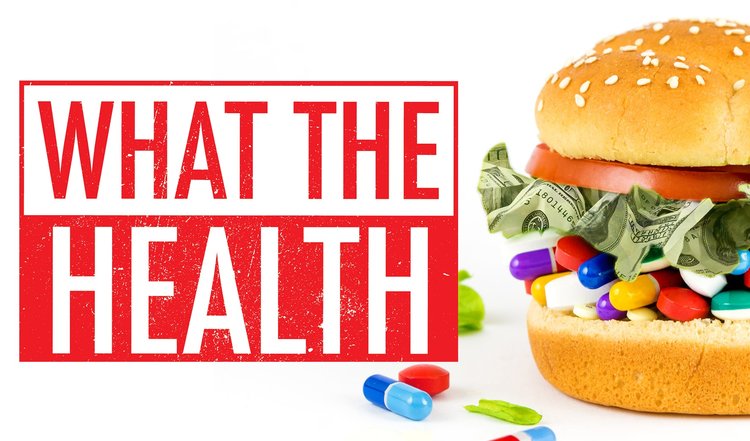
This leads me to what specifically inspired this post. Last week, I couldn’t sleep so I decided to fire up Netflix and find some random show. Usually, certain documentaries help make me sleepy, usually the ones that narrated by soft British voices from the BBC. For some reason, I ended up watching a new documentary that came recommended on my list. It was called “What The Health.”

The premise of the documentary was simple. Pretty much all the food you enjoy eating, from fast food to candy to beef jerky to fried eggs, is terrible for you. It’s not just bad for you health-wise. It will give you cancer. I swear on Pamela Anderson’s tits that’s the actual message.

Kip Andersen, the director of this documentary, has a simple message. If your food has any animal products, then you might as well be sprinkling plutonium on your food. It’s also worth mentioning that Kip Andersen is an ardent vegan with a very pro-vegan agenda. He is to health conspiracy theories what Alex Jones is to government conspiracy theories.

That’s not to say that “What The Health” is completely devoid of facts, but it is very much an extended slate of pro-vegan, anti-meat, anti-corporate, pro-hippie propaganda. Even by liberal standards, this documentary is pretty slanted. It would be like a anti-gun control documentary that claims not having a gun makes your penis small, your tits shrink, and your asshole itch. It’s that bias.

Again, I don’t doubt for a second that Kip Andersen believes in what he’s saying. He comes off as the kind of guy who just obsesses so much over his health. That’s what gets him up in the morning. That’s what makes his dick hard at night. What sexy novels are to me, health is to Kip Andersen.

The problem with that, which also happens to be the problem with every documentary, is that it’s produced with an agenda in mind. The size and scope of that agenda varies. There are some documentaries that try to be objective. Most of those produced by PBS tend to be fairly balanced, but even they can fall into the same Alex Jones trap every now and then.

What bothers me about documentaries like “What The Health” is that it’s produced in a way that really preys on our caveman brain’s biggest flaws. There’s just no way to shrug off something like cancer. Pretty much everyone, myself included, knows someone who has suffered from cancer. According to the CDC, cancer killed nearly 600,000 people in 2014 alone. The suffering these people endured cannot be understated.

The problem is that cancer is such a complex disease. There are all sorts of genetic, environmental, lifestyle, disease, and chemical factors that go into it. There’s no one single virus, one single gene, or one single food group that causes it. The human body is too complex, as anyone who has ever studied the female orgasm can attest.

The message “What The Health” sends is not only horribly skewed to the hippie end of the political spectrum, but it’s downright misleading. It gives the impression that cancer and disease have a singular cause. All anyone needs to do to avoid is to just shun animal products, become a vegan, and eat cardboard for the rest of their lives. The fact that this is the same lifestyle as the director is just a hell of a coincidence.

I won’t deny it. “What The Health” does a damn good job of painting itself as credible. However, every documentary does that to some extent. They parade out all these doctors and experts in the field, making bold claims that they can legitimize with their PhDs and titles. However, it’s worth remembering that, as smart as these people are, they’re still human.

It’s also worth remembering that doctors do get things wrong more than we care to admit. There’s also a distressingly large amount of medical research that turns out to be wrong. Like I said, the human body is extremely complex and our caveman brains aren’t wired for that kind of complexity.

On some levels, Kip Andersen and Michael Moore exploit those flaws in our brains. They know how to craft a message that seems credible. They craft a slick, polished narrative that appeals to certain fears and misgivings that everybody has to some degree. They create a false or half-true narrative that preys on our desire to understand the world.

What often happens is that they’re very selective about the information they present. In a sense, they’re taking advantage of the same paradox I pointed out with health care. It’s not just very difficult to offer all the facts in a simple, two-hour documentary. It’s physically impossible. There isn’t enough film on a reel or enough seconds in two hours to convey all that information.

As a result, the message in every documentary is incomplete. In some cases, they’re so incomplete that someone else will try to verify those messages, only to find out how wrong they were.

This actually happened with Morgan Sporlock after his hit film, “Super Size Me.” That movie, much like Kip Andersen, had a very clear agenda. It was anti-corporate, anti-fast food, pro-nutrition. Sporlock even put himself in the line of fire, eating nothing but McDonald’s for 30 days. The proof seemed so clear and apparent.

Then, another documentary called “Fat Head” by Tom Naughton tried to replicate Sporlock’s experiment. There was just one glaring problem, though. The math didn’t add up. He literally could not eat as many calories as Sporlock claimed in “Super Size Me.” You can push an agenda all you want, but if the math doesn’t add up, you’ve got a problem.

On top of that, other people have done similar experiments and come up with different results. A science teacher armed with none of Sporlock’s movie-making resources was able to eat nothing but McDonald’s and actually lost weight. When there’s this kind of inconsistency on all sides, chances are there’s something missing from the story.

Again, I don’t believe that these people do what they do entirely out of malice and greed. Some might, but I choose to have a higher opinion of people in that respect. I think Andersen and Moore sincerely believe the messages in their documentaries, just as creationists ardently believe in their message, despite all the evidence to the contrary.

Now, you can choose to side with men like Moore, Sporlock, and Andersen on various issues. That doesn’t make you a bad or foolish person. However, it’s important to understand that documentaries are not the same as verified, scientific research. They are movies, made for the purpose of telling a story and gaining an audience. They may contain some elements of truth, but they will never tell the whole story.

1 Comment

Filed under Jack Fisher's Insights