Tag Archives: nature

A Sexually Transmitted Fungus Is Making Trillions of Cicadas Hypersexual and Gay

I know. If you just read the headline on this post, you’re probably confused. You might think I’ve just stumbled into an insane rabbit hole that would make Alex Jones pee his pants. But I promise that what I’m sharing is real. It’s not from some comedy website or Onion post. This is a real story about a real fungus that has a peculiar effect on cicadas.

There’s a lot I could say about that effect. But I do no think I’m mature enough to paraphrase it. So, go ahead read the article for yourself. Even if you don’t find it interesting, you can’t deny that this might very well be the single greatest headline of the year thus far. And I don’t know if or when it can be topped.

Them: A Sexually Transmitted Fungus Is Making Trillions of Cicadas Hypersexual and Gay

No, society is not turning your kids gay. But cicadas and fungus? Well, that’s another story.

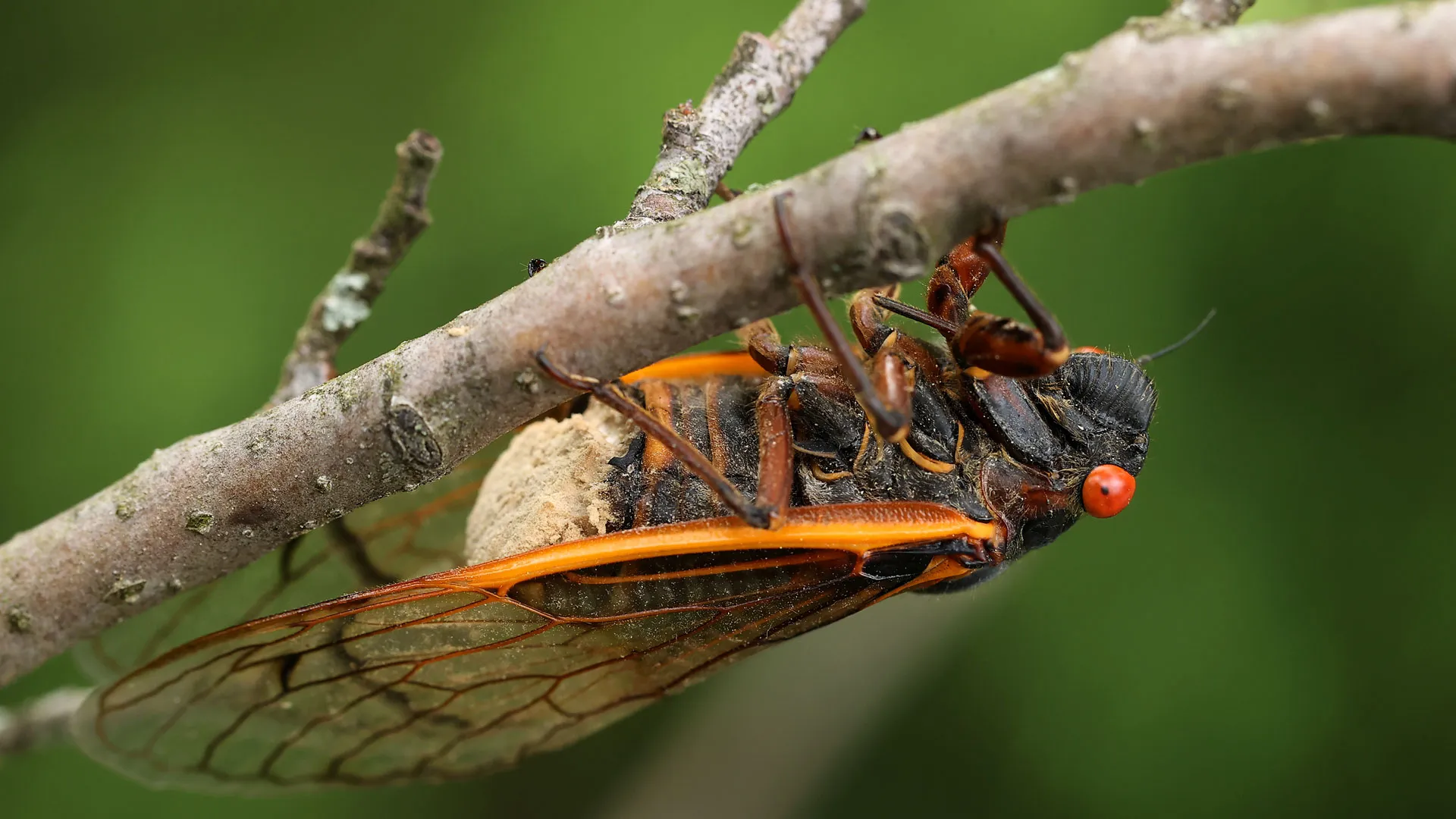
Last week, CBS News reported that, this spring, trillions of the bugs are expected to emerge in huge numbers not seen in decades and maybe even centuries, resulting in “cicada-geddon,” as one scientist called it. On top of that, some of the bugs will be “zombie cicadas,” who are infected with a sexually transmitted fungal pathogen known as Massospora cicadina. The fungus makes them hypersexual… and gay.

Matthew Kasson, a professor of mycology and forest pathology at West Virginia University, told CBS that, when infected, a cicada’s genitals will fall off within the next week or so as the fungus erupts and covers roughly a third of their body. Yet at the same time, the fungus produces an amphetamine that, basically, makes male cicadas super horny for their fellow bugs, regardless of their sex.

“Males, for example, they’ll continue to try and mate with females — unsuccessfully, because again, their back end is a fungus,” Kasson said. “But they’ll also pretend to be females to get males to come to them. And that doubles the number of cicadas that an infected individual comes in contact with.”

If you managed to make it through that snippet and aren’t uncomfortably horny right now, I’ll just add this.

Nature is amazing!

It’s also kinky, dirty, and horny as hell. But it’s still amazing.

Beyond the sheer poetry of the headline and the raw sexiness of the science, I also think it’s worth taking a moment to appreciate the sheer weirdness of our world. Everyone has a certain perception when it comes to nature, how it works, and what makes it beautiful. Those perceptions aren’t right or wrong. But no matter how we feel about nature, the way it manifests in the real world is always going to be more elaborate.

We see bugs and we usually don’t give them a second thought.

Someone mentions fungus and the first thing we think about is mushrooms on pizza.

But nature dares to do more with both in ways we never would’ve imagined, even in our most eccentric moments. It’s capable of producing bugs like cicadas, which make this strange, but distinct noise that most always associate with hot summer days. It’s capable of producing fungus that causes mold in our showers, as well as mold that makes cicadas irrationally horny.

Again, nature is amazing!

You can think what you want about fungus affecting the sexual behavior of bugs. Our moral judgements really don’t affect nature, no matter how weird we think it is. But it still happens. It manifests around us. And there are probably other ways it manifests that we’re not aware of that might very well be even kinkier.

Even so, I challenge nature and those who study it to top this headline. Because honestly, I don’t think it can be done.

Leave a comment

Filed under funny, sexuality

The (Non-Monetary) Root Of All Evil

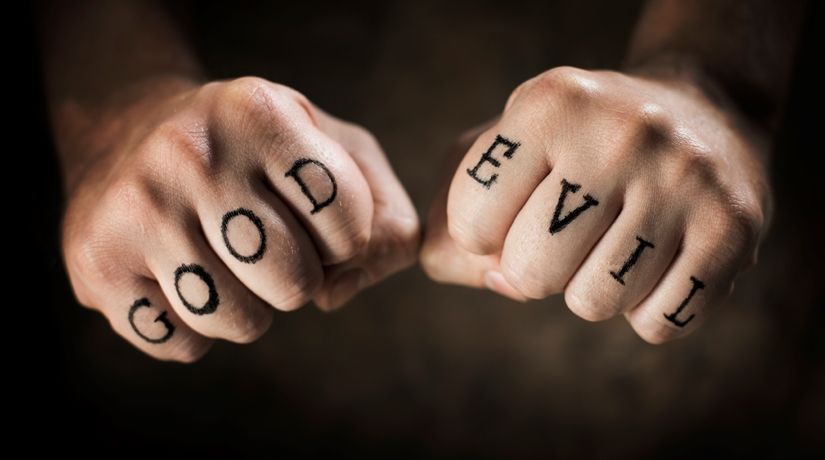
What is it about the human race that makes some people amazingly generous while others become sickeningly depraved? It’s a question we’ve all contemplated in some form or another. What drives the person who helps out at a soup kitchen every week? What is it that drives the person who throws cherry bombs at mailboxes just for kicks? How can one species have this much variation in terms of evil and altruism?

As an erotica/romance writer, and a writer in general, I have to contemplate these questions more than most. In every story I write, whether it’s a sexy love story like “Holiday Heat” or an erotic thriller like “The Escort and the Gigolo,” I need to understand on some levels what makes people tick, for better and for worse.

Questions about evil aren’t new. In fact, they’re among the oldest questions that we, as a species, have asked ourselves. It’s right up there with questions about why aliens haven’t landed yet and why some insist on using anal probes. It’s an existential question as much as it is a scientific question. It’s one of the few questions that both science and religion work hard to answer, albeit with different methods.

In western religious traditions, which primarily involve the big three Abrahamic faiths of Judaism, Christianity, and Islam, there are certain assumptions about human nature that are intrinsically tied to the faith. In this tradition, human nature is believed to be inherently evil and in need of redemption. Anyone who spends more than two hours watching reality TV will probably find some merit to that argument.

Then, there are other traditions like Hinduism, Taoism, and Buddhism that don’t make the same assumptions. In these traditions, there are other forces that make human beings good or evil that aren’t necessarily innate. To be evil by nature is too simplistic in these traditions. There’s a whole host of factors, divine and otherwise, that contribute to someone’s capacity for either.

Neither tradition can be completely right, but that doesn’t mean both are wrong. Scientific studies on human nature are quite varied, but come to some intriguing conclusions. According to a Scientific America article from 2012, the current body of research suggests that humans are innately good and evil is more of an aberration.

That doesn’t mean that we humans should be thumbing our noses at the rest of the animal kingdom though. This research, like all scientific research, is incomplete and subject to change. New research could emerge tomorrow that concludes that every human being has a depraved, psychotic asshole lurking within and we’re doing just enough to keep it at bay.

These are very difficult questions to answer and many of those questions don’t have clear answers. I look at the concept of good and evil the same way I look at what makes something sexy. The line is not clear and constantly shifting. In the same way we find strange things sexy for stranger reasons, we see the line between good and evil as an exceedingly obscure sea of gray.

Everybody has their opinions on what makes someone good, but I’ve noticed that people have stronger opinions on what makes someone evil. It happens every time there’s a heinous crime, like a mass shooting. Everybody has their theories as to why someone does something so evil.

Some claim it’s bad parenting. Some claim it’s a product of poverty. Some claim it’s a product of abuse. Some say it’s genetic. Some say it’s a learned behavior from someone’s environment. Some just claim that some peoples’ brains are wired poorly.

The most frustrating part of this issue is that to some degree, every one of those theories might be right. Some people become evil due to bad parenting or a rough environment. Some become evil through severe mental illness that makes it difficult for them to make sense of right and wrong. Human beings are erratic, diverse creatures. We’re never content to just have one reason for doing something.

This becomes even more pronounced when you apply it to fiction. As an admitted comic book fan, the distinction between superheroes and supervillains is a cornerstone of the genre. Most people can pick up a comic and know who’s who. You see a comic with Superman and you know he’s the hero. You see a comic with Dr. Doom and you know he’s the asshole who will make people miserable.

However, recent years have given more emphasis to the villains, as opposed to the heroes. I like to think of it as the Walter White effect. We now expect our villains to be more complex and multi-dimensional. It has lead to developments like Dr. Doom becoming Iron Man and Lex Luthor becoming Superman. It’s as crazy a concept as it sounds, but believe it or not, it works.

It’s a strange era with respect to our understanding of evil. On one hand, our most cherished traditions say we’re intrinsically evil. On the other, science says we’re intrinsically good. What do we make of this? That’s a question nobody, especially not an aspiring erotica/romance writer, is equipped to answer in a single blog post.

It’s still a question that I find myself contemplating more as I prepare my next round of projects. In every major story, there are protagonists and antagonists. It’s not too hard to put a lot of energy into what makes a protagonist tick. They are, after all, the lens through which the story is told. The antagonists, on the other hand, present a different challenge.

For the most part, I haven’t had a chance to flesh out complex antagonists. The two most notable examples I’ve had, to date, are Warren Irvine in “Skin Deep” and Madam Felicity in “The Escort and the Gigolo.” In both cases, I made a concerted effort to give layers to these characters. I think I did the most with what I could, but I do feel there’s room for improvement.

For me, this means seeking a greater understanding of evil and what makes evil people tick. It’s a potentially scary subject, but I survived high school and puberty so I think I have the stomach for it. If it means being able to write more complex, well-rounded characters, I’ll gladly take that chance.

5 Comments

Filed under Jack Fisher's Insights