
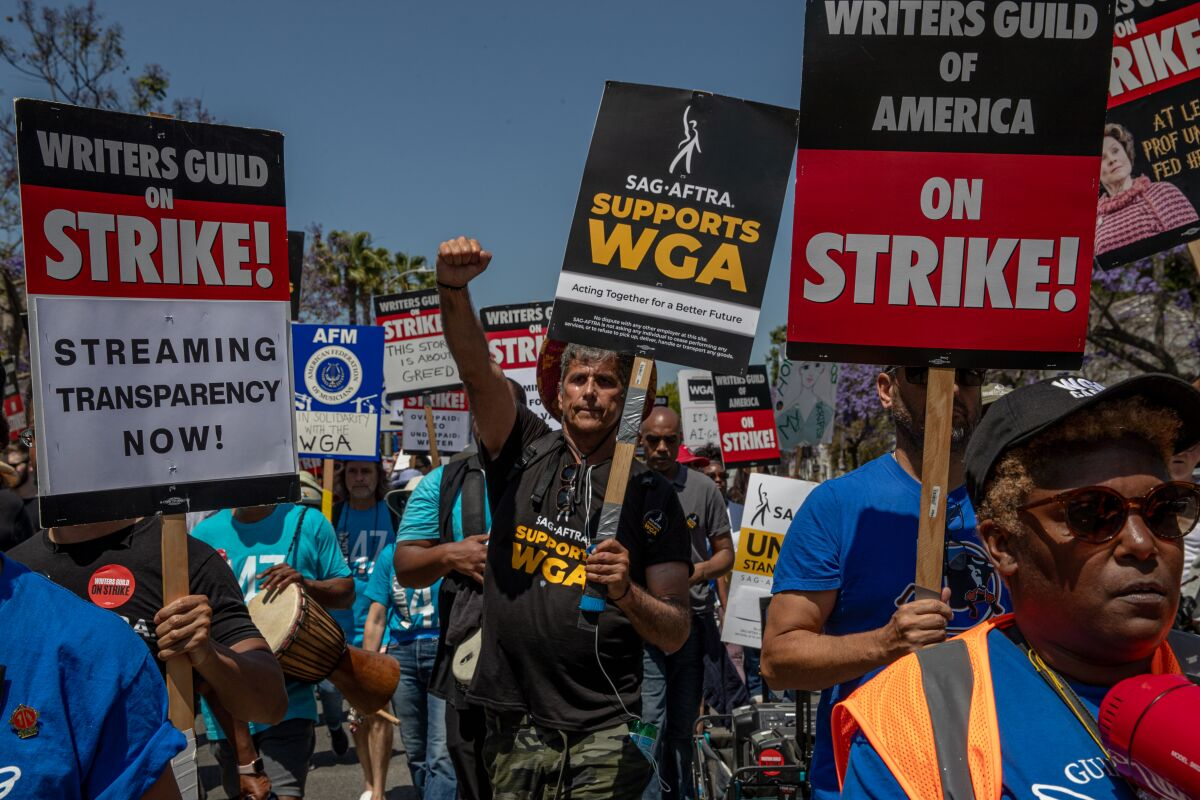
Firstly, let me go on record saying that I fully support the WGA and SAG’s strike. I’ve said before that we should support them as they fight the very powerful, very well-funded Hollywood studios who profit from all their hard work.
The fact that both the actors and writers stand united in this strike for the first time since 1960 is promising. As I write this, pretty much every major movie production has shut down. The studios could only do so much without their writers, but they literally can’t do anything without their actors. That likely means highly-anticipated movies will be delayed, but it also means the people actually making those movies might actually enjoy some of the profits.
That shouldn’t be such a radical concept, but that’s where we are right now. You need only look at many of the recent testimonies to attest how poorly compensated some people are compensated.
However, this brings me to the second reason I’m making this. Because I’d like to offer what I feel is an important message to both the writers and the actors on strike right now. It happens to involve artificial intelligence, something I’ve written about before and something that happens to be a major concern for this strike.
There’s a lengthy list of issues associated with AI and how it may impact the entertainment industry at large. I’m not qualified to go over all the particulars. So, here’s a video I found that should help break it down.
With that out of the way, the first part of that message goes to the actors. Their concerns about AI might not be as significant as the writers, but I strongly believe they’re not showing enough concern. And even if they don’t understand the true impact of AI, I hope they at least heed this critical message.
Do NOT under any circumstances sign away your likeness, voice, and persona to any studio without retaining some measure of control and an appropriate structure for long-term compensation.
Seriously, I don’t care how big a star you are or how well-off you might be. Do not give any studio, large or small, the right to use your voice and likeness at the moment. The current laws are not at all equipped to protect against the never-ending efforts by studios to exploit the hell out of any star, franchise, or intellectual property.
This is not a popular novel, character, or fairy tale for which copyright laws were intended to protect. This is your name, identity, voice, and brand. Giving any studio complete or even partial control over that right now is akin to giving every hacker on the Dark Web your tax returns and credit reports for free.
I don’t know when or if the law will ever catch up to this. Right now, your best bet is to make sure your next union contract addresses this issue and ensures at least some level of control. Because I promise the technology to fully render someone in a way that’s indistinguishable from reality is coming within our lifetime. You need only look at the current state of deep-fakes to appreciate why this is the time to act.
The second part of my warning is to the writers. They are definitely more aware of how AI technology could affect their livelihood. They’ve all seen how products like ChatGPT can write a movie script in seconds. That’s not to say it writes those scripts particularly well. Most reasonable people can still tell when a piece of writing is generated by AI. And no skilled writer or studio executive will mistake an AI written script for the real deal at the moment.
But therein lies the issue that I’d like to highlight. So, to the WGA writers striking right now, please heed my words when I offer this important message.
Plan for the long term with respect to AI. Because it will get better over time. And at some point, it’ll be better than you at almost every writing task.
This is not a dire prediction. I’m not trying to be overly fatalistic, either. When I say plan for the long-term, I don’t just mean get a binding contract that gets everyone back to work for another decade or two. I’m saying the writers striking right now need to think much furthe ahead.
Right now, AI products like ChatGPT are a long way from replacing skilled writers, but not as long as most people think. I’ve heard a number of writers and influencers scoff at AI, saying it’s nothing more than autocorrect on steroids. Some even call it a script blender, which just takes a bunch of data from other writers and scrambles it like a blender until it produces something that just seems original.
If that’s what you’re thinking, then I strongly encourage you to find a better source of information on emerging technology. Because writing off the ability of ChatGPT to write scripts is like writing off the first iPhone because it just looks like an iPod with a call feature. You’re not seeing the forest from the trees.
The current AI programs we have right now are limited, clunky, and crude. They’re very much akin to the early models of the iPhone in that they are in the early stages of refinement. You could definitely make the case that early versions of ChatGPT were basically fancier versions of autocorrect blended with your standard virtual assistant.
However, the latest version of ChatGPT is much more capable in terms of scale and ability. To simply call it a more advanced version of autocorrect is like calling a motorcycle a more advanced version of a kids’ tricycle. And it will continue to improve. That is the only certainty we have at this point with AI technology.
That’s not to say it’ll become sentient and go full-blown Skynet on the human race. In fact, AI doesn’t even need to achieve human-level intelligence to be just as capable as any writer or producer. It just needs to be refined, capable, and developed to a point where it can “think” about entertainment on a level that’s better than any human being ever has or ever will.
That kind of AI might not be feasible now. It might not even be feasible this decade. But make no mistake, it will likely happen in your lifetime. And the studio executives you’re up against now would love nothing more than to see this technology perfected so that the process of creating hit shows and movies is as automated as a modern assembly line.
It doesn’t matter to them if it means putting you, the actors, or the many crews on movie sets out of work. It just matters that it turns a profit in the short and long term.
That means that when negotiating with the studios, it’s not enough to just think 10 years ahead. It’s not even enough to think 20 or 30 years ahead. This may very well be your first and only chance to get something in writing that ensures writers will have some stake in the creative process moving forward. And if you fail to achieve that now, then rest assure the studios will screw you over the nanosecond an AI can write scripts as good as you.
Don’t let that happen.
Don’t let the studios screw you like that.
Get something in writing that ensures or at least complicates those efforts as technology continues to change entertainment.
But if I have one final message to the actors and writers alike, It’s this.
You cannot stop AI from affecting your industry.
We’re past the point of no return on this. The genie is out of the bottle. Like smartphones and electricity, the technology can’t be uninvented. You’re not going to convince the studios to just ignore AI moving forward. That’s like trying to convince horse-and-buggy manufacturers to ignore cars.
One way or another, you’ll have to find a way to co-exist with AI. I don’t claim to know how this will manifest in terms of a contract or some sort of legal protection. I just know that in the history of any industry, fighting new technology is a losing battle.
We’re still with you.
We still want you to succeed.
Just don’t assume that the AI you’re concerned about now is anywhere near as disruptive as it’s going to be.


 Jack Fisher's Official Publishing Blog