Tag Archives: Constitution

Why Americans Should NEVER Talk To The Police: A (Relevant) Legal Perspective

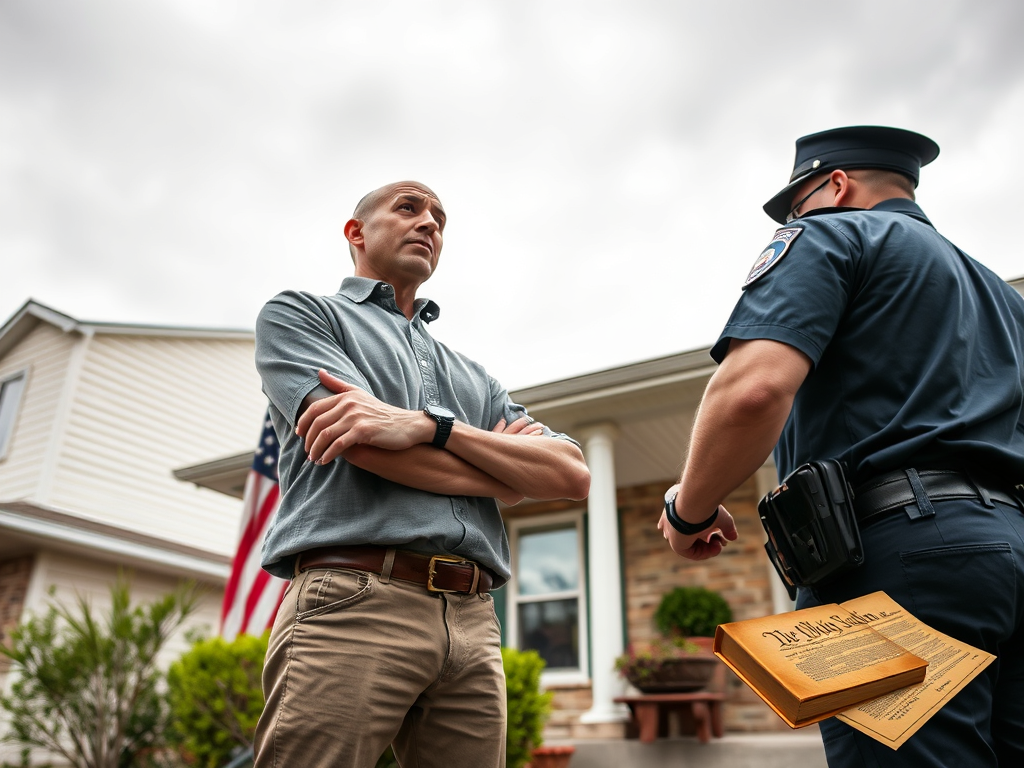
These are strange, distressing times for America. As an American myself, I’ve never been more concerned or pessimistic about the future of the country I love. There are many reasons for that. But rather than get overly political and go on another rant, I want to offer some important advice to any American who might find this.

Regardless of what you see in the news or in rage-baiting headlines, you still have rights under the Constitution.

The current people in power have shown time and again that they are very willing to undermine those rights. You cannot let them. As an American, it is your responsibility to protect and defend those rights. Believe it or not, you do have the law on your side, even if those enforcing it would have you believe otherwise.

To understand, I’d like to refer to an old YouTube video from 2012 that I often share with people who don’t understand the law, the Constitution, or rights in general. It’s a lecture from a former criminal defense attorney at a law school. He makes the case better than anyone before or since that you, an American citizen, should never under any circumstances talk to the police.

It doesn’t matter if you’re innocent. It doesn’t matter if you’ve never broken a single law in your entire life. Thanks to the Constitution, specifically the 5th Amendment, you have the right to not talk to the police. And you should use it. If you want to know why, just watch this video and share it with everyone you know.

Hopefully, you now understand and will act accordingly, should you ever encounter the police or any law enforcement official. There are plenty of other videos on YouTube that document police encounters. But this one is still the most informative from a purely legal perspective.

Also, I would supplement this video with a few other details that are worth mentioning. If the police ever knock on your door, don’t open it unless you have a screen door separating you and the officers. Unless they have a warrant, they cannot legally enter your home by force.

And if possible, record your encounter and let the officers know that you’re recording. It doesn’t matter if they have body cameras. Make sure you document every detail of the encounter. And make sure the video you’re recording is stored somewhere other than your phone. If you ever have any legal issues, that video will be instrumental.

Lastly, and this is something that I doubt the men in the video could’ve foreseen, but these rights apply to everyone in the United States, regardless of their citizenship status. It doesn’t matter what anyone in the reactionary media say. The language of the 14th amendment is very clear.

All persons born or naturalized in the United States, and subject to the jurisdiction thereof, are citizens of the United States and of the State wherein they reside. No State shall make or enforce any law which shall abridge the privileges or immunities of citizens of the United States; nor shall any State deprive any person of life, liberty, or property, without due process of law; nor deny to any person within its jurisdiction the equal protection of the laws.

Note the bold text. It says person and not citizen. Anyone who claims otherwise is an idiot, a liar, or both.

I really wish I didn’t have to make a post like this for my fellow Americans, as well as those aspiring to be American. But these are the times we currently live in. They suck. They’re probably going to get a hell of a lot worse. But at least for now, the Constitution says you have rights. And now, more than ever, you should cherish and defend them.

Leave a comment

Filed under Current Events, politics

Post-Election Day PSA: Do NOT Trust Or Expect Politicians To Solve Your Problems

It’s over, my fellow Americans.

It’s finally over.

Election Day has come and gone. I won’t get into the drama leading up to it or the drama that’s still unfolding, as I write this. I just want to take a step back, catch my breath, and offer some perspective to those who will hear it.

I agree this was rough. I think most others will agree with me when I say this was the most chaotic, divisive, and downright stressful election in recent memory. I’ve spoken to relatives who voted for Kennedy in 1960. They agree that this year was, by far, the worst in terms of stakes, rhetoric, and tone.

That’s saying a lot, by the way.

However you feel about the candidates or who you voted for, I genuinely hope this election has been revealing, to a certain extent. It’s tempting to be cynical about it. I certainly wouldn’t blame anyone for feeling that way. At the same time, we should also take stock as to why this election was so harrowing, for lack of a better word.

The world is such a messed-up place right now. We’ve got wars, economic collapse, and a once-in-a-century pandemic has that killed over a million people in the span of nine months. Things are bad right now, more so than they’ve been at any point in my lifetime.

Most don’t question that, unless they’re rich and well-connected.

What I do question, however, is why people trust or even expect politicians to help solve these problems.

That’s a notion that, in my opinion, fuels stressful elections like this. An election is supposed to be a job interview for a position for a public-serving official. It’s not supposed to be some expensive spectacle in which we all get behind the candidate who says the right things to just enough people in a handful of swing states.

That’s not democracy.

That’s a bad reality TV show.

Now, it’s tempting to just blame the politicians and that’s understandable. Politicians are easy targets for mockery and they’ve no one to blame but themselves for that. We should criticize them. They are, after all, in positions of power and public trust. They should be held to a higher standard.

That standard, however, should not involve trusting them to fix everything that ails us, from the economy to who pays a fine for when a female nipple is shown during a halftime show. That’s not just asking too much of one person. It’s asinine.

It’s also self-defeating. Politicians make lots of promises and break plenty of them, but let’s not lay the blame entirely on their honesty or lack thereof. They’re only human. Even the most selfless, hard-working politician can only do so much to deliver on every promise. There just aren’t enough hours in the day or enough personnel to get it done.

That’s not even accounting for the times when politicians make objectively impossible promises. Certain policy pitches may sound like great slogans or taglines, but logistically speaking, they just cannot be done in the real world. It’s not that the sincerity isn’t there. There just isn’t enough people or resources.

Therein lies the source of the great cycle of toxic politics. It goes something like this.

Politician A makes a bold promise. People rally behind them. Politician A get elected.

Politician A cannot deliver on those promises. People turn against them.

Politician B comes along, offering new or better promises. People rally behind them. Politician B get elected.

Again, Politician B can’t deliver on all those promises. People turn against them.

Politician C comes along to make another set of promises and the cycle continues.

It goes beyond party affiliation, political systems, or shifts in power. It’s an unavoidable flaw in a democratic system. An election, by default, isn’t going to elect someone with the greatest governing skill. It can only elect someone with the skills to convince enough people that they can govern.

I won’t say it’s a terrible system. Compared to the alternatives, it’s probably the best we can manage right now in our current environment. However, it is not a system in which any politician, no matter how successful, can solve the problems we want them to solve. Even when the system is working at its best, it’s still limited.

That’s not to say politicians can’t be part of a solution. They definitely can be. A politician can be a facilitator of sorts, either by leadership or by policy. The specifics, though, are best left to people with the right drive, incentives, and know-how.

Whether it involves combating climate change, reducing poverty, or promoting public health, the bulk of the responsibility will still fall on the general public. We, as a people, have to collectively work on these issues together. That’s how any social species within a functional society adapts, grows, and prospers.

The role of government and politicians is always changing. The extent or details of that role depends heavily on the issue at hand. The Presidents we elect, as well as the various legislators and judges at all levels, will always have some impact on how we further our interests. The key is balancing that impact with actual, tangible efforts on our part.

The next four years are sure to be eventful. Hopefully, they’re eventful for all the right reasons. Whatever happens, use this past election as a teachable moment.

Politicians come and go.

Ambitious people will keep making bold promises and breaking them, either on purpose or through no fault of their own. At the end of the day, it all comes back to us. We have a part to play in making our world and our lives better. Let’s focus on doing ours before we trust anyone else to do it for us.

1 Comment

Filed under Current Events, human nature, media issues, political correctness, politics

Why I’m Not Overly Excited About Voting

Vote

I’m bracing myself right now because I’m about to express a sentiment that’s going to put me at odds with a lot of people here in America. It’s a sentiment that runs contrary to some pretty loud rhetoric that has been brewing over the past two years. Some of it has even come from close family members. Knowing I’ll probably upset them too, I’ll just come out and say it.

I’m not that excited about voting.

I’ll give my fellow American’s a moment to stop fuming. For everyone else, I think a larger explanation is warranted. Bear with me because these are sensitive times for freedom, democracy, and everything in between.

Today, my country will conduct its mid-term election. It occurs every four years, right in between Presidential elections. These elections are a critical part of the foundation on which the United States government is built. These are the elections in which a sizable chunk of governors, senators, and representatives are elected.

While mid-term elections rarely generate the same voter turnout of Presidential elections, this year is different. The impact of the 2016 Presidential Election has galvanized the passions of both sides of the political spectrum. Conservatives seek to maintain their hold on power. Liberals seek to re-establish power after some of the worst setbacks in recent memory. To them, the stakes are very high.

I’m not entirely convinced of that. In fact, I feel like those stakes are so inflated that it makes me feel even less excited about voting. I see people in the media, on message boards, and within political circles calling this election the most important mid-term in history. That makes me suspect they have a narrow concept of history.

Now, I don’t deny the sincerity of those who say stuff like this. I get that they’re genuinely concerned about the direction of the country they love. They have this ideal vision for how they want America to be and getting like-minded people to vote is part of realizing that vision. Whether it’s reigning in the President, outlawing abortion, or legalizing weed, they have a fantasy that they want to make reality.

As someone who writes a lot about the sexy kind of fantasies, I can appreciate that to some extent. When I was younger, I even entertained similar visions. As I’ve gotten older, though, I’ve become less enchanted by my country’s democratic processes. The reasons for that have less to do with the content of those visions and more to do with the unique quirks of American elections.

The first complications surrounding American democracy, and one that sets it apart from other democratic countries, is that we don’t elect the President by a popular vote. We use something called the Electoral College. Simply put, our votes don’t go towards who we want to be President. They go towards electing the people who go onto elect the President.

If that sounds confusing, then you’re starting to see why I’m skeptical about voting. The logic behind the Electoral College made sense 200 years ago when trying to ensure that heavily populated states didn’t gain too much power over all the others. A lot has changed in 200 years and I’m not just talking about the prevalence of powdered wigs.

Since I became eligible to vote, I’ve seen two of the past three Presidents get elected without winning the popular vote. That means the candidate that got the most votes did not win the election. Call me cynical, but that does not sound very democratic.

To be fair, the Electoral College applies only to the President. Other representatives like governors, senators, and mayors are elected by way of popular vote. While that is more democratic, on paper, the logistics still aren’t ideal. That’s due to additional factors like gerrymandering, a practice that dilutes democracy to the point of watered down light beer.

Simply put, it ensures that your vote only partially matters because you didn’t necessarily pick the candidate. The candidate picked you by making sure you lived in their voting district. It’s a big reason why incumbents have such high re-election rates. It doesn’t matter how voting trends change. All that matters is aligning districts with a certain type of voters.

It’s not quite on the same level as the phony elections conducted by dictators, but it sends a painfully clear message. No matter how passionate you are at voting, there’s a good chance that it has little bearing on the outcome. That doesn’t mean your vote is thrown away. It still counts. It just doesn’t matter and I’m not the only one who has reached this conclusion.

Most of the time, you live in an area where the overwhelming majority of people align themselves with a particular part of the political spectrum. Districts located in rural areas almost always vote conservative. Districts located in cities almost always vote liberal. That divide has only widened over the years, especially since I began voting.

Some of that goes beyond direct influences like gerrymandering and voter suppression tactics. None of those tactics would even work if not for the predictable psychology of the average voter. In a perfect world, every voter goes to the polls as an objective, impartial citizens who weighs the worth of every candidate. However, we live in an imperfect world full of many imperfect people.

According to analysis of past elections, most people adopt the voting patterns of their parents. It’s not a minor factor, either. By a substantial margin, your vote was mostly determined when you were still a kid. That’s not a flaw in the system as much as it is a flaw in perspective.

If you grow up in a conservative environment, then you’ll vote in accord with conservative candidates. The same applies if you live in a liberal environment. The area I live is pretty liberal, for the most part. I’ve seen the polls for my candidates. The outcome is pretty much a given, no matter how I vote.

On top of all that, and it’s more than enough to temper my enthusiasm for democratic processes, voting in America is extremely inconvenient. It’s not a national holiday. It’s on a Tuesday in the middle of the week and often involves standing in long lines at poorly-staffed polling places. Sure, you can cast an absentee vote, but that process has its own set of complications.

Taken together, I find it frustrating, as a voter. The older I get, the more resigned I’ve become. Each passing year, I see more and more flaws in the system. I see reprehensible human beings and shameless hypocrites win elections, time and again. I also see the list of candidates and groan at my lack of options.
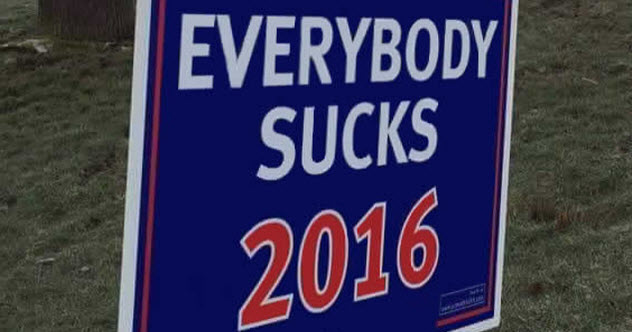
Despite all this, I’m still told that voting is important. Voting is what separates us from tyranny. Ignoring the historical fact that some tyrants come to power through democracy, I’m supposed to believe that my vote will help further the ideals my country espouses. As much as I love my country, I just have a hard time believing that.

Don’t get the wrong idea. I’m pretty cynical about voting and the current democratic processes in place for the United States. I’m not completely resigned, though. I still intend to vote, but I’m under no illusions. I know it won’t change much in the grand scheme of things. Like renewing my driver’s license, it’s part of my civic duty.

Regardless of who wins and who gets voted out, I can already sense where this narrative will go from here. I have a feeling that as soon as this day passes, the 2020 Election will be subsequently billed as the most important election in history. Just like before, the act of voting will be framed as taking part in a battle against a fascist army led by Darth Vader and Joseph Stalin.

That narrative, in my opinion, will do more to undermine voting than help it in the long run. At the end of the day, elections come and go. Leaders change, politics evolve, and demographics shift the cultural landscape. Not every election will go down in history as the most important. The act of voting in those elections won’t matter that much in the long run. It’s still worth doing, but it’s also worth maintaining perspective along the way.

2 Comments

Filed under Current Events, human nature, media issues, outrage culture, psychology